
Field notes
Cambodia Main Travel Guide for Indians 2026
The Cambodia main travel guide for Indians covers a Southeast Asian country of temple complexes, a riverside capital and a southern coast, with Angkor Wat as its signature attraction. November to February is the best season. Three experiences stand out: Angkor at sunrise, the Royal Palace in Phnom Penh, and island ferries from Sihanoukville. It suits first-timers, couples and families with 7 to 14 nights.
Cambodia at a Glance
Cambodia is a Southeast Asian country between Thailand, Vietnam and Laos, built around Angkor in the northwest, Phnom Penh in the centre and a southern coastline on the Gulf of Thailand. A first trip usually runs 7 to 14 nights and starts at Techo International Airport (KTI) or Siem Reap-Angkor International Airport (REP).
The country is mostly low and flat, with mountains in the southwest and north. Angkor Wat and the wider temple complex sit near Siem Reap. Phnom Penh is the national capital and the main urban gateway. The south holds coastal towns and islands reached from Sihanoukville.
For Indian travellers, the shape of a trip is simple: fly into Siem Reap or Phnom Penh, move between towns by bus or private car, and add the coast if you have the days. A week covers Siem Reap and Phnom Penh. Ten days to two weeks lets you add Kampot, Kep or the islands.
One practical point shapes everything else. Siem Reap and Phnom Penh are two separate bases, and moving between them takes a half day by road. Most first-timers choose either an arrival in one city and departure from the other, or a return to the same airport. Sorting this out early saves a lot of backtracking later.
| Detail | What to know |
|---|---|
| Region | Southeast Asia, bordered by Thailand, Vietnam and Laos |
| Best season | November to February, the cool and dry months |
| Ideal trip length | 7 to 14 nights |
| Main gateways | Techo International Airport (KTI) for Phnom Penh; Siem Reap-Angkor International Airport (REP) for Siem Reap; Sihanoukville is the coastal hub |
| Entry basics | Indian passport holders should confirm the current visa route on the official source before booking |
| Language | Khmer is official; English is used in tourist areas |
| Flight time from India | Roughly 6.5 to 8 hours including a stop, depending on the city |
Why Travellers Choose Cambodia
Indian travellers choose Cambodia for three reasons: the scale of the Angkor temple landscape, a compact mix of city and coast, and a trip that is easy to plan from India. Each rests on something specific to the country rather than general holiday appeal.
The first reason is the temples. Angkor is not a single building but a spread-out complex of stone temples that rewards more than one day. Indian visitors often find the Hindu-origin carvings familiar, since much of the stonework depicts epic scenes and deities. That recognition makes the visit more personal for many families, and it gives older travellers a clear reason to make the trip.
The second is range within a short distance. Phnom Penh adds the Royal Palace, museums and riverside dining, while the south adds Kampot, Kep and the islands off Sihanoukville. Together they make a balanced route without long internal flights, and buses and ferries link the pieces.
The third is ease. Flights from major Indian cities take roughly 6.5 to 8 hours including a stop, and once you land, buses, tuk-tuks and ferries cover most movement. Rice and noodle dishes are common, which makes meals manageable for Indian palates. English is used in tourist areas, so hotels, tour desks and ride apps are simple to deal with. To see how these pieces are usually combined, browse the Cambodia tour packages.
Top Places to Visit
Most first-time Cambodia holidays are built around eight places across the northwest, the capital and the south. Each entry below gives the area, why it appeals and one practical tip.
Siem Reap and Angkor
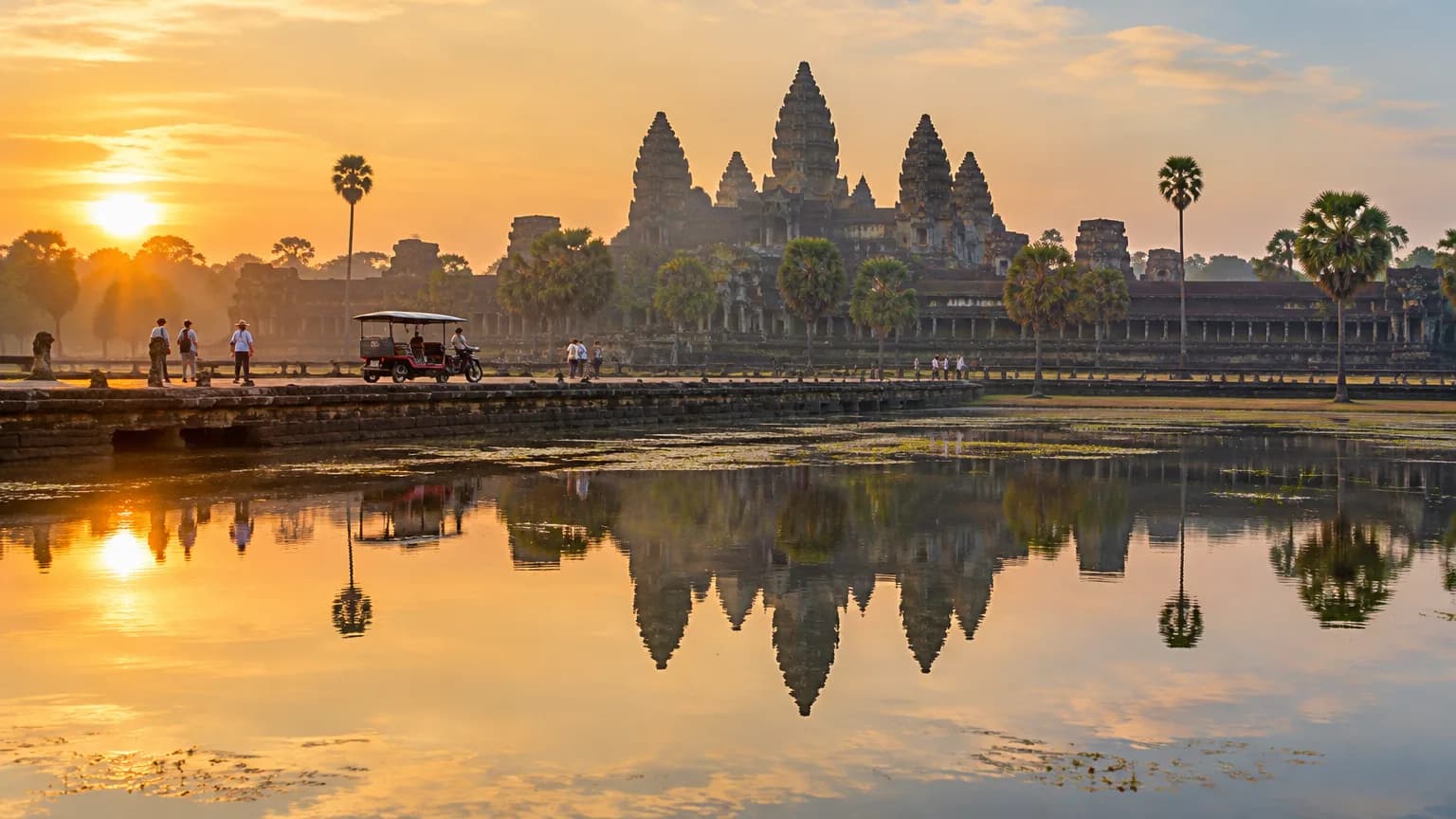
The northwest town is the base for Angkor Wat and the surrounding temple complex. Several temples can be seen in a day, with a comfortable town to return to each evening. Tip: start early to beat the midday heat, carry water, and keep one day for the outer temples rather than rushing the main ones.
Phnom Penh
The capital in central Cambodia works as the main urban gateway. Visitors come for the Royal Palace, museums and historical sites that explain the country's recent past. Tip: group the central sights together and use app-booked tuk-tuks for short rides. Some museum visits are emotionally heavy, so leave room in the day afterwards.
Battambang
A smaller town known for Phsar Nath Market and nearby historical attractions. Travellers who want a slower pace and lower costs than the main hubs tend to like it. Tip: it fits well as a break between Siem Reap and Phnom Penh if you have spare days, and it suits those who like walking around a local market.
Kampot
A southern stop that appears on one-week itineraries. Its relaxed setting and its position on the way to the coast are the draw. Tip: treat it as a bridge between Phnom Penh and the seaside rather than a long stay, and pair it with Kep to share the road transfer.
Kep
A coastal destination added to routes that cover Cambodia's south. Couples and families who want a quiet seaside break get the most from it. Tip: pair it with Kampot so the transfers are shared, and expect a calm pace with few organised activities.
Sihanoukville
The coastal transport hub with ferry connections to Cambodian islands. Its value is mainly practical, as a stop on the way to the islands. Tip: check ferry timings before you arrive and avoid leaving the connection to the last minute, since you may need a night here if schedules do not line up.
Koh Rong
An island reached by speedboat from Sihanoukville in about 45 minutes. Beach time and simple island stays are what people go for. Tip: carry some cash, as card use on islands can be limited, and pack light because transfers from the pier are often on foot or by small boat.
Koh Rong Samloem
A second island on the same ferry route from Sihanoukville. Couples who want fewer crowds will find it suits them. Tip: confirm the return ferry schedule when you arrive, and avoid planning a same-day flight out on the day you leave the island.
Best Time to Visit Cambodia from India
November to February is the best time to visit Cambodia from India, with low rainfall and more comfortable temperatures of roughly 22-33 C. It is also peak season, so prices and crowds are highest, and December and January are the busiest months for bookings.
March to May is the hot and dry window, with April the hottest month at about 25-36 C. June to October is the wet and humid season, with frequent rain, high humidity and lower prices. Flooding can affect rural roads and some attractions during these months. The southwest monsoon brings heavy rainfall and strong winds from May to November, which is worth knowing if you plan island time.
- Best months: November to February
- Shoulder months: March, and the start and end of the wet season
- Months to avoid if you dislike heat or rain: April for heat; September and October for heavy rainfall
| Season | Months | Conditions | Prices and crowds |
|---|---|---|---|
| Cool and dry | November to February | Lower rainfall, comfortable temperatures | Peak demand and higher prices |
| Hot and dry | March to May | Rising heat, April the hottest | Lower prices from April |
| Wet and humid | June to October | Frequent rain, high humidity, possible flooding | Lower prices |
Indian school holidays and the December-January period overlap with Cambodia's peak, so family trips in those weeks need early booking. If your dates are flexible, March is a sensible compromise: still dry, with medium crowds and lower prices than the winter peak. The wet season is not a wash-out, and rain often arrives in short heavy bursts, but it does make long road transfers and island plans less predictable.
Trip Cost from India
A Cambodia trip from India is priced by stay category, meals, transfers and season, and the right figure depends on how many towns you cover. This guide gives no fixed amounts, so check current prices at the time you plan.
| Tier | Stay category | Meals | Transfers |
|---|---|---|---|
| Budget | Guesthouses and simple hotels | Breakfast, plus local eateries | Buses, shared tuk-tuks, ferries |
| Mid-range | Three-star hotels and boutique stays | Breakfast and some dinners | Private car between towns, app-booked tuk-tuks in cities |
| Luxury | Upscale hotels and resorts | Most meals, including set menus | Private car and driver, private transfers |
Four things move the price most:
- Travelling in peak months from November to February
- Adding the southern coast and island ferries
- Choosing private cars over buses between towns
- The number of days spent around Angkor
Local transport is inexpensive by comparison. Published guidance as of March 2026 lists tuk-tuk rides in cities, intercity buses, the ferry to the islands and daily scooter hire as low-cost items, but exact rates vary by route and season, so confirm current prices before you travel. Phnom Penh's public bus runs on a flat fare of 1,500 KHR per ride. Visa and entry costs are separate and should be confirmed on the official source.
Common budgeting mistakes
- Forgetting the airport transfer, which can be a meaningful cost at both Techo International and Siem Reap-Angkor, since the latter is an hour or more from town.
- Leaving out Angkor entry and guide costs, which are paid separately from hotels and should be checked on the official source.
- Underestimating island costs, where food, water and boat transfers are priced higher than on the mainland.
- Booking peak-season rooms late, when the better properties are already full and prices are at their highest.
Scooter hire is listed in published guidance, but first-timers who are not used to local traffic are usually better off with app-booked tuk-tuks or a driver. It is a small saving that carries real risk, and many travel insurance policies treat two-wheeler accidents differently, so read yours before deciding.
How to Reach Cambodia from India
Travellers from India usually reach Cambodia by a one-stop flight into Siem Reap or Phnom Penh, with total journey times of roughly 6.5 to 8 hours. Which airport you pick depends on whether you start with the temples or the capital.
| From | Usual gateway | Approximate journey time |
|---|---|---|
| Delhi | Siem Reap or Phnom Penh | About 8 hours |
| Mumbai | Siem Reap or Phnom Penh | About 7.75 hours |
| Bengaluru | Phnom Penh | About 6.4 hours |
| Chennai | Siem Reap or Phnom Penh | About 6.75 hours |
| Hyderabad | Siem Reap or Phnom Penh | About 7.25 hours |
| Kolkata | Siem Reap or Phnom Penh | About 6.5 hours |
| Ahmedabad | Phnom Penh | About 7.6 hours |
| Kochi | Siem Reap or Phnom Penh | About 7.1 hours |
These timings are published indicative figures as of September and October 2026, and routings change by airline and schedule. Confirm them when you book.
Techo International Airport began operations in July 2025 and replaced Phnom Penh International Airport as the capital's main gateway. It is about 20 km south of the city, and published guidance gives taxi or app fares of USD 10-20 depending on the drop-off point. Siem Reap-Angkor International Airport is roughly an hour or more from Siem Reap town, so plan the transfer before you land. Sihanoukville International Airport (KOS) serves the coast.
Choosing your arrival and departure airports
An open-jaw routing, arriving in one city and leaving from the other, usually fits a first trip better than a return to the same airport. It avoids a long overland backtrack. Move between the two cities by bus, which connects Phnom Penh with Siem Reap, Sihanoukville and Kampot, or by private car if you prefer a door-to-door transfer.
When comparing flights, look at layover length as well as total time. A short connection saves hours but leaves little buffer if the first leg is delayed, and baggage rules can differ between the two legs. Carry your onward booking, hotel details and passport copies in hand luggage, as airlines and immigration may ask for them.
Where to Stay in Cambodia
Base yourself in Siem Reap for the temples and in Phnom Penh for city sights, then add southern stops if the trip runs longer than a week. Stay types range from guesthouses to resorts across all budget tiers.
- Siem Reap: best for couples and families. Guesthouses suit budget travellers, boutique hotels suit mid-range, and resorts suit those wanting a luxury stay near the temples.
- Phnom Penh: best for couples and families. City hotels across all tiers, with options close to the riverfront and central sights.
- Battambang: best for couples and budget travellers. Small guesthouses and simple hotels in a smaller town.
- Kampot and Kep: best for couples, budget travellers and families. Riverside and seaside stays, mostly budget to mid-range.
- Sihanoukville: best for couples and families. Practical hotels near the ferry connections.
- Koh Rong and Koh Rong Samloem: best for couples. Beach bungalows and simple island resorts.
What each tier typically gets you
- Budget: guesthouses and simple hotels with basic rooms, fans or air-conditioning, and breakfast in many cases. Best in Battambang, Kampot and Kep, where options are plentiful.
- Mid-range: three-star hotels and boutique stays with a pool or garden in the temple town and central rooms in the capital. This is the usual choice for families.
- Luxury: upscale hotels and resorts with larger rooms, on-site dining and arranged transfers. Concentrated in Siem Reap and Phnom Penh, with fewer choices on the islands.
Book early for November to February, when peak demand fills the better rooms. If you are travelling with parents, ask for a ground-floor or lift-access room, as not every small property has a lift. Before you commit to dates, read the Cambodia visa for Indians page so the entry paperwork is ready.
Local Food and Cuisine
Khmer food is built on rice and noodles and is lightly spiced, which makes it easy to adjust for Indian tastes. These five dishes give a good first introduction.
- Amok: a coconut-based curry, often made with fish. Found in restaurants in Siem Reap and Phnom Penh.
- Kuy teav: a noodle soup usually eaten at breakfast. Common at markets and street stalls.
- Lok lak: stir-fried beef served with rice. Widely available in city eateries.
- Fresh spring rolls: rice-paper rolls with herbs and vegetables. Sold at markets and casual cafes.
- Num banh chok: rice noodles with a fish-based gravy. A market and street-stall staple.
Vegetarian travellers should ask for no fish sauce, shrimp paste or meat stock, as these are common in home-style cooking. Indian restaurants operate in the larger tourist towns, and Jain travellers should confirm ingredients directly with the kitchen. Outside the main hubs, simple rice, vegetable and noodle dishes are the safest requests.
Eating well and staying well
- Drink bottled or filtered water and avoid ice from unknown sources, especially at street stalls.
- Choose busy stalls where food is cooked fresh in front of you.
- Carry a short written note in English asking for no meat, fish or fish sauce, which helps in places where spoken English is limited.
- Pack a few familiar snacks for long road transfers and island stays, where vegetarian choices can be thin.
Fresh tropical fruit is easy to find at markets and makes a dependable vegetarian breakfast or snack. Hotels in the main tourist areas generally cope with vegetarian requests if you tell them a day ahead.
Travel Tips for Indians
Indian passport holders should confirm the current Cambodia entry rule and any fee on the official government source before booking, because visa routes can change. Beyond entry, a few practical points cover money, connectivity and safety.
- Entry: check the visa route and required documents on the official source close to your travel date. Carry a printed copy of any approval along with your passport.
- Currency: the Cambodian riel is the local currency, and the public bus in Phnom Penh uses a flat fare of 1,500 KHR per ride. Carry small notes for markets and tuk-tuks, and confirm current exchange arrangements before you travel.
- SIM and eSIM: check current local SIM and eSIM options before departure, as the gathered sources did not cover them. Sort connectivity before heading to the islands.
- Getting around: PassApp and Grab can be used to book tuk-tuks and cars in cities, and buses and minivans connect major towns.
- Safety: wet-season flooding can affect rural roads and some attractions. Keep plans flexible between June and October.
- Emergency numbers: police 117; emergency hotline for foreigners 031-201-2345 or 031-601-2345.
- Health: keep routine immunisations, seasonal influenza and COVID-19 vaccination up to date. Hepatitis A and typhoid protection are advised for travellers.
- Etiquette: dress modestly at temples, remove shoes before entering shrines, and ask before photographing monks or people.
Before you leave India
- Check that your passport has enough validity beyond your return date and blank pages for stamps.
- Buy travel insurance that covers medical care and trip delays, and note the claim contact number.
- Save digital copies of your passport, visa approval, flight tickets and hotel bookings, and keep a printed set separately.
- Tell your bank about the trip so card transactions are not blocked, and check international usage charges.
- Download a ride app and an offline map before you land, so the first transfer is not a negotiation.
On the ground
Agree on a price or use the app before boarding a tuk-tuk, and keep small notes ready so you are not stuck without change. At temples, shoulders and knees should be covered, and a light scarf or shawl is useful for women and men alike. Heat is the most common problem for first-timers, so plan outdoor sightseeing for early morning and late afternoon, and use the middle of the day for rest or a museum.
Keep valuables in the hotel safe and avoid carrying your passport on day trips unless required. A photocopy is usually enough. In crowded markets and on busy roads, keep bags in front of you and phones out of easy reach.
Is Cambodia Right for You?
Cambodia suits travellers who want temples, a capital and a coast within one route, and it works best with at least a week. A shorter trip is workable if you focus on one area, while a longer trip adds the south.
Short trip versus long trip
A trip of about a week covers Siem Reap and Phnom Penh and keeps the pace sensible. A short trip that tries to include Siem Reap, Phnom Penh and the southern coast leaves too little time in each place. With 10 days to two weeks, adding Kampot, Kep or the islands becomes realistic.
On a shorter plan, the trade-off is clear: you give up the coast and gain unhurried days at Angkor. On a longer plan, you gain beach time and a slower middle section, but you add road and ferry transfers that eat into the days. Neither is better; it depends on whether you want temples and city, or a mix with seaside rest.
Who it suits
- Travellers combining temples, heritage sites and city visits
- Couples and families comfortable with road and ferry transfers
- Travellers with 10 days to two weeks who want to add the southern coast
- Budget and mid-range travellers who prefer land travel over frequent flights
Who it suits less
- Travellers seeking a short trip that includes Siem Reap, Phnom Penh and the southern coast
- Anyone who dislikes heat or heavy rain and cannot travel between November and February
- Travellers who want a single-base holiday with minimal movement between towns
Once the plan feels right, compare the current Cambodia packages and pick the one that fits.