
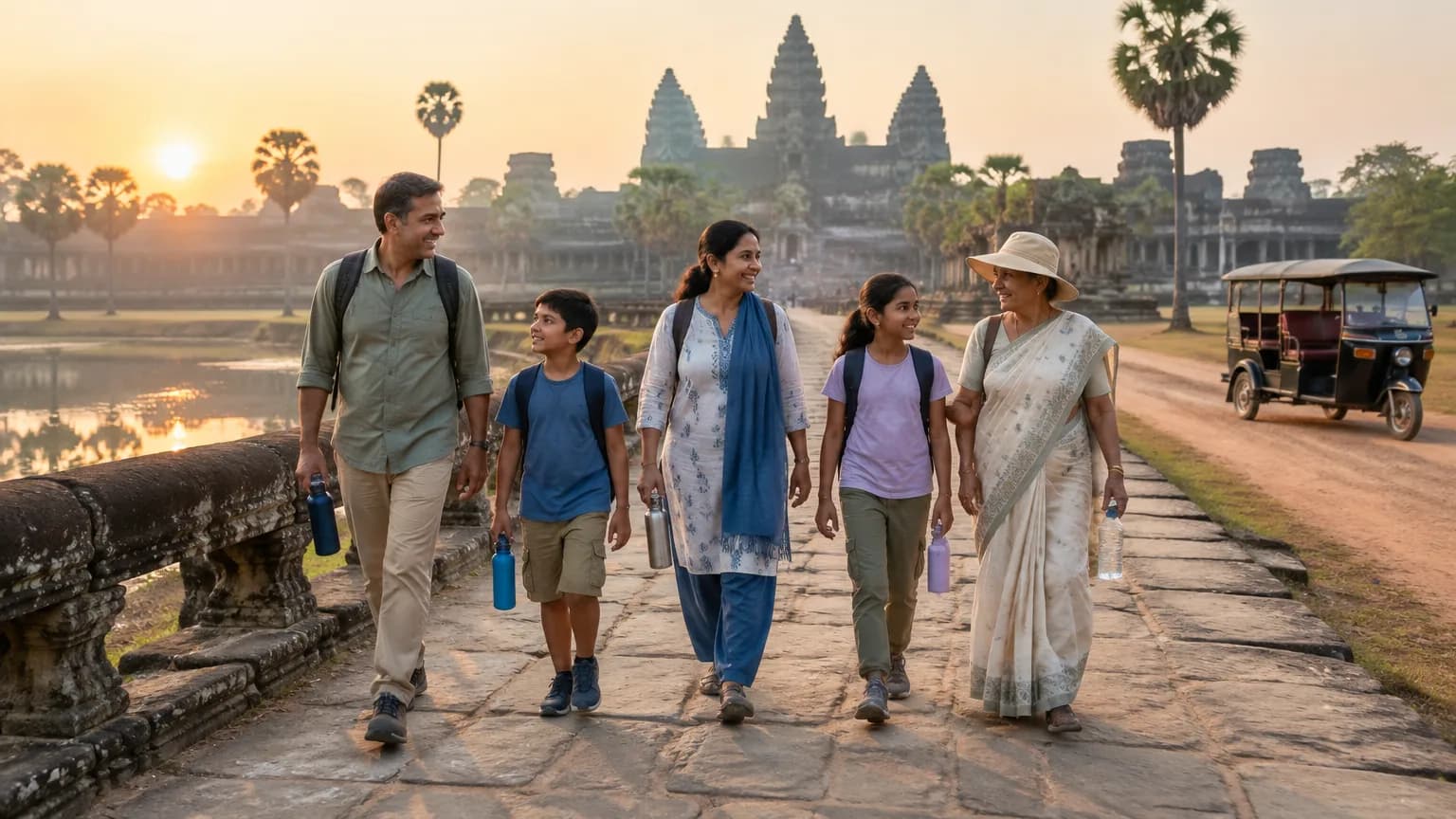
Field notes
Cambodia Family Travel Guide for Indians 2026
This Cambodia family travel guide for Indians answers one question first: yes, Cambodia works for families with school-age children, teenagers and active grandparents. Seven to nine nights is the practical length, with short transfers and a pool afternoon after every temple morning. Parents should plan mainly for heat and pacing, not for distance.
Is Cambodia good for families?
Cambodia suits families who want temples, water and easy city time in one trip, provided the pace stays slow. It works best for school-age children, teenagers and fit grandparents, and is harder for toddlers and anyone who struggles with heat or steps.
- Toddlers (under four): Difficult. Heat, uneven stone ground and long transfers make strollers impractical at Angkor. A beach stay with one short temple morning is more realistic, and a baby carrier is easier than a pram on temple paths.
- School-age children (five to twelve): A good fit. Temple mornings, a boat ride on Tonlé Sap and a pool afternoon fill a day without tiring them out. Give them a small task, such as spotting carvings or counting faces at Bayon, so temples do not feel like a lecture.
- Teenagers: Usually enjoy it most. Longer temple circuits, island time, cycling and the food scene in Siem Reap and Phnom Penh keep them engaged. Let them choose one activity each so the trip feels shared.
- Grandparents: Manageable if transfers are short, the car is air-conditioned and the hotel has a lift and a pool. Many temples have steep stairs, so choose which ones to enter and let elders wait in the shade at others.
Families who should pick another destination are those with a child on a strict nap schedule, a grandparent with limited mobility who cannot manage steps at all, or a group that wants a first international trip with minimal heat. For Indian families used to warm weather, the dry-season heat is usually tolerable if mornings are used well.
What parents often get wrong
- Too many temples in one day. Children and elders tire of stone ruins faster than adults expect. Two temples a day is a sensible ceiling for a mixed-age group.
- Underestimating the heat. March and April are the hottest months, and even November to February middays are warm. Plan the sun-heavy part of the day for the early morning.
- Booking tight flight connections. Most flights from India are one-stop, so a long wait in a transit hub with young children and elders is common. Ask for a connection with enough time to eat and rest.
- Skipping travel insurance. It is recommended for the whole family, and elders in particular should have cover that includes medical care.
Cambodia is generally considered budget-friendly compared with many international trips, which helps when you are paying for four or more people. Indian passport holders should check the Cambodia visa for Indians before booking flights, since entry paperwork affects the whole group at once. Check each passport's validity for every traveller, including children and infants, before you pay for tickets.
Best trip length and pace with children
Seven to nine nights is the most comfortable length for a family of four with children or grandparents. That allows three nights in Siem Reap, two or three in Phnom Penh, two or three on the coast or at a slower stay, and one buffer day.
Keep any single transfer under four hours where you can. Phnom Penh to Siem Reap is the longest common leg, and buses and shared vans are widely used on it. A domestic flight on that stretch saves most of a day of sitting, which matters with young children and elders. Avoid two long road days back to back, and avoid road travel at night or in heavy rain.
Most Indian families reach Cambodia through Phnom Penh International Airport or Siem Reap-Angkor International Airport, usually with a stop in Bangkok, Singapore, Kuala Lumpur or Ho Chi Minh City. Landing in Siem Reap first lets you start with the main attraction while energy is high. Landing in Phnom Penh suits families who prefer an easy first city day. Either way, avoid planning anything demanding on arrival day after a long journey.
Rest windows that work
- Early start, early finish: Temples are most comfortable in the morning. Aim to be back at the hotel by late morning or early lunch.
- Midday reset: Use the pool, a nap or an air-conditioned room between noon and mid-afternoon.
- One main activity per day for children under eight, and two for older children and teens.
- Rest mid-trip, not only at the end: A half-day with no plans after the first temple day resets everyone before the next transfer.
- Light evenings: Dinner near the hotel and an early night keep the next morning's start realistic for children.
A private car with a driver gives you control over timing, and tuk-tuks suit short city hops. Ride-hailing apps and hotel-arranged cars are common in the cities, and roads can be slower in the rainy season. For a family with elders, an air-conditioned private car is worth prioritising over a tuk-tuk for longer hops, since it gives shade, space for bags and a place to rest between stops.
Choosing the right time of year
November to April is the best overall window, with dry weather and easier sightseeing. November to February is cooler and more comfortable, which suits families with elders and young children. March and April stay dry but are the hottest months of the year. December and January bring peak crowds and prices, so book early or consider the shoulder weeks.
The rainy season from May to October brings humidity, strong winds at times and frequent showers. It also means fewer tourists and greener landscapes. Families with school-age children often have no choice but to travel in school holidays, so build in extra rest and indoor options if that falls in the wet months.
Places and activities for all ages
Angkor Wat and the wider Angkor temple complex near Siem Reap are the main reason most families come. Beyond that, Tonlé Sap Lake, Phnom Penh's Royal Palace and riverside, the coast and the slower towns of Battambang, Kampot and Kep cover a range of ages and energy levels.
Younger children (about five to ten)
- Angkor Wat: Keep it to one or two temples and use an air-conditioned car between stops. Go early, before the heat builds, and carry water, hats and a small snack.
- Tonlé Sap floating villages: A short boat ride with constantly changing scenery. Check current water levels at booking, since routes change through the year, and ask whether life jackets in children's sizes are provided.
- Beach and island time: Sihanoukville and the islands offer easy beach days. Beach trips are most popular from November to March. Choose a calm, shallow stretch for young swimmers and keep sun cover handy.
- Phnom Penh riverside: A flat evening walk where children can run around once the day cools, with plenty of places to stop for a cold drink.
Teenagers
- Longer Angkor circuit: Bayon and Ta Prohm add variety, including the tree roots growing over ruins. Carry water and plan a long midday break.
- Battambang: Countryside rides and cultural sites suit older children who like to move.
- Cooking classes and village cycling: Flat roads, fixed durations and hands-on activity help with attention spans.
- Island and water time: Snorkelling or a boat day off the coast gives older children a break from temples, subject to sea conditions and operator safety checks at booking.
Grandparents
- Royal Palace and riverside, Phnom Penh: Flat grounds and an easy evening walk. A half day is enough.
- Kampot and Kep: A slower coastal and riverside pace with quiet evenings, suited to elders who prefer sitting and watching.
- Selected Angkor temples: Pick the ones with fewer stairs and use a guide to choose where to stop.
- Sunset or sunrise viewpoints: Ask your guide which are reachable with the least climbing, and decide on the day based on how everyone feels.
Evening performances of traditional Khmer dance in Siem Reap work for all ages because they are seated, air-conditioned and have a fixed running time. A short market visit in the early evening is another easy shared activity, but keep bags zipped and valuables close in crowded lanes.
Temple etiquette with children
Angkor is an active religious and cultural site, so shoulders and knees should be covered when entering temples. Light cotton shirts and long, loose trousers or skirts work for children and elders alike. Explain in advance that climbing on carvings and shouting inside sanctuaries is not acceptable. Carry a lightweight scarf as a cover-up for anyone who arrives in shorts.
Stays, rooms and meals for families
Family rooms, extra beds and connecting rooms are widely available in Siem Reap and Phnom Penh. For a family of four, two connecting rooms usually beat one large room, especially with teenagers, and a hotel pool becomes the daily afternoon activity.
- Connecting or adjacent rooms: Ask for these at booking rather than on arrival, since availability varies by hotel and season.
- Lift and ground-floor access: Request this for grandparents, and confirm in writing.
- Pool: Worth the extra cost on this trip, as it gives children somewhere to burn energy and elders a shaded place to sit.
- Apartment-style stays: Useful on longer trips for simple breakfasts before early temple starts and for fussy eaters.
- Location: A stay close to restaurants and a short ride from the main sights cuts down on travel time with tired children.
How to choose the area
In Siem Reap, staying in or near the town centre keeps restaurants, markets and evening shows within a short ride, while quieter properties further out can offer more space and larger pools. In Phnom Penh, the riverside area is convenient for the Royal Palace and evening walks. On the coast, a beachfront stay saves daily transfers, which matters with young children. Always read recent reviews for family-specific comments about noise, pool depth and room size.
Meals and food
Vegetarian food is easy to find in tourist areas. Khmer cooking uses rice, noodles, vegetables and tofu, and Indian restaurants operate in Siem Reap and Phnom Penh. Many Khmer dishes use fish sauce or shrimp paste, so ask for them to be left out and repeat the request at each meal.
For children, plain rice, fried rice, noodle soups and fresh fruit are reliable. English is commonly understood in hotels, restaurants and among guides in major tourist areas, so these requests are usually simple to make. Carry dry snacks for transfer days, since options on the road are limited. Pack familiar items such as biscuits, thepla or roasted snacks for fussy eaters, subject to the airline and import rules for food, and check current rules before flying.
- Breakfast: Hotel buffets usually have eggs, bread, fruit and noodles, which is practical before an early start.
- Jain or strict vegetarian diets: Tell the hotel and your guide in advance, as options are narrower and cross-contamination is possible in shared kitchens. Indian restaurants can help for at least some meals.
- Elders with dietary needs: Low-salt or low-oil requests are easier at hotel restaurants than at street stalls.
Health, safety and elders
Heat is the main health factor for families in Cambodia. The dry season from November to April is the best sightseeing window, with November to February the most comfortable and March and April the hottest. The rainy season from May to October brings humidity, frequent showers and slower roads.
Medicines and water
- Carry oral rehydration salts, fever and pain medicine, antiseptic cream, plasters and any prescription medicines in original packaging, with a doctor's note for elders.
- Use mosquito repellent in the evenings and near the lake.
- Drink sealed bottled water and use it for brushing teeth if you are unsure of the supply. Be careful with ice and raw salads for young children.
- Siem Reap and Phnom Penh have clinics used by visitors. Your hotel can direct you to the nearest one.
- Speak to your family doctor before travel about vaccinations, any chronic conditions and a written medicine list that includes generic names.
Heat and sun care
Dress children and elders in light, loose cotton, a wide-brimmed hat and sunscreen suited to their skin. Take a break in shade or a cool room whenever someone looks flushed or unusually quiet. Sip water regularly rather than waiting for thirst, particularly for elders, who may not notice dehydration early. If someone develops a headache, dizziness or stops sweating, move them somewhere cool and seek medical help.
Accessibility and elders
Angkor has some step-free paths and boardwalks, but many temples involve steep stairs and uneven stone. Strollers and wheelchairs are not practical at most temple sites, so ask your guide which entrances and viewpoints are flat. Accessibility in hotels varies by property, so confirm lifts, step-free bathrooms and ground-floor rooms at booking.
- Ask for grab bars or a shower seat in the bathroom if an elder needs them, and confirm availability before arrival.
- Choose a hotel with a lift if rooms are above the ground floor.
- Use a guide who is comfortable adjusting the route on the day if an elder needs to skip a climb.
- Carry a lightweight folding stool or cushion for rest stops if an elder tires quickly.
General safety
Cambodia is generally manageable for tourists. Watch for petty theft, overcharging and opportunistic scams in busy areas, markets, transport hubs and nightlife zones. Use licensed transport, agree fares before a tuk-tuk ride starts, and keep valuables secure around temples. Travel insurance is recommended for the whole family.
With children, keep a firm hand near roads and tuk-tuk stands, as traffic can be dense and unpredictable. Agree a meeting point and give older children your hotel's name and phone number written on a card. Avoid road travel at night or in heavy rain, and use the hotel safe for passports and spare cash.
Family budget and child pricing
For a family of four, cost is driven by flights from India, hotel category, number of rooms, private cars and guides, internal flights and the season. Peak crowds and prices fall in December and January, so travelling at other times in the dry season often costs less. Check current prices and confirm at booking.
| Cost driver | Why it changes the total for a family of four |
|---|---|
| Flights from India | Most itineraries are one-stop via a regional hub such as Bangkok, Singapore, Kuala Lumpur or Ho Chi Minh City, so routing and timing change the fare for four. |
| Season | December and January are peak. March to April is hot, and May to October is the rainy season. |
| Room setup | Two connecting rooms cost more than one family room but are easier with teenagers and elders. |
| Transfers | Private cars suit groups of four. A domestic flight between cities saves time but adds a per-person fare. |
| Guides and entry | Priced per person or per group, so ask for a written inclusion list. |
| Meals | Hotel dining costs more than local eateries, while Indian restaurants and tourist areas sit in between. |
| Insurance and visas | Both apply per traveller, so the cost multiplies with group size. |
Cambodia uses the Cambodian riel, but US dollars are widely used for hotels, tours and larger purchases, with small change often returned in riel. Carry small notes for markets and tuk-tuks. Keep dollars in good condition, since worn or torn notes can be refused.
Where families save, and where not to
- Save on: Local meals, shared city tuk-tuks for short hops, and off-peak dates within the dry season.
- Do not skimp on: Air-conditioned transport for elders, a hotel with a pool, travel insurance and a licensed guide at Angkor.
- Ask about inclusions: Confirm whether airport transfers, breakfast, temple entry and a guide are inside the quoted package, so there are no surprises at the gate.
Child and infant pricing generally depends on age, bed sharing and the supplier. Many hotels and operators treat young children sharing existing bedding as free or reduced, and charge more once an extra bed is needed. Infants usually pay only for flights. Age limits vary, so confirm at booking.
Ask each supplier for their age cut-offs in writing and carry proof of age for every child. If a child turns a year older between booking and travel, recheck the pricing, since the category may change. You can compare Cambodia tour packages to see how rooms, cars and guides are bundled for families.
Browse the Cambodia holiday packages to see how these choices turn into a bookable trip.