
Field notes
Manali to Leh Highway: Road Trip Guide & Best Time
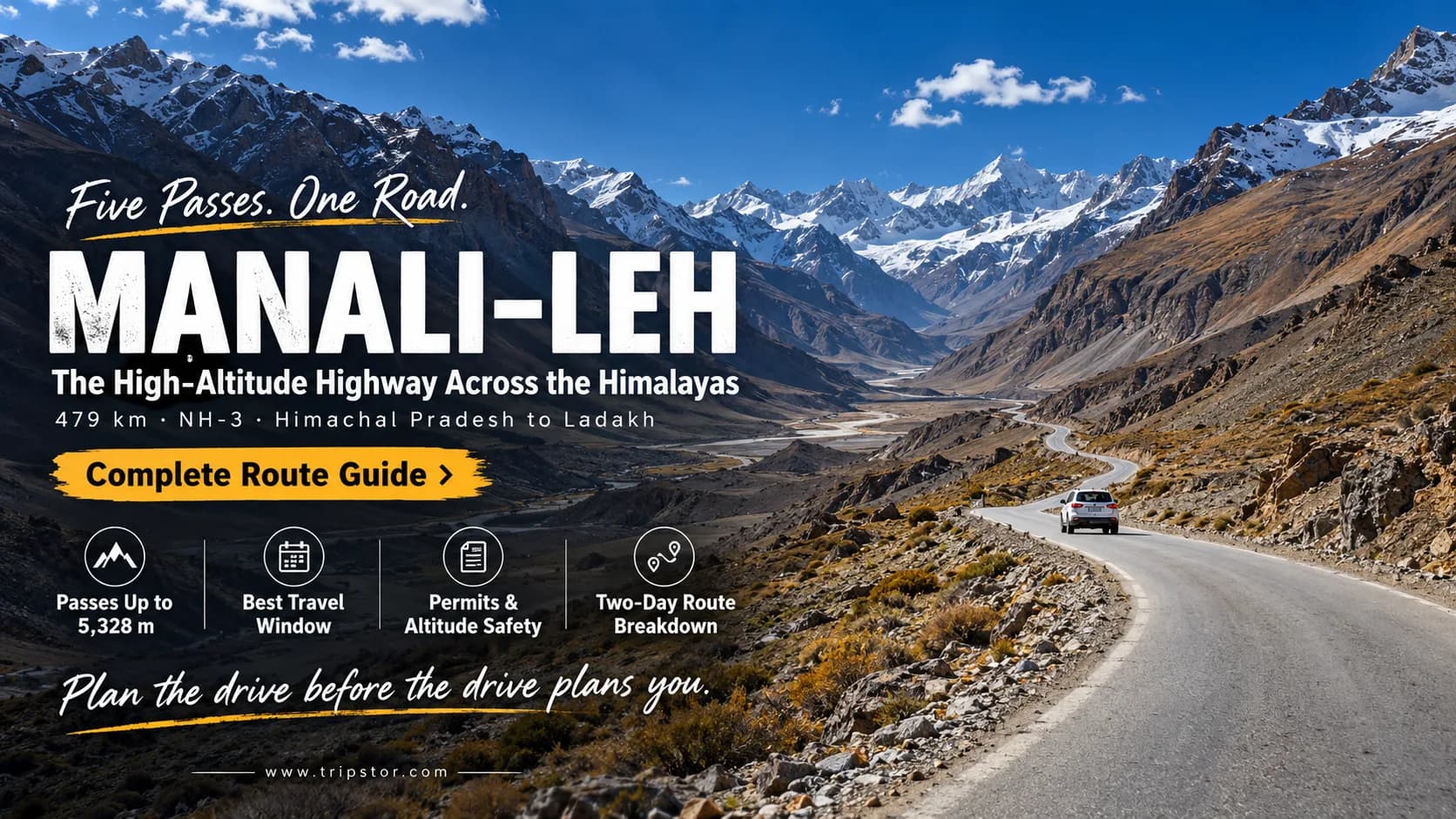
The Manali to Leh highway road trip guide you need starts with one number: 479 km. That is the distance on NH-3 from Manali in Himachal Pradesh to Leh in Ladakh, crossing five mountain passes above 4,000 m. This guide covers the route, best travel window, permits, vehicle choice, altitude safety, and costs — for first-timers and repeat travellers planning the logistics properly.
What is the Manali to Leh Highway and what does the route cover?
The Manali to Leh Highway is NH-3, a 479 km high-altitude road connecting Manali in Himachal Pradesh to Leh in Ladakh. The route crosses five mountain passes, runs through Lahaul-Spiti district, and is maintained by the Border Roads Organisation.
NH-3 begins at Manali, situated at 2,050 m in Kullu district. The road climbs immediately toward Rohtang Pass before descending into the Lahaul valley. From there, the route continues northeast through Keylong, Jispa, Baralacha La, Sarchu, and Tanglang La before reaching Leh at 3,524 m.
The 479 km of high-altitude road includes a mix of tarmac and gravel sections. Gravel and broken stretches are most common between Baralacha La and Pang. The Border Roads Organisation clears and repairs the road each season, typically opening it by mid-May.
Most travellers split the drive into two days, stopping overnight at Jispa (3,200 m) or Sarchu (4,253 m). Sarchu sits on the Himachal Pradesh–Ladakh border. Spending a night there helps the body adjust before the final climb over Tanglang La. Keylong, the district headquarters of Lahaul-Spiti, is another common overnight stop at 3,114 m and has more guesthouses than Sarchu.
The total driving time without overnight stops is roughly 18 to 22 hours depending on road condition and traffic. Convoys of trucks slow progress significantly between Rohtang and Keylong. Starting before 6 AM from Manali reduces time lost behind heavy vehicles on the narrow sections near Rohtang.
Which passes does the Manali-Leh route cross?
Rohtang Pass — 3,978 m, Kullu-Lahaul district boundary, Himachal Pradesh
Baralacha La — 4,890 m, Lahaul-Spiti district, Himachal Pradesh
Naki La — 4,739 m, Lahaul-Spiti district, Himachal Pradesh
Lachulung La — 5,059 m, Lahaul-Spiti district, Himachal Pradesh
Tanglang La — 5,328 m, Leh district, Ladakh; second-highest motorable pass in India
Each pass presents a different challenge. Rohtang is the most congested because it also serves local Lahaul traffic and tourists from Manali. The National Green Tribunal limits the number of vehicles crossing Rohtang daily, so a permit is required. Baralacha La and Lachulung La are less crowded but more exposed to sudden weather changes. Snow can appear on Tanglang La even in July.
What are the key towns and distances along the route?
Town / Landmark | Distance from Manali (approx.) | Altitude (m) | Overnight Stop Suitability |
|---|---|---|---|
Rohtang Pass | 51 km | 3,978 | No — no accommodation |
Keylong | 114 km | 3,114 | Yes — guesthouses available |
Jispa | 133 km | 3,200 | Yes — camps and guesthouses |
Baralacha La | 256 km | 4,890 | No — no accommodation |
Sarchu | 222 km | 4,253 | Yes — seasonal tent camps |
Pang | 319 km | 4,500 | Limited — a few dhabas with beds |
Tanglang La | 399 km | 5,328 | No — no accommodation |
Leh | 479 km | 3,524 | Yes — full hotel options |
Sarchu accommodation is entirely seasonal. Tent camps at Sarchu operate from June to mid-September. After that, the camps close and the area has no shelter. Travellers arriving late in the season should confirm camp availability before planning a Sarchu overnight stop.
The stretch between Pang and the More Plains is a flat, high-altitude plateau at around 4,500 m. It looks easy to drive but the altitude affects engine performance and tyre grip on loose gravel. Vehicles with poor ground clearance struggle here after rain.
Related: Leh Ladakh tour packages
When is the best time to do the Manali to Leh road trip?
The Manali to Leh Highway is open from mid-May to mid-October each year. September is the most reliable month — snow has cleared, monsoon landslides on the Rohtang side have reduced, and daytime temperatures at Sarchu stay above freezing.
BRO typically clears the highway after winter snowfall and declares it open between 15 May and 10 June. The exact opening date changes year to year depending on snowfall volume. Travellers planning a May departure should check the BRO official bulletin before booking anything.
June is popular but comes with residual snow at Baralacha La and Tanglang La. Road surfaces at these passes can be icy in the early morning. Driving through these sections before 9 AM in June carries a real risk of skidding.
The highway covers approximately 490 km between Manali and Leh. Most travellers split the drive over two or three days, stopping at Jispa or Sarchu on the first night. Doing it in a single day is possible but not advisable — altitude gain is rapid and the body needs time to adjust.
Acclimatisation matters more than speed on this route. Sarchu sits at 4,253 metres. Travellers who push straight through from Manali to Leh in one day frequently report severe altitude sickness on arrival in Leh.
Is July or August safe for the Manali-Leh drive?
July and August bring monsoon rains to the Rohtang Pass side of the route. Landslides between Manali and Rohtang are common during this period. BRO clearing teams work daily, but a blocked road can delay travel by 12 to 48 hours. Travellers driving in July or August should carry two extra days of buffer in their schedule.
The Lahaul valley beyond Rohtang receives far less rain than the Kullu side. Road conditions from Keylong onward are generally stable even during monsoon months. The risk is concentrated in the first 50 km out of Manali.
One practical option for July and August travellers is to use the Atal Tunnel. The Atal Tunnel, which opened in 2020, bypasses Rohtang Pass entirely and connects Manali to Sissu in Lahaul. This tunnel eliminates the most landslide-prone section of the old route. Travel time from Manali to Keylong drops by roughly three hours when the tunnel is used.
Can you do the Manali-Leh highway in winter?
The highway closes between November and April or early May each year. Mid-September to early October is the last reliable window before BRO begins winter closure preparations. Leh is reachable in winter only by air from Delhi or Srinagar. No road access via NH-3 exists during the winter closure period.
October travel is possible but carries risk. Snowfall at Tanglang La and Baralacha La can begin as early as the first week of October. Travellers planning an October drive should monitor weather forecasts daily and carry snow chains.
Month | Road Status | Key Risk | Recommended For |
|---|---|---|---|
Mid-May to June | Newly opened, partially icy at high passes | Ice on Baralacha La and Tanglang La before 9 AM | Experienced drivers comfortable with snow patches |
July to August | Open, landslide risk near Rohtang | Blockages of 12–48 hours on Manali side | Travellers using Atal Tunnel with buffer days |
September | Fully open, most stable conditions | Minimal — occasional afternoon rain near Rohtang | First-time road trippers, families, self-drive groups |
Early October | Open but closing soon | Early snowfall at high passes from first week onward | Experienced travellers with flexible return dates |
November to April | Closed | Full closure, no road access | Not applicable — fly into Leh instead |
Related: Best Time to Visit Goa: Month-by-Month Season Guide
How many days does the Manali to Leh road trip take?
The Manali to Leh road trip takes a minimum of 3 days, but a 5-day itinerary is the safer and more practical choice. The extra days allow for altitude acclimatisation at Keylong and Jispa, reducing the risk of AMS above 4,000 m.
What is the standard 3-day Manali to Leh itinerary?
The 3-day route covers 479 km across three driving days with long daily distances and limited rest time.
Day 1 — Manali to Jispa (165 km, 3,200 m): The drive exits Manali via the Atal Tunnel, bypassing Rohtang Pass. Jispa is the last reliable fuel and food stop before the route climbs significantly.
Day 2 — Jispa to Sarchu (80 km, 4,290 m): Sarchu sits on the Himachal Pradesh–Ladakh border at 4,290 m. Only tent camps are permitted here; no permanent structures exist at Sarchu.
Day 3 — Sarchu to Leh (234 km, 3,524 m): This is the longest single day, crossing Tanglang La at 5,328 m. Drivers should start before 7 AM to avoid afternoon weather at the high passes.
What is the recommended 5-day itinerary for acclimatisation?
The 5-day itinerary is medically safer because it spreads altitude gain across more days and includes two acclimatisation halts.
Day 1 — Manali to Keylong (114 km, 3,114 m): Keylong is the district headquarters of Lahaul-Spiti. Guesthouses and a district hospital are available here.
Day 2 — Keylong to Jispa (25 km, 3,200 m): This is a short driving day designed for rest and acclimatisation. Jispa has basic dhabas and camping options.
Day 3 — Jispa to Sarchu (80 km, 4,290 m): The route crosses Baralacha La at 4,890 m on this day. Sarchu camp is the overnight halt.
Day 4 — Sarchu to Pang or Upshi (approx. 100 km, 4,400 m): Pang sits at around 4,400 m and has basic tent accommodation. Upshi is closer to Leh and sits at a lower altitude of 3,350 m.
Day 5 — Upshi to Leh (approx. 50 km, 3,524 m): The final leg follows the Indus River valley into Leh. This short drive allows arrival before noon.
Day | 3-Day Route (Overnight Halt + Distance) | 5-Day Route (Overnight Halt + Distance) | Altitude at Halt (metres) |
|---|---|---|---|
Day 1 | Jispa — 165 km from Manali | Keylong — 114 km from Manali | 3,200 m / 3,114 m |
Day 2 | Sarchu — 80 km from Jispa | Jispa — 25 km from Keylong | 4,290 m / 3,200 m |
Day 3 | Leh — 234 km from Sarchu | Sarchu — 80 km from Jispa | 3,524 m / 4,290 m |
Day 4 | N/A | Pang or Upshi — approx. 100 km from Sarchu | N/A / 4,400 m or 3,350 m |
Day 5 | N/A | Leh — approx. 50 km from Upshi | N/A / 3,524 m |
Related: Tour packages from Delhi
What permits do you need for the Manali to Leh road trip?
The Manali to Leh road trip requires two separate permits for most travellers: an Inner Line Permit to enter Ladakh district and a Rohtang Pass permit to cross the first major pass. A third permit applies if you plan to visit Nubra Valley or Pangong Lake.
Inner Line Permit is mandatory for all Indian nationals who are not residents of Ladakh. The permit is issued free of cost through the Ladakh government's online portal or at the Deputy Commissioner's office in Leh. Carry a printed copy and a government-issued photo ID at all checkpoints.
The ILP covers entry into Leh district only. It does not automatically permit access to restricted border zones like Nubra Valley, Pangong Tso, or Tso Moriri. Each of those areas requires a separate Protected Area Permit, applied through a registered tour operator or the DC office in Leh.
The Rohtang Pass permit is separate from the ILP. The National Green Tribunal mandates this permit to control vehicle numbers and reduce pollution near the pass. Only 1,200 non-commercial vehicles are allowed per day on the Manali side.
Diesel vehicles face stricter restrictions near Rohtang Pass. The NGT order limits diesel cars to 800 slots per day, while petrol and CNG vehicles share the remaining 400 slots. Check your vehicle fuel type before applying, as the portal categorises slots accordingly.
If you are riding a motorcycle, the same permit rules apply. Bikes are counted under non-commercial vehicles. The fee structure is the same — INR 500 per vehicle regardless of whether it is a car or a two-wheeler.
How do you get the Rohtang Pass permit online?
The Rohtang Pass permit is applied for on the HPTDC online portal at rohtangpermits.nic.in. The fee is INR 500 per vehicle. You must enter the vehicle registration number at the time of application. Permits are issued day-wise and slots fill up quickly during peak season, so apply at least two days in advance.
The portal opens new date slots at 10 AM daily. Slots for weekends and holidays fill within hours during June and July. If your preferred date is full, you can apply for an alternate date and adjust your departure from Manali accordingly.
Permits are non-transferable. The vehicle registration number on the permit must match the vehicle at the checkpoint. If you change your rental vehicle after booking, you will need to cancel and reapply. Cancellations are allowed up to 24 hours before the travel date.
Weather closures are common on Rohtang Pass between late September and early June. The Border Roads Organisation announces closures on short notice. If the pass is closed on your permit date, the permit is treated as lapsed. You must reapply for a new date — there is no automatic rescheduling on the portal.
Permit Name | Who Needs It | How to Apply | Approximate Cost (INR) |
|---|---|---|---|
Inner Line Permit | All non-Ladakh residents entering Leh district | Online via Ladakh government portal or DC office, Leh | Free |
Rohtang Pass Permit | All vehicles crossing Rohtang Pass from Manali side | Online via rohtangpermits.nic.in; vehicle number required | 500 per vehicle |
Protected Area Permit (Nubra / Pangong) | All Indian nationals visiting restricted border areas | Applied through registered tour operator or DC office, Leh | Approx. 400 per person |
What documents do you need to carry at checkpoints?
Every checkpoint on the Manali–Leh highway requires a printed permit copy, not a screenshot. Officers at Rohtang, Baralacha La, and the Leh entry point all verify physical documents. Keep at least two printed sets — one for the driver and one for the vehicle file.
Alongside permits, carry the vehicle's original RC book, insurance papers, and a valid driving licence. Rental vehicles must carry a No Objection Certificate from the rental company. Police at Keylong and Pang checkpoints ask for the NOC specifically for outstation-registered vehicles.
Checkpoint | Location on Route | Documents Verified | Typical Wait Time |
|---|---|---|---|
Rohtang Pass | ~51 km from Manali | Rohtang permit, vehicle RC, driving licence | 15–30 minutes |
Keylong Police Post | ~115 km from Manali | ILP, vehicle RC, NOC for outstation vehicles | 10–15 minutes |
Pang Checkpoint | ~290 km from Manali | ILP, vehicle RC, driving licence | 10–20 minutes |
Leh Entry Point | Upshi, ~30 km from Leh | ILP, all vehicle documents | 15–25 minutes |
According to the Ladakh Tourism Department, over 3.5 lakh tourists visited Ladakh by road in 2023, making permit management at checkpoints one of the most reported friction points for first-time travellers on this route.
Related: Getting Around Goa: Complete Transport Guide
What does the Manali to Leh road trip cost, and how should you budget for it?
A solo traveller doing the Manali to Leh road trip on a rented bike can expect a total budget of INR 15,000–25,000 per person for the full route, covering rental, fuel, accommodation, food, and permits over five days.
The Manali to Leh road trip covers 479 km on NH-3, also called the Leh-Manali Highway. The route crosses five high-altitude passes: Rohtang La (3,978 m), Baralacha La (4,890 m), Nakee La (4,739 m), Lachulung La (5,059 m), and Tanglang La (5,328 m). Most riders complete the route in five to six days, stopping overnight at Sissu or Keylong, Jispa, Sarchu, and Pang or Lato before reaching Leh.
Bike rental in Manali costs INR 1,500–2,500 per day for a Royal Enfield Himalayan or 350. A five-day rental comes to roughly INR 7,500–12,500 before deposit. Most rental shops ask for a refundable security deposit of INR 5,000–10,000, paid in cash or held against a government ID. Confirm whether the rental includes a toolkit and basic spares — puncture repair kits matter on this route.
Fuel for the full 479 km route costs approximately INR 3,000–4,500. This figure assumes one full tank at Manali, a top-up at Tandi (the last petrol pump before Leh for roughly 365 km), and a final fill at Karu near Leh. Carry a two-litre spare fuel can from Tandi as a precaution. Petrol prices at Tandi and Karu are slightly higher than Manali rates.
Accommodation at dhabas and tent camps along the route runs INR 500–1,500 per night. Sarchu has only tent camps; Keylong and Jispa have basic guesthouses in the INR 600–1,200 range. Tent camps at Sarchu include a basic dinner and breakfast in the tariff during peak season (June to September). Pang has a small cluster of military-style tents; expect minimal facilities there.
Food costs INR 300–600 per day at roadside dhabas. Options thin out after Jispa, so carrying dry snacks for the Sarchu-to-Leh stretch is practical. Dal-rice and Maggi are standard at most stops. Hot meals are available at Sarchu and Pang camps, but variety is limited.
Permit costs add INR 700–900 total: INR 500 for the Rohtang Pass permit and approximately INR 200 for the Inner Line Permit. The Rohtang Pass permit is booked online through the Himachal Pradesh government portal and is capped at 1,200 non-diesel vehicles per day. Book it at least two to three days in advance during July and August. The Protected Area Permit for Nubra Valley or Pangong Tso is separate and costs around INR 400 per person.
Travellers using a private SUV should budget INR 8,000–14,000 for fuel alone, depending on vehicle mileage. Mid-range hotel stays in Leh add INR 2,000–4,000 per night to the total. A group of four sharing an SUV and splitting costs can often match or beat the per-person cost of a solo bike trip.
Cost Head | Bike Trip (Solo) — INR | Private SUV (Per Person, 4 Pax) — INR |
|---|---|---|
Vehicle rental or fuel share | 7,500–12,500 (rental) + 3,000–4,500 (fuel) | 2,000–3,500 (fuel share) |
Accommodation (5 nights) | 2,500–7,500 | 3,000–10,000 |
Food (5–6 days) | 1,500–3,600 | 1,500–3,600 |
Permits (Rohtang + ILP) | 700–900 | 700–900 |
Miscellaneous (spares, oxygen, tips) | 500–1,500 | 500–1,000 |
Estimated Total Per Person | 15,700–30,000 | 8,200–19,000 |
Oxygen cans are worth budgeting for, especially if this is your first high-altitude trip. A 500 ml portable oxygen can costs INR 200–400 in Manali and is available at most medical shops near the Mall Road. Altitude sickness can affect anyone above 3,500 m regardless of fitness level. Spending an acclimatisation night at Keylong (2,950 m) or Jispa (3,200 m) before crossing Baralacha La reduces the risk significantly.
Related: Maldives Travel Packages from India: Complete Guide with Prices in Indian Rupees