Field notes
Maldives Food Guide for Indians: Vegetarian, Halal & Indian Restaurants
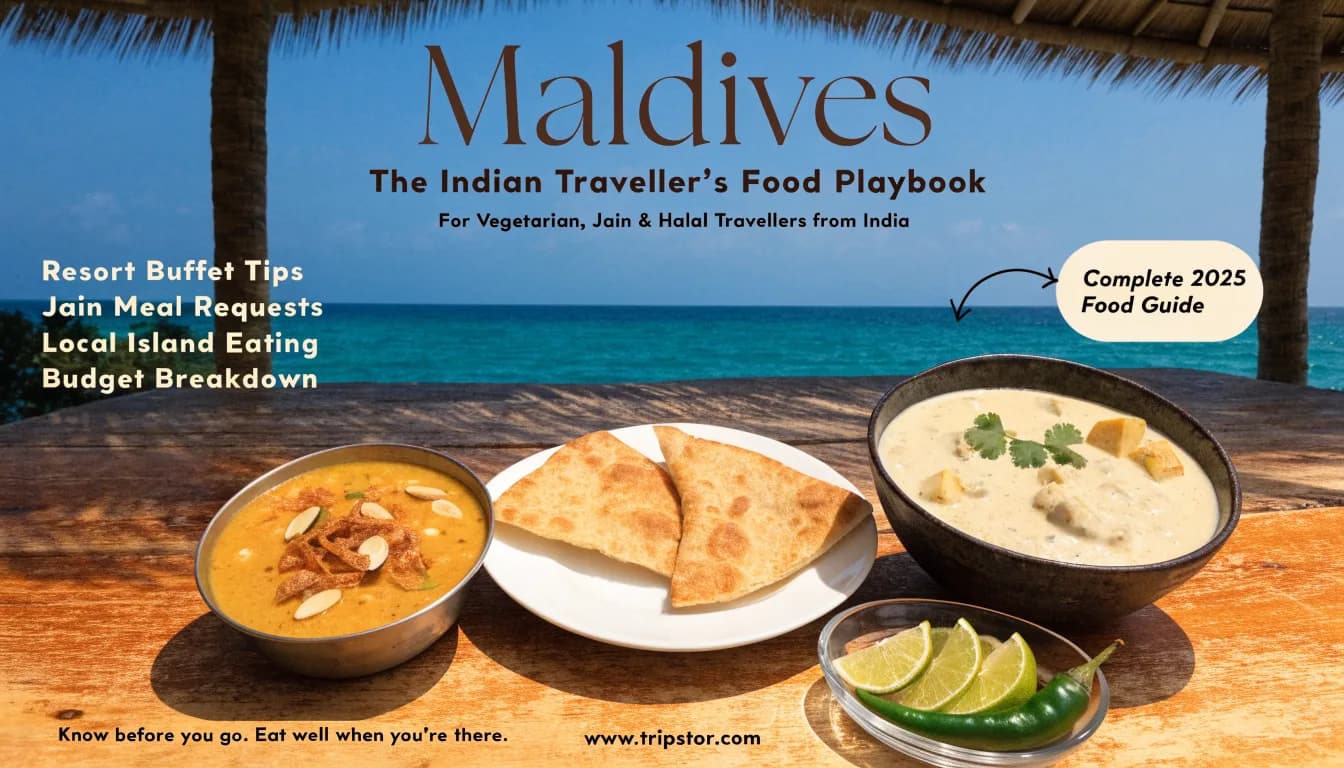
This maldives food guide for indians covers what to eat, where to eat, and how much to budget — with specific answers for vegetarian, Jain, and halal requirements. Most Indian travellers arrive without a clear food plan and end up overpaying at resorts or going hungry on local islands. This guide fixes that.
What does everyday Maldivian food actually taste like?
Maldivian cuisine centres on three staple ingredients: tuna, coconut, and rice. The flavour profile is coconut-forward and moderately spiced, closer to South Indian coastal cooking than North Indian food. Fish appears in almost every traditional dish, including breakfast.
Mas huni is the national breakfast dish. It is made from shredded smoked tuna, grated coconut, finely chopped onion, and green chilli. The dish is served cold with roshi, an unleavened flatbread similar to a thin Indian chapati. Indian travellers who eat fish find mas huni familiar and filling.
Garudhiya is a clear fish broth served with rice, lime, chilli, and raw onion on the side. It functions as the Maldivian equivalent of a dal-chawal meal — simple, light, and eaten daily by locals. The broth itself has no heat; diners add chilli to taste.
Short eats, called hedhikaa locally, are fried or baked savoury snacks sold at tea shops across the islands. Most hedhikaa contain tuna paste or fish flakes. Pure vegetarians should ask before eating any snack from a tea shop counter.
The spice level in Maldivian food is lower than most Indian regional cuisines. Indian travellers used to heavy masala cooking often find local food mild. Resorts compensate by running Indian food stations at buffets.
Is Maldives food safe for vegetarians and Jain travellers from India?
Vegetarian food is available in the Maldives but requires planning. Resorts with Indian buffet counters reliably serve dal, sabzi, and rice. On local islands, vegetarian options are limited to egg dishes, coconut-based curries, and imported packaged food at small shops.
What vegetarian dishes are reliably available at resorts?
Most 4-star and 5-star resorts in the Maldives operate a dedicated Indian food counter at the main buffet. These counters typically serve dal tadka, paneer dishes, rice, roti, and at least one dry vegetable preparation. The counter is usually open for lunch and dinner, not always for breakfast.
All-inclusive and half-board meal plans cover the buffet, so vegetarian Indian food is included in the plan cost. À la carte Indian menus at resort restaurants are a separate charge. A vegetarian main course on an à la carte Indian menu costs between USD 18 and USD 35 depending on the resort tier.
Smaller 3-star resorts may not have a dedicated Indian counter. Before booking, email the resort and ask specifically whether Indian vegetarian meals are available daily at the buffet. Get a written confirmation.
What about Jain food — no onion, no garlic, no root vegetables?
Jain meals are not a standard offering at any Maldives resort. A Jain traveller must send an advance written request to the resort chef at least 72 hours before arrival. Most 5-star resorts accommodate this request when given enough notice.
Guesthouses on local islands are more flexible than resorts for Jain requests. Many guesthouse owners have hosted Indian guests before and understand the no-onion, no-garlic requirement. Confirm this over WhatsApp or email before arrival, not at check-in.
Carrying dry Jain snacks from India — mathri, roasted chana, dry chakli — is a practical backup. Customs in the Maldives permits sealed, commercially packaged dry food items.
Is all food in the Maldives halal?
All meat and poultry sold and served on local islands in the Maldives is halal by law. The Maldives is a 100% Sunni Muslim nation, and Maldivian law prohibits the sale of pork and non-halal meat across the inhabited island network. Resorts are a partial exception.
The Constitution of the Maldives (Article 9) restricts citizenship to Muslims, and the country is classified as a Muslim-majority state with a 100% Muslim population according to Pew Research Center data. This constitutional basis means halal food standards apply nationally across all local food establishments.
Resort islands operate under a tourism exemption. Alcohol is legally served at resort islands but is completely banned on local inhabited islands. Pork is available at some international resort restaurants as an imported item, clearly labelled on menus.
For Indian Muslim travellers, local island stays offer the most straightforward halal dining. Every tea shop, guesthouse kitchen, and local restaurant on an inhabited island serves halal food without exception. Resort dining is also halal for meat dishes, but the presence of alcohol and pork on the same premises is a consideration for some travellers.
Which Indian restaurants in Maldives are worth knowing about?
Indian restaurants in the Maldives are concentrated in Malé city and Hulhumalé. Both North and South Indian cuisine are available. Resort properties across the atolls also run Indian food outlets, though the quality and range vary significantly by property tier.
Where are Indian restaurants concentrated in the Maldives?
Malé city, the capital island, has the highest density of Indian restaurants in the country. The Majeedhee Magu and Orchid Magu areas in central Malé have several Indian and Sri Lankan restaurants serving rice meals, biriyani, dosa, and North Indian curries. Meal prices in these restaurants average USD 4–9 per person.
Hulhumalé, the reclaimed island connected to the airport, has a growing number of Indian-run eateries. These are popular with Indian transit travellers spending a night before or after their resort stay. South Indian tiffin — idli, vada, sambar — is available at a few Hulhumalé outlets in the morning.
Do resorts have dedicated Indian food counters?
Most 4-star and above resorts include an Indian food station at the main buffet. Some larger 5-star properties run a standalone Indian restaurant with a full à la carte menu. These standalone outlets are not always covered under the standard all-inclusive plan; check the meal plan inclusions before booking.
| Food Setting | Cuisine Type Available | Approx. Cost per Meal (USD) | Vegetarian Options Available | Halal Confirmed | Best Suited For Indian Traveller Type |
|---|---|---|---|---|---|
| Malé city restaurant | North and South Indian, Sri Lankan, local Maldivian | 4–9 | Yes — dal, sabzi, dosa available | Yes | Budget travellers, transit stopover, local island base |
| Resort buffet (Indian counter) | Indian vegetarian and non-veg, continental | Included in meal plan (plan costs USD 80–150/day) | Yes — daily dal, paneer, roti | Yes for meat dishes | Families, vegetarians, first-time Maldives visitors |
| Resort à la carte Indian restaurant | North Indian, tandoor, biriyani | 18–40 per main course | Yes — dedicated vegetarian section on menu | Yes for meat dishes | Couples, special occasion dinners, luxury resort guests |
| Local island guesthouse kitchen | Indian-style meals on request, local Maldivian | 5–12 | On advance request — confirm before arrival | Yes | Budget travellers, Indian families preferring home-style food |
| Self-catering (resort or guesthouse room) | Packaged Indian food brought from India | 0–3 (own supplies) | Yes — fully controlled by traveller | N/A — traveller's own food | Jain travellers, picky eaters, families with young children |
How much should Indians budget for food in the Maldives per day?
Daily food costs in the Maldives range from USD 10 to over USD 200 per person depending on travel style. Local island stays cost far less than resort stays. A resort meal plan adds USD 80–150 per person per day on top of the room rate, making food the second-largest trip expense after accommodation.
| Travel Style in Maldives | Daily Food Budget Per Person (USD) | Recommended Meal Plan Type | Key Notes for Indian Travellers |
|---|---|---|---|
| Budget local island stay | 10–20 | No meal plan — eat at local restaurants | Indian food available in Malé; limited on remote islands |
| Mid-range guesthouse | 20–40 | Breakfast included; lunch and dinner outside | Request Indian meals in advance; carry dry snacks |
| 3-star resort | 50–80 | Half-board (breakfast + dinner) | Indian counter may not be available; confirm before booking |
| 4 or 5-star resort | 80–150 | All-inclusive or full-board | Indian buffet counter standard; Jain meals on written request |
| Overwater villa (luxury) | 150–250+ | Full-board or dine-around plan | In-villa dining and standalone Indian restaurant usually available |
The math on meal plans works in favour of all-inclusive at 5-star resorts. A single à la carte lunch and dinner at a luxury resort can cost USD 80–120 without a plan. The plan pays for itself within one full day of eating.
Related: For a full breakdown of what a Maldives trip costs from India including flights, transfers, and accommodation, see our Andaman tour packages page for Indian Ocean travel planning context.
How do you plan meals on a Maldives trip to avoid food regret?
Meal planning for a Maldives trip starts before you book the resort, not after you land. The single most common complaint from Indian travellers is paying resort prices for food that does not suit their diet.
Step one: email the resort before booking and ask three specific questions. Ask whether an Indian food counter runs daily at the buffet. Ask whether Jain or pure vegetarian meals are available. Ask whether the all-inclusive plan covers the Indian restaurant or only the main buffet.
Step two: run the meal plan math. Take the all-inclusive daily cost and divide it by three meals. Compare that per-meal cost against the à la carte menu prices, which most resorts publish online. If the plan covers your diet, it almost always saves money.
Step three: pack permitted dry Indian snacks. The Maldives customs authority permits sealed, commercially packaged dry food. Bringing instant poha, dry mathri, roasted makhana, or packaged namkeen gives you a reliable backup for early mornings or late nights when resort kitchens are closed.
Step four: use local tea shops on any local island day. Tea shops serve hot roshi, egg curry, and short eats for under USD 5. These are filling, halal, and far cheaper than resort snacks.
Related: Planning a local island stay versus a resort stay changes your food options significantly. See our Andaman family tour packages for a comparable Indian Ocean island planning approach.
What should Indians know about food rules on local islands in the Maldives?
Local inhabited islands in the Maldives follow strict Islamic food rules that directly affect what Indian travellers can eat and drink. Knowing these rules before arrival prevents confusion at guesthouses and tea shops.
Alcohol is completely banned on all local islands. No restaurant, tea shop, or guesthouse on an inhabited island serves alcohol. This rule applies without exception and is enforced by Maldivian law.
Pork is not available anywhere on local islands. Every meat item served — chicken, beef, fish — is halal. Indian travellers who eat halal meat have no dietary concern on local islands.
Guesthouse meal schedules are fixed. Most guesthouses serve breakfast between 7:00 and 9:00 AM and dinner between 7:00 and 9:00 PM. Lunch is not always included. Arriving late or missing the meal window means eating at a local tea shop or going without a hot meal.
During Ramadan, local island restaurants open only after Iftar, typically around 6:00 PM. Daytime food service is minimal or unavailable at local eateries. Travelling during Ramadan on a local island requires advance planning — stock packaged food for daytime and eat after sunset.
Related: For food planning on Indian Ocean islands closer to home, read our Andaman food and travel guide. For timing your Maldives trip around Ramadan or peak season, check our best time to visit Maldives content.
Ready to Plan Your Trip?
Tripstor helps Indian travellers plan Maldives trips with the right meal plan, resort, and local island combination for their diet. Our consultants know which resorts confirm Jain meals and which local islands have reliable Indian food nearby. Reach out before you book — it saves money and avoids surprises on the ground.
For package booking assistance, call us at +91 98253 43323