Package overview
The thinking behind this journey.
A closer look at this 7-night journey through Vietnam— who it's built for, what you'll experience, and why the pace works.
Journey notes
Why this route works
What does this Vietnam cultural tour package cover?
This trip covers eight days across southern Vietnam, with four nights in Ho Chi Minh City and three in the Mekong Delta. The days are split between guided city walks, museum and temple visits, the Cu Chi Tunnels, river boat rides and a floating market morning.
Saigon, the older name still used by locals for Ho Chi Minh City, and the Delta sit close together. Can Tho is roughly three to four hours by road from the city, so no internal flight is needed. Vietnam also completed more than 3,000 kilometres of expressways in January 2026, which has shortened several inter-regional drives.
Evenings are kept free after dinner, and two afternoons are left open. You are not rushing from site to site, and there is time to sit with a coffee and watch a market work.
Who is this route suited to?
This route suits couples who want history and everyday local life more than beaches, nightlife or adventure sports. You should be comfortable with 2 to 4 km of walking on some days, one pre-dawn start for the floating market, and warm, humid weather.
Elders travelling with family can manage it when walking is broken up with rest stops. Tell us at booking if you need ground-floor rooms, step-free access or a shorter day, and we will plan around it. If you are still deciding on route length, the full range of Vietnam tour packages shows other durations.
Best time to visit Vietnam from India for this route
December to April is the best window for Saigon and the Mekong Delta, because the southern dry season brings warm, relatively dry conditions. February and March are usually the most comfortable months for walking and boat rides.
| Period | Southern Vietnam conditions | Fit for this route |
|---|---|---|
| December to April | Warm and relatively dry | Best window; April is also the busiest and priciest month |
| May to August | Monsoon showers begin; hot and humid | Workable with a rain jacket and flexible afternoons |
| September to November | Wettest stretch, with some Mekong flooding risk | Possible, but plan for weather changes and lower prices |
Pack light cotton, a compact rain jacket from May onward, and footwear that slips off easily for temple entrances.
What drives the Vietnam trip cost?
The listed price is Rs.45,000 per person, land only, on twin sharing, with flights excluded. Hotel category, travel month and room type move the final figure the most. A Standard 3-4 star stay sits at the listed price, while a Budget 3-star stay is indicatively near Rs.34,000 and a Premium 5-star stay near Rs.72,000 per person.
Local transport outside the package is cheap if you add free-time outings. As of July 2026, city buses cost about 5,000-15,000 VND depending on the city, a GrabCar starts around USD 2, and train fares start near USD 4. Confirm current rates at booking.
Practical Vietnam travel tips for this route
Carry small notes for markets, tips and boat vendors. Cards work in city hotels and larger restaurants but less reliably in Delta towns. Grab and Xanh SM ride apps show a fixed fare before you book, which removes bargaining for short city hops.
Vegetarian food is easy in Ho Chi Minh City, where Chay restaurants specialise in vegetarian Vietnamese cuisine. In the Delta, tell your guide a day ahead so the kitchen can plan a meat-free meal.
The stories behind the places
Three stops on this route carry the history that connects the rest of the trip. Each is easier to follow with a guide who can explain what you are looking at.
Ho Chi Minh City's colonial core
The French period left its mark on the historic centre, most visibly in the Central Post Office and the Notre-Dame Cathedral Basilica. Your guide explains how a colonial administrative quarter grew into the commercial heart of southern Vietnam, and which buildings still serve their original purpose.
The Cu Chi Tunnels
The Cu Chi Tunnels are a network of narrow underground passages northwest of the city, used during the Vietnam War. Walking the site shows how people lived, cooked and moved underground. Some tunnel sections are tight, and you can skip them and still follow the guided walk.
Cai Rang floating market and Delta trade
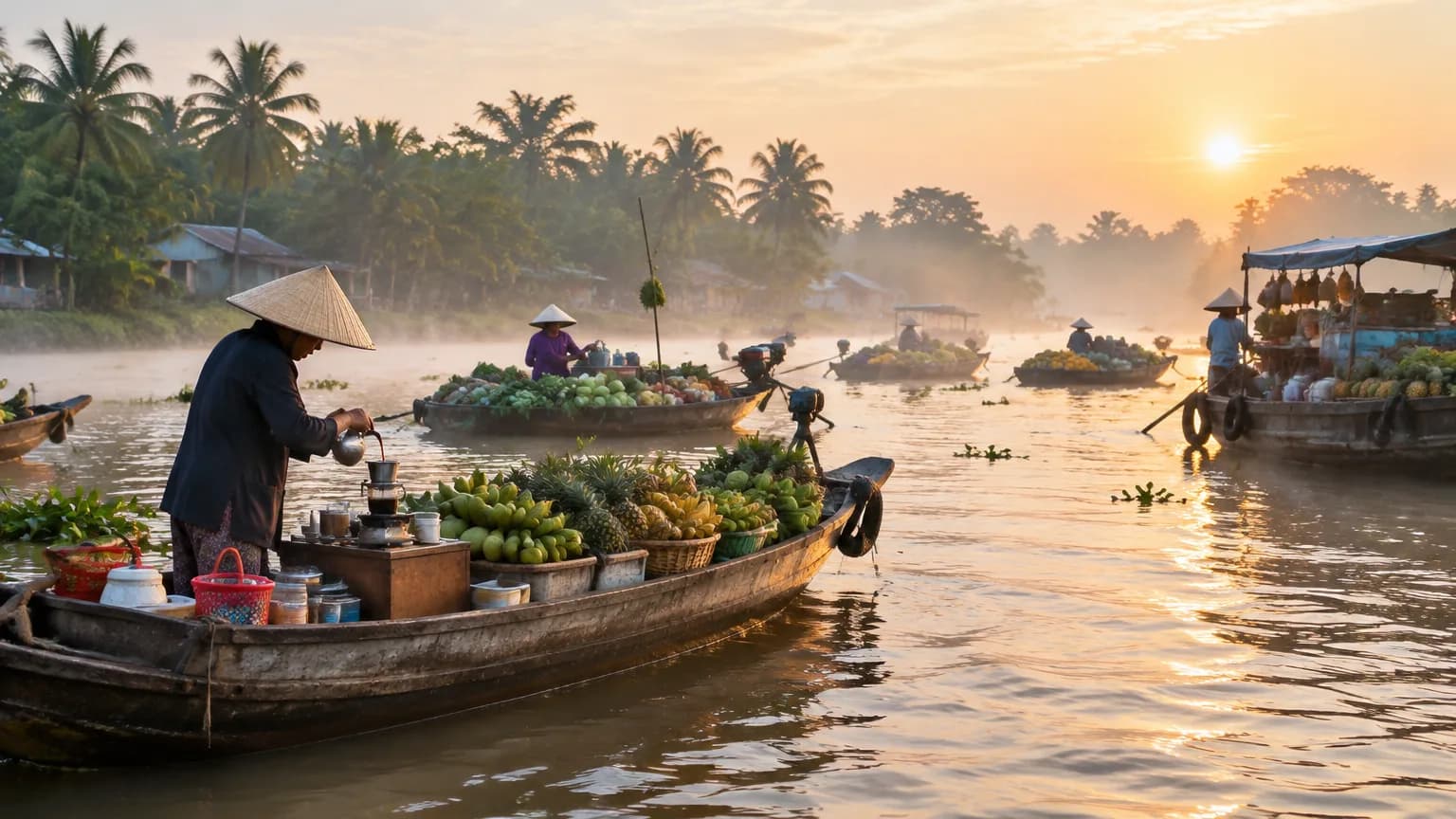
The Mekong Delta has long moved goods by water, and Cai Rang near Can Tho is where that habit is still visible. Boats act as shops, selling fruit, noodles and coffee directly from the deck. The early start is worth it, because trade is thickest at dawn.
What makes this journey distinctive
The thread running through this route is trade and daily life along the water, from a French-era commercial centre to boats selling produce in the Delta. Instead of ticking off monuments, you see how people in southern Vietnam have fed, housed and moved themselves.
Village workshops, a cooking session and a market morning replace shopping-mall time. That is why the days feel slower and why couples who like to talk to people tend to enjoy it more than those who want an activity list.
Places and what to know
- Historic centre, Ho Chi Minh City: the best place for colonial-era architecture; walk it in the morning before the heat builds.
- Cu Chi Tunnels: a war-history site about two hours each way by road; wear closed shoes and expect uneven ground.
- Ben Thanh Market: a long-running city market covered in coffee, dried fruit and lacquerware; compare prices at a few stalls before buying.
- Mekong Delta canals: reached by small boat; boarding needs a steady step, so ask for help if mobility is an issue.
- Cai Rang floating market: a dawn trading scene near Can Tho; leave before sunrise and carry a light layer.
- Delta village workshops: places where coconut candy and rice paper are made; ask before photographing people at work.
Etiquette, timings and access
At temples and pagodas, cover shoulders and knees and remove shoes before entering a shrine room. A light scarf works for both men and women, and socks help on hot or rough floors.
Museums in the city usually open in the morning and close by late afternoon, and many close one day a week, so your guide checks timings the day before. Ask before photographing monks, workers or families, and avoid flash inside shrines. Boat boarding and tunnel sections are the main access points to flag if you or a parent has limited mobility.
Pace and comfort
The pace is easy: most days include one main sightseeing block and a free afternoon or evening. Walking on city days is typically 2 to 4 km in short stretches with rest stops.
Driving is the main fatigue factor. Saigon to the Delta is roughly three to four hours, the Cu Chi return trip is about four hours in total, and the return to the city on Day 7 repeats the Delta drive. Vehicles are air-conditioned, and we plan a comfort break on each leg. Heat is the other factor, so afternoon rest at the hotel is built in.
Local food and shopping in southern Vietnam
Southern Vietnamese food is the draw at most meals. In Ho Chi Minh City, Chay restaurants serve vegetarian Vietnamese dishes, which makes meat-free eating straightforward. In the Delta, the cooking session teaches a southern dish and a vegetarian variation.
For shopping, Ben Thanh Market is the main stop for coffee, dried fruit and local crafts such as lacquerware. In the Delta you can buy coconut candy and rice paper directly from the workshops that make them. Keep luggage space in mind for fragile items.
Stay: Saigon hotels and Mekong Delta riverside lodging
The base fare uses Standard 3-4 star hotels: four nights in a city hotel near the historic centre and three nights in a riverside property in the Delta. Rooms are twin-sharing with air conditioning, and breakfast is included.
- Budget 3-star (approx Rs.34,000 per person, indicative): simpler rooms, fewer facilities, usually a short ride from the main sights.
- Standard 3-4 star (Rs.45,000 per person, listed price): comfortable rooms, a restaurant on site, central or riverside location.
- Premium 5-star (approx Rs.72,000 per person, indicative): larger rooms, pool, spa and upgraded dining; subject to availability.
Specific hotel names are confirmed at booking, based on dates and availability.
Visa, money and flights from India to Vietnam
Indian passport holders apply for the Vietnam e-visa online through the official government portal; check the official portal for the current fee and processing time, and carry a printed copy plus a digital backup. The local currency is the Vietnamese dong (VND); we do not quote an exchange rate, so check one close to departure. For visa rules in detail, read our Vietnam visa for Indians guide.
As of October 2026, typical flight times to Ho Chi Minh City are about 8 hours from Delhi, 7.75 hours from Mumbai, 6.83-7.17 hours from Bengaluru, 6.67-6.92 hours from Chennai and 6.58 hours from Kolkata, with some routes connecting via Singapore. Fares vary by season, so confirm at booking.
Share your dates and what you most want to see; we will arrange guides and timings around it.