What does this Laos spiritual tour package cover?
The route covers three places over 8 days: Vientiane for the national Buddhist sites, Phonsavan for the Plain of Jars, and Luang Prabang for the alms round, Wat Xieng Thong and Mount Phou Si. The group stays in Standard 3-4 star hotels on twin sharing.
- Vientiane (Days 1-2): Wat Sisaket, Hor Phra Keo, Buddha Park and an evening at That Luang.
- Phonsavan (Days 3-4): the megalithic jar sites with a local guide.
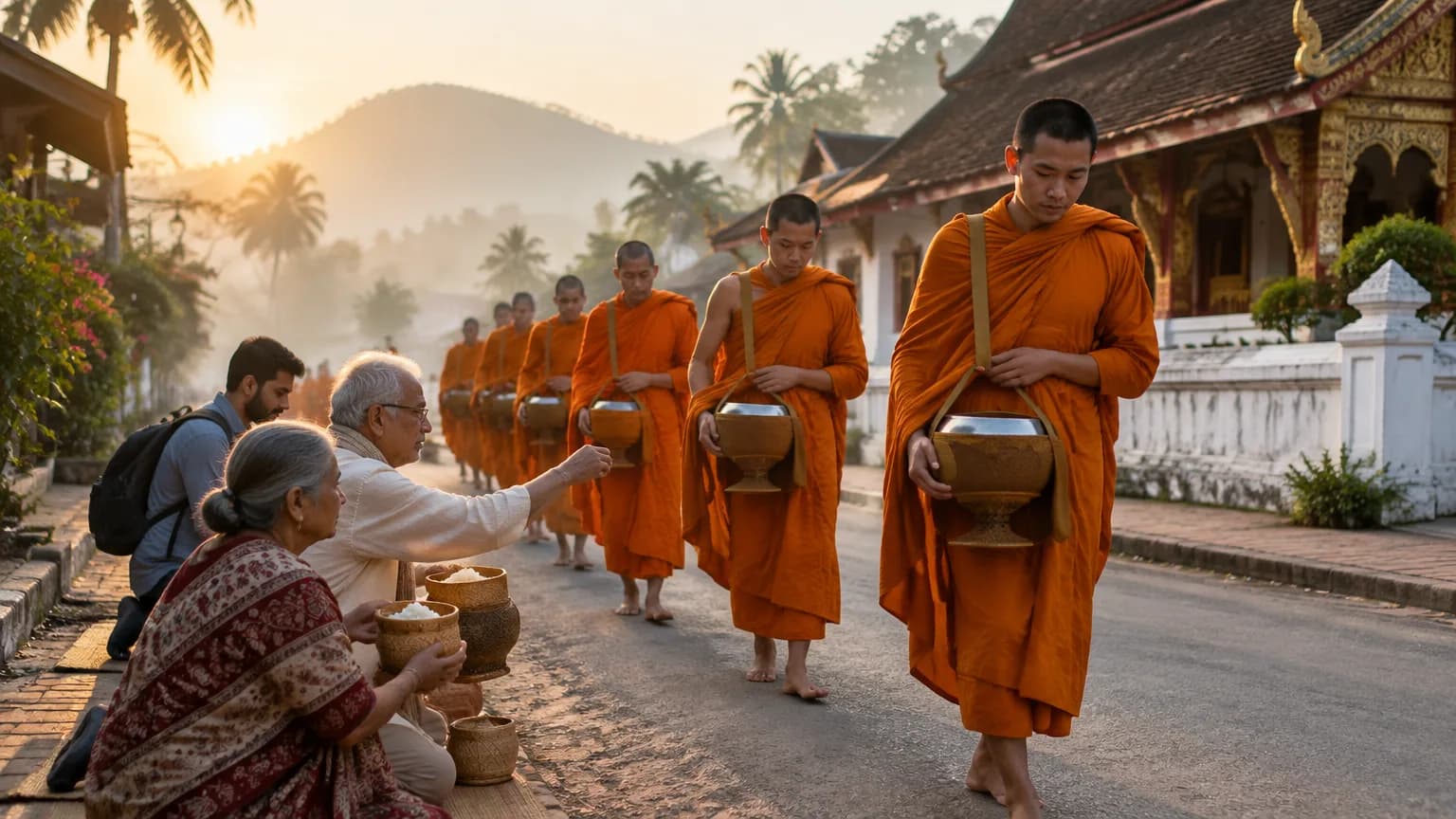
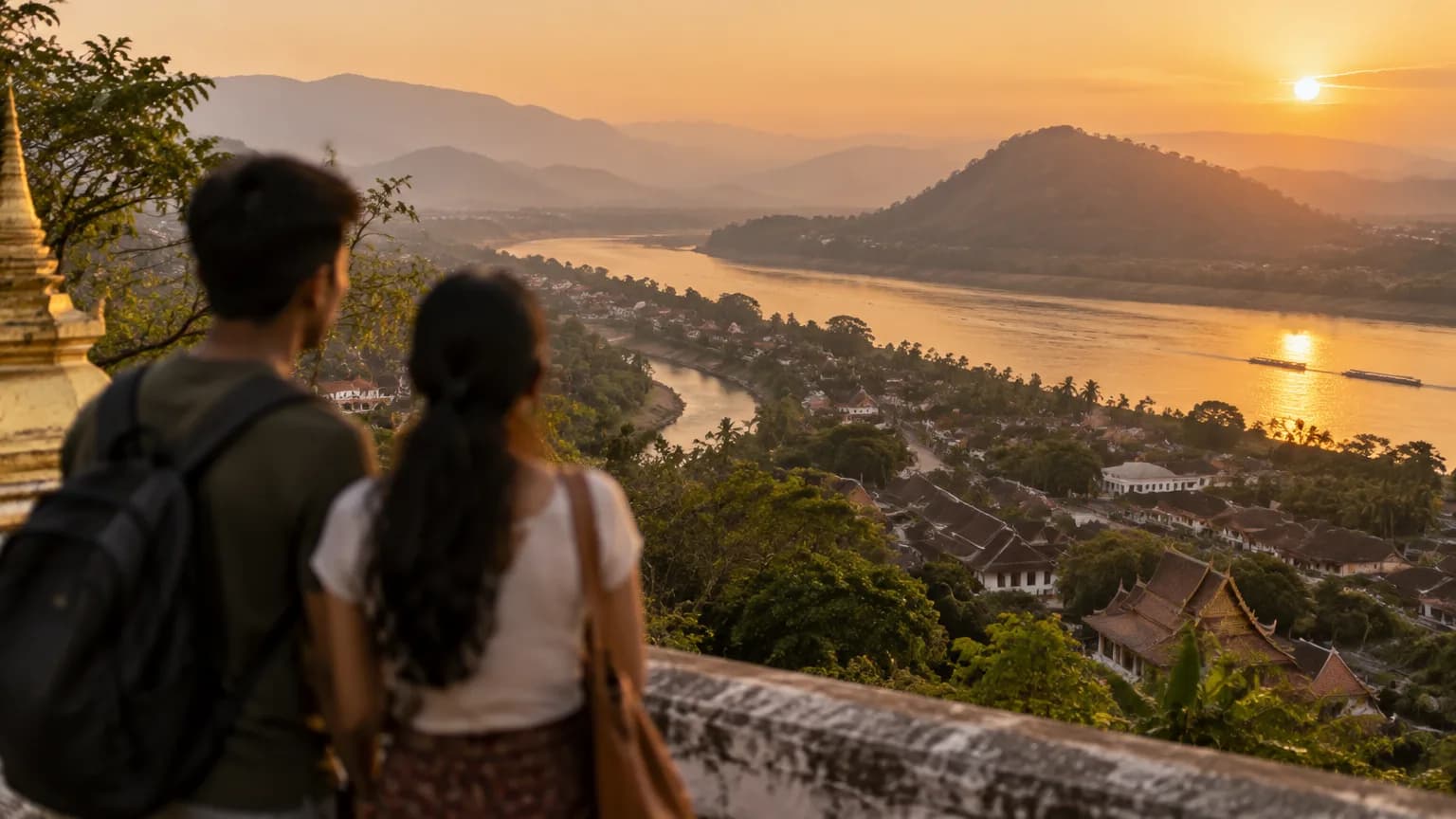
- Luang Prabang (Days 5-8): dawn alms-giving, Wat Xieng Thong, Wat Visounnarath, the former Royal Palace museum and a Phou Si sunset.
Each day has a morning, afternoon and evening slot, with the heavier temple visits placed early before the heat builds.
Why choose a pilgrimage-style route for a Laos holiday?
A pilgrimage-style route schedules each stop around when the site is actually used for worship, not around when it photographs well. Most general Laos itineraries treat temples as short photo stops. Here the alms round is on the morning it happens, the That Luang walk is in the evening when devotees gather, and Phou Si is climbed before sunset.
Phonsavan adds a different layer. The Plain of Jars is an archaeological site with a funerary history, so the trip moves from living Buddhist practice to an older stone landscape. Elders keep pace because days are short on walking and long on sitting, listening and resting.
Which Laos spiritual places does this trip visit?
This trip visits six main sites: That Luang, Wat Sisaket and Hor Phra Keo in Vientiane, the Plain of Jars near Phonsavan, and Wat Xieng Thong and Mount Phou Si in Luang Prabang. The list below shows what each is and what to know before going.
When is the best time to visit Laos from India?
November to February is the most comfortable window for this route, with temperatures between roughly 14 C and 31 C and very little rain. March and April turn hot, often above 35 C, so visits shift to early morning.
- November to February: clear skies, low humidity, cool mornings in the north. Prices are medium to peak, with November and December at peak.
- March to May: hot, with temperatures that can approach 38 C or higher in some periods. April is a peak-price month.
- May to October: monsoon showers and green landscapes. Heavy rain can disrupt road travel, and rainfall is highest in August and September.
Festival dates move each year with the lunar calendar, so confirm any specific festival you want to attend at booking.
What does a Laos trip cost from India?
This departure costs Rs.69,000 per person on twin sharing, land only, as of 2026. International flights from India are billed separately. The figure covers stays, internal transport, listed meals, guide services and the entrance fees named in the itinerary.
Single room supplements, travel insurance, the visa fee and optional extras are quoted separately at booking.
Rituals, darshan and timings
Visitors can join the dawn alms-giving in Luang Prabang, walk around That Luang in the evening, and enter most temple halls outside closed hours. In Laos the practice is Theravada Buddhist, so the word darshan is used loosely here: the sense is paying respects to Buddha images and offering alms, not a timed queue for a single deity.
- Alms-giving: happens at sunrise along the main street of Luang Prabang. Your guide provides the sticky rice offering set and explains where to sit. Exact start time shifts with sunrise, so confirm at booking.
- That Luang circumambulation: locals walk clockwise in the evening. Join quietly and keep to the right of the path.
- Temple halls: shoes come off at the door. Closing days and midday breaks vary by site, so confirm at booking.
- Queues: there are no formal darshan queues. Popular sites are busiest mid-morning in the cool season.
What links the sacred sites on this route?
The thread is Theravada Buddhism as practised in Laos, from the national stupa in Vientiane to the royal-era temples of Luang Prabang. That Luang and Wat Sisaket anchor the capital's Buddhist heritage, while Wat Xieng Thong and Wat Visounnarath do the same in the old royal town.
Hor Phra Keo and the former Royal Palace show how religion and royalty shared the same buildings. Buddha Park sits slightly apart, with concrete Buddhist and Hindu sculptures that Indian travellers often find familiar. The Plain of Jars then sets all of this against a far older, pre-Buddhist stone landscape.
Etiquette, timings and access
Cover shoulders and knees at every temple, remove shoes before halls, and ask before photographing monks. These rules apply to all visitors regardless of religion, and guides will remind the group before each stop.
- Dress: loose full-length trousers or skirt, sleeved top, and a light scarf for last-minute stops. Avoid sleeveless tops and shorts.
- Behaviour with monks: women should not touch a monk or hand items directly to one. Place offerings in the bowl or on a cloth.
- Photography: usually fine in courtyards, restricted inside halls with consecrated images. Do not use flash near worshippers.
- Feet and heads: do not point your feet at Buddha images and do not touch anyone's head.
- Access: older temple compounds have steps, uneven stone and no ramps. Tell us about mobility needs at booking so we can plan drop-off points and seating.
How demanding is the pace?
The pace is slow: most days have one main site in the morning, a lighter afternoon and a short evening activity. The only stepped climb is Mount Phou Si, which can be skipped, with the group meeting at the base.
- Road and rail: the Vientiane to Phonsavan and Phonsavan to Luang Prabang legs are the longest travel days. Mountain roads are winding, so carry motion-sickness tablets if you need them. The Laos-China Railway can be used for sectors between Vientiane and Luang Prabang, as per final routing.
- Walking: short stretches inside temple compounds and at the jar sites. Wear comfortable shoes that slip off easily.
- Rest: Day 7 is deliberately light, with a free morning and an optional Mekong boat ride.
The Laos Luang Prabang Family Holiday is a better fit if your group includes young children and wants a different pace.
Lao food is built on sticky rice, fresh herbs and river fish, and vegetarians can eat well if they say so early. Sticky rice is eaten by hand and is the base of most meals.
- Dishes to ask for: khao niao (sticky rice), tam mak hoong (papaya salad, ask for no fish sauce), vegetable laap, and fresh spring rolls with tofu or vegetables.
- Vegetarian notes: fish sauce and shrimp paste are common, so tell the guide and restaurant staff you are vegetarian each time. Jain travellers should flag requirements at booking.
- Shopping: the Luang Prabang night market sells local products and handicrafts. Textiles and silver items are common buys. Bargain politely and carry small kip notes.
Where do you stay on this Laos route?
The group stays in Standard 3-4 star hotels in central Vientiane, in Phonsavan, and in or near the old town of Luang Prabang. We describe stay categories here and confirm the final properties at booking.
- Vientiane (2 nights): a city hotel close to the Mekong riverfront and the main temples.
- Phonsavan (2 nights): a simpler hotel or guesthouse used as a base for the jar sites.
- Luang Prabang (3 nights): a hotel in or near the old town, walkable to the night market and the alms route.
Rooms are twin sharing with breakfast. Upgrades to a 5-star level are possible at roughly Rs.1,10,500 per person indicatively.
Visa, kip and flights for Indian travellers
Indian passport holders need a visa or an approved entry route for Laos. Check the Laos visa for Indians guide and the official Lao government portal for the current fee and processing time before you pay anyone. Laos has also introduced a digital arrival and departure card at four international checkpoints, as of August 2026.
The local currency is the Lao kip. Carry small notes for tuk-tuks, donations and markets, since cards work mainly in larger hotels. Do not rely on a fixed exchange rate; check on the day you convert. Flights from Indian cities usually connect through a regional hub, so total journey time varies. Confirm routing and duration when you book.