
Field notes
Laos Food & Cuisine Guide for Indians 2026
The Laos food & cuisine guide for Indians starts with sticky rice, larb and khao soi, and vegetarian versions are widely available if you ask clearly. The one mistake to avoid is assuming every Lao dish is meat-free, because fish sauce, padaek and pork stock appear in dishes that look vegetarian. Say no fish sauce, no padaek and no meat stock every time you order.
Dishes to try in Laos
Lao cooking is built around sticky rice, fresh herbs, lime and grilled or steamed protein. Most of the signature dishes can be adapted for vegetarians if you are specific about the ingredients you want left out. Ordering a few of these on your first day gives you a good sense of the cuisine's balance of sour, spicy and savoury flavours.
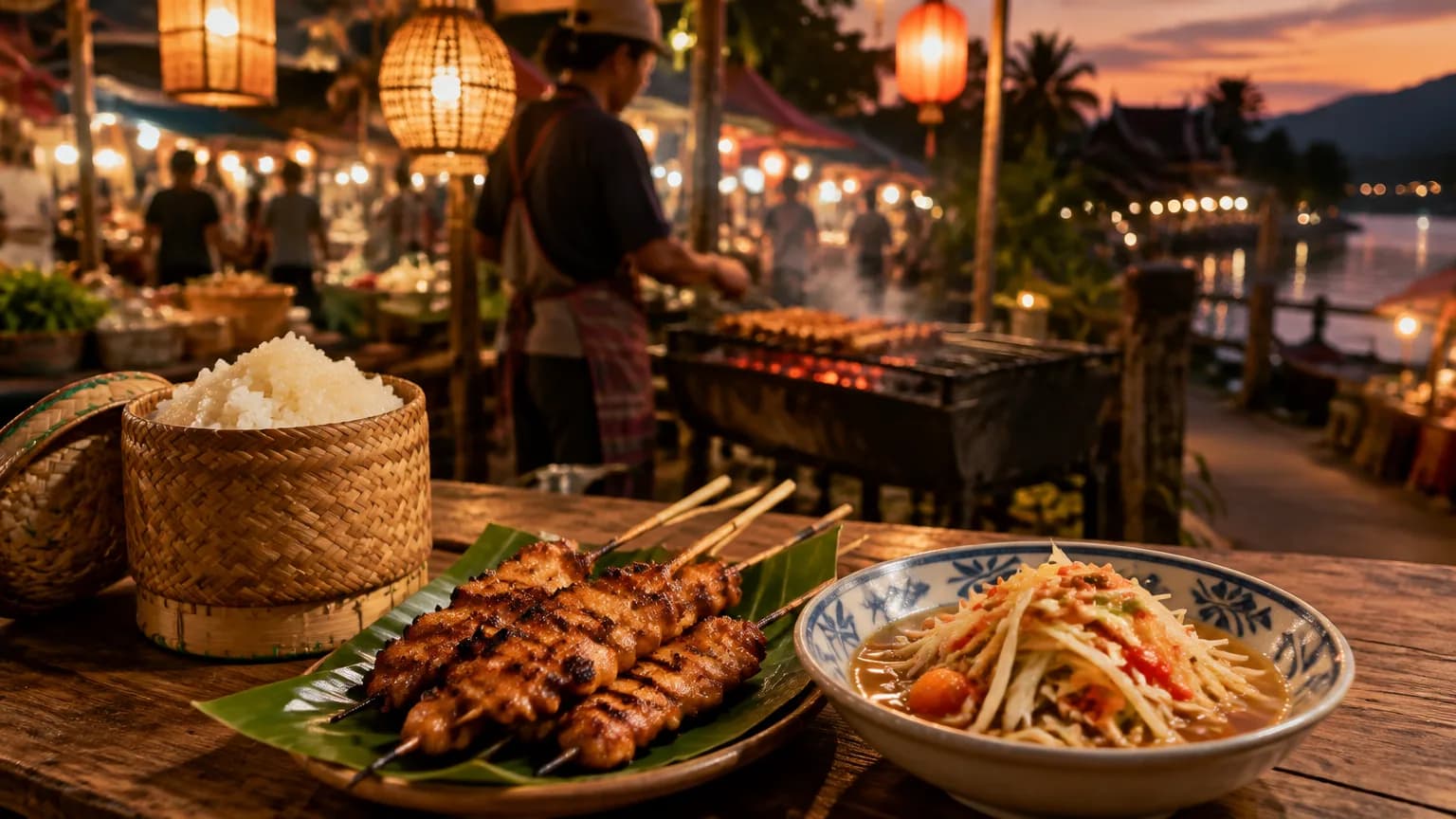
- Khao niaw (sticky rice): the staple, served in a woven basket and eaten by hand, rolled into small balls. You will find it at market stalls and family kitchens across the country, and it is the best companion for almost every other dish on this list.
- Larb: a warm salad of minced meat or tofu with lime juice, fish sauce, chilli and toasted rice powder. Luang Prabang and Vientiane both do strong versions, and tofu larb is a good request for vegetarians. Ask for it without fish sauce, since the dressing is often built on it.
- Tam mak hoong (green papaya salad): shredded papaya pounded with lime, chilli and tomato. Many versions include padaek, a fermented fish paste, so vegetarians must ask for it to be left out. Dried shrimp is another common addition to check for.
- Khao soi: in Laos this is a broth of rice noodles with pork or chicken, tomato and fermented soybean, quite different from the coconut curry version found in northern Thailand. Luang Prabang is the best place to try it, usually at breakfast or lunch.
- Mok pa: fish steamed in banana leaf with herbs and chilli, found along the Mekong in Luang Prabang and Vientiane. It is a good dish to share, and the banana leaf keeps the fish moist and fragrant.
- Or lam: a Luang Prabang stew of aubergine, wood ear mushroom and chilli, usually with meat and thickened with padaek. Vegetarian versions exist, but confirm the stock before ordering, since the flavour depends heavily on the base.
- Khao piak sen: thick rice noodles in a clear broth, usually chicken or pork, sold as a breakfast bowl in Vientiane and Pakse markets. It is filling and inexpensive, and vegetarians can ask for a vegetable broth where stalls offer one.
- Ping kai (grilled chicken): marinated in lemongrass, garlic and fish sauce and grilled over charcoal. Common at night markets and roadside stalls, and it pairs well with sticky rice and a spicy dipping sauce.
Two more to look for are sai oua, a herb-packed Lao sausage, and khao nom kok, small coconut-rice cakes sold at morning markets. Sai oua is pork-based and usually not suitable for vegetarians, while khao nom kok is naturally vegetarian and makes a good mid-morning snack. For a sense of how food fits into a wider Laos trip, see the Laos Luang Prabang Family Holiday.
Where to eat by area
Lao food is easiest to find in the main tourist centres, and each town has its own eating rhythm. Markets are busiest early in the morning and again in the evening, when grilled food takes over. Plan your main meal around these two windows, since many stalls close once the stock runs out.
Luang Prabang
The morning market near the royal palace is where locals buy khao nom kok, fresh herbs and grilled fish. Go before about eight in the morning for the best selection. The evening night market along Sisavangvong Road sets up stalls with sticky rice, sai oua and noodle soups. Riverside restaurants along the Mekong and Khan rivers serve mok pa and or lam. Vegetarians will find a few dedicated kitchens here, while most Lao restaurants will adjust a dish if asked clearly.
Vientiane
The capital offers the widest range. Ban Anou night market and the area around Nam Phou fountain suit casual Lao meals, and Talat Sao morning market is useful for fruit, sticky rice and coffee. Riverside restaurants along the Mekong serve grilled fish and Lao salads. Indian restaurants operate in Vientiane, which helps if you want a familiar meal after several days of Lao food. Expect the city's evening markets to be quieter on weekdays than at weekends.
Vang Vieng
Food here leans towards traveller-friendly menus with pancakes, sandwiches, fruit shakes and Lao staples. The night market near the main street serves grilled skewers, sticky rice and papaya salad. Vegetarian options are easy to find because many places cater to long-stay visitors. Because the town is small, most eateries are within a short walk of each other, which makes it easy to compare menus.
Pakse and the 4000 Islands
Pakse has a good morning market and a cluster of casual restaurants near the Mekong. In the 4000 Islands, Don Det and Don Khone have simple guesthouse kitchens serving fried rice, noodle soup and grilled fish. Vegetarian choice is narrower here, so plan around rice, vegetables and eggs. Bring some snacks if you are travelling between islands, since food options on the boats are limited.
Vegetarian, Jain and other dietary needs
Vegetarian eating in Laos is manageable but not automatic. The main obstacle is padaek, the fermented fish paste used widely in Lao cooking, along with fish sauce and pork stock. Jain travellers face an extra challenge because onion and garlic appear in most dishes, and root vegetables are used more freely than many Indian kitchens would expect.
What is easy: sticky rice, plain rice, steamed vegetables, fresh fruit, baguettes, eggs, and any dish a kitchen will cook to order. What needs checking: larb, papaya salad, or lam, khao soi, noodle soups and most stir-fries. Ask whether the sauce, stock or marinade contains fish, meat or shrimp before you order, because the menu description rarely says.
Useful phrases to carry in Lao or on a translation app:
- No fish sauce: bo sai nam pa
- No padaek: bo sai padaek
- No meat: bo sai sin
- No onion or garlic: bo sai hom, bo sai kathiam
Hidden non-vegetarian ingredients to watch for include shrimp paste in chilli dips, pork stock in vegetable soups, dried shrimp in papaya salad, and fish sauce in marinades for grilled vegetables. A few vegetarian restaurants in Luang Prabang and Vientiane cook without fish sauce by default, which makes them the safest choice. Outside the main towns, expect to explain your needs more than once, and it helps to show the phrase written down. Carry a few packets of dry snacks such as nuts or biscuits for long bus rides or remote areas where a safe vegetarian meal may be hard to find. If you are also sorting out entry paperwork, the Laos visa for Indians guide covers the basics.
Street food safety and eating etiquette
Lao street food is generally safe if you choose busy stalls with high turnover and food cooked fresh in front of you. The bigger risks are tap water, ice from unknown sources and raw herbs washed in untreated water. Most stomach upsets among visitors come from these three, not from the grilled food itself.
Practical rules:
- Drink bottled or filtered water only. Sealed bottles are widely available in shops and guesthouses, and a 1.5 litre bottle is a practical daily amount in the heat.
- Ask for drinks without ice unless you are in a hotel or a busy restaurant.
- Choose stalls where locals are eating and the grill or wok is in active use.
- Avoid pre-cut fruit that has been sitting out, and skip salads if the washing water is unclear.
- Peel your own fruit where possible.
- Start with one or two small portions if your stomach is not used to chilli, and build up over the first few days.
Etiquette is relaxed. Sticky rice is eaten with the right hand, rolled into a small ball. Dishes are shared from the centre of the table. Chopsticks are used for noodles and spoons for rice dishes. Tipping is not expected but is appreciated in tourist areas, and rounding up the bill at a casual restaurant is enough. Shoes come off before entering a home, and in temples dress modestly and do not eat inside the main shrine buildings. Monks should not be offered food directly by visitors unless taking part in an organised almsgiving.
What meals cost
Meal costs in Laos vary more by type of place than by town. Street stalls and market vendors are the cheapest, casual Lao restaurants sit in the middle, and hotel or riverside sit-down places cost the most. Your daily food budget will depend heavily on how many meals you eat at stalls versus restaurants.
At a street stall or market, a bowl of noodles, sticky rice with grilled chicken or a papaya salad is the lowest-cost option. Casual restaurants serving larb, or lam or mok pa charge a little more, with larger portions. Sit-down restaurants in Luang Prabang and Vientiane, especially along the Mekong, charge the highest prices, particularly for imported ingredients, wine and Western dishes.
Vegetarian meals are usually cheaper than meat dishes, because they avoid the premium on grilled fish and imported protein. Bottled water, coffee and beer add up over a day, so budget for drinks separately, since they can cost as much as a main dish in some places. Prices change, so confirm at booking or check current prices locally. Carry some cash, because smaller towns and many local businesses may not accept cards reliably, and ATMs are easiest to find in the major cities.
To see this turned into a complete trip, have a look at the Laos holiday packages.