What does a Spiti Valley cultural tour package cover?
This trip covers seven nights across Tabo, Dhankar and Kaza, with guided sessions at four monasteries and time for village walks, local meals and craft visits. Driving is kept short so mornings stay free for site visits.
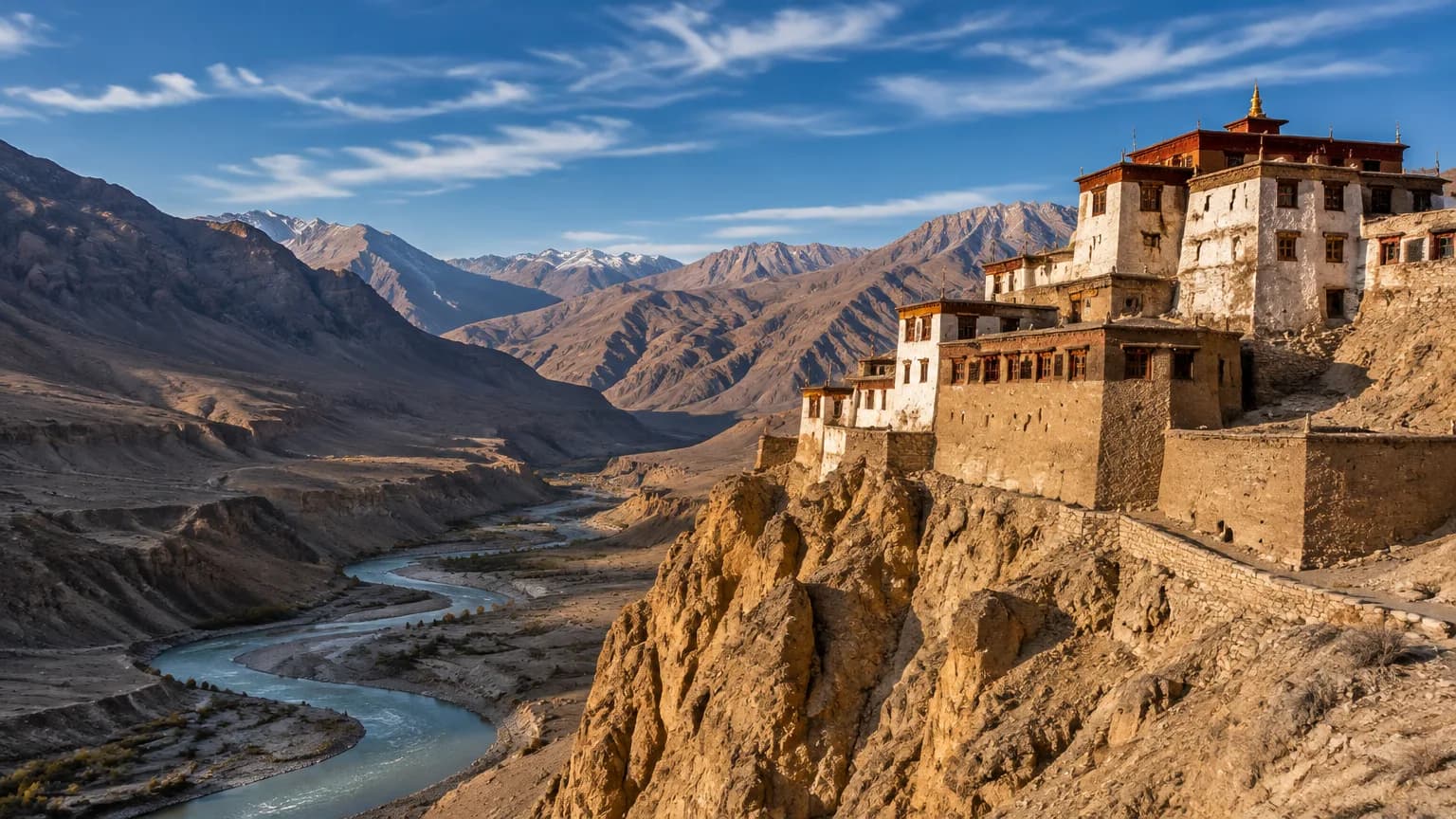
Tabo Monastery is more than a thousand years old and holds ancient Buddhist murals and manuscripts. Dhankar Monastery is a historic cliff-hugging monastery between Kaza and Tabo. Key Monastery, the largest in Spiti, overlooks Kaza, and Kungri Monastery in Pin Valley is among the oldest in the region. Each gets a proper guided visit rather than a photo stop.
Who is this Spiti Valley heritage trip best suited for?
This route suits couples and slow-paced travellers who prefer monasteries, homestay-style stays and village lanes to trekking or camping. Fit senior travellers can manage it too, since the daily drives are shorter than on a full Spiti circuit.
Anyone wanting a fast road trip, a high-pass motorbike ride or a long trek will find it too slow. Travellers who want a low-altitude holiday should also look elsewhere, because even the shortest approach involves long hill drives and altitude. If adventure is the priority, the wider range of Spiti Valley tour packages will fit better.
Itinerary at a glance
The eight days move from Tabo to Dhankar to Kaza, then out to Pin Valley and back. The table below gives each day's base and main stop.
The stories behind Tabo, Dhankar and Key
These three stops are linked by one idea: Spiti's monasteries were built to hold teachings, not just to house monks. Each one shows a different side of that.
Tabo. The monastery is more than a thousand years old and is known for its Buddhist murals and manuscripts. Guides walk through the assembly hall and explain the painted panels one by one, which is why the visit is given a full morning.
Dhankar. The monastery sits on a cliff above the confluence of the Spiti and Pin rivers, and its position tells you why: a high, defensible ridge above the valley floor. The older section is reached by steps and uneven ground, so go slowly.
Key. The largest monastery in Spiti sits on a ridge above Kaza. Monks still live and pray here, so the visit follows their daily rhythm and the guide plans around prayer times.
What makes this journey different from a standard Spiti circuit
This route is built around heritage rather than distance. A standard circuit often runs Manali to Kaza to Shimla with the monasteries as brief stops. Here, Tabo and Dhankar get two nights each, which leaves time to sit in a courtyard, walk the old lanes and meet local households.
The thread connecting the stops is Buddhist practice in a cold desert: how villages, monasteries, food and craft developed around the same rivers and ridges. You see it in the murals at Tabo, the fossil beds and Buddha statue at Langza, and the wool work in Dhankar households.
Places on this route and what to know before you go
- Tabo Monastery: More than a thousand years old, with ancient murals and manuscripts. Entry timings follow prayer schedules, so confirm at booking.
- Dhankar Monastery: A cliff-hugging monastery between Kaza and Tabo. The upper section involves steps, and you can skip it if mobility is limited.
- Key Monastery: The largest in Spiti, overlooking Kaza. Dress modestly and keep voices low in the prayer hall.
- Langza: A village known for fossils and a large Buddha statue. Altitude is high here, so walk slowly and carry water.
- Hikkim: Known for its high-altitude post office. Whether you reach it depends on road conditions on the day.
- Kungri Monastery: One of Spiti's oldest, in Pin Valley. Allow extra time, as the drive from Kaza is part of the day.
Etiquette, timings and access at the monasteries
Cover shoulders and knees, remove shoes before prayer halls and ask before photographing murals or shrines. Photography is usually fine in courtyards but is often restricted inside, so follow your guide and any notice displayed.
Monastery opening hours change with prayer schedules and festivals, so exact timings are confirmed at booking rather than assumed. Step-free access is limited. Tabo is the easiest site, while Dhankar and Key involve steps and uneven ground. Tell us about mobility needs in advance and we will plan the day around them.
Pace and comfort on the road
The daily pace is slow by design. The longest drive on the plan is Day 8, when you leave Kaza and head towards Manali or Shimla, depending on which road is open that week. Most other transfers run two to three hours with stops.
Altitude is the main comfort factor, with Kaza at about 12,500 feet. Day 1 is kept light for that reason, and the monastery visits are spaced so you are not climbing every day. Walks such as the Dhankar lake trail take about an hour each way at an easy pace. Senior travellers should carry any regular medication and speak to a doctor before booking.
Local food and what to buy in Spiti
Meals at the stays are simple, vegetarian-friendly and based on dal, rice, vegetables, bread and tea, which is what most homestay kitchens serve. Vegetarian travellers are well catered for. Tell the stay in advance if you avoid onion or garlic.
In Kaza market you can pick up dried fruit, woollens and everyday supplies, and in Dhankar you can see wool spinning and weaving at a local household. Carry some cash, since card and UPI access is patchy outside Kaza. Prices for crafts vary, so ask before buying.
Where you stay in Tabo, Dhankar and Kaza
The trip uses standard 3-4 star category stays: a guesthouse in Tabo, a guesthouse or homestay in Dhankar and a hotel in Kaza. Tabo, Dhankar and Kaza all have homestay-style accommodation, and the stay in each village is chosen for easy access to the monastery.
Indicative per-person tiers, derived from the listed price, are shown below. They are for context only, and exact prices depend on season and group size.
Getting to Spiti Valley and what to expect on the road
Spiti has no airport or railway station, so you reach it by road. The nearest railheads are Chandigarh and Kalka, and the nearest airport is Bhuntar (KUU), each followed by a road transfer. Road travel via Shimla generally takes two days from Delhi, and the Manali route is stated as 12 to 14 hours of nonstop driving to Kaza.
The Manali route is open only from mid-June to mid-October, and the Kunzum Pass section reopened for 4x4 vehicles in May 2026 after a long closure. Monsoon rain can cause landslides on approach roads. Permit rules, if any, and mobile connectivity should be confirmed at booking.
Best time to visit Spiti Valley
May to October is the working window, and June to September is the most accessible period for a full circuit. In July and August, rain can disrupt the Manali approach road, even though Spiti itself gets little rain. October brings clear skies and fewer visitors, with night temperatures between 0 and 10 degrees Celsius.
Winter is not advised for this route. Snowfall can close passes, and temperatures can fall below minus 20 degrees Celsius.
Spiti Valley trip cost and travel tips
The land-only price is Rs.33,500 per person on twin sharing as of 2026, flights excluded. Season, group size, vehicle type and stay category all move the final cost. June to September is peak pricing, while May and October cost less.
- Keep the first day light while your body adjusts to the altitude.
- Carry cash, layers, a windproof jacket, sunscreen and a refillable bottle.
- Save offline maps and stay addresses before leaving Shimla or Manali.
- Confirm monastery timings, permits and entry charges at booking.
Send your preferred season and group details and we will confirm access and timings before quoting.