Package overview
The thinking behind this journey.
A closer look at this 7-night journey through Morocco— who it's built for, what you'll experience, and why the pace works.
Journey notes
Why this route works
What sets this Marrakech and Atlas route apart
This route stays in two bases instead of moving every second night: four nights in Marrakech and three in the Atlas foothills, with one arrival night built into the first stay. Unpacking happens twice, and the days stay loose.
Mornings are for medina walks or a late breakfast in the riad courtyard. Afternoons go to the souks, a garden or a hammam. Evenings are for Jemaa el-Fna, a rooftop dinner or an early night. Internal travel is short on purpose. Marrakech-Menara Airport (RAK) is the arrival point, and the transfer into the medina takes about 20 minutes. The road to the Atlas foothills takes roughly 90 minutes to two hours, depending on the village.
Why couples choose Marrakech and the Atlas together
Marrakech and the Atlas Mountains give a honeymoon two different moods in one trip. Marrakech is social and walkable, with the medina, gardens and palaces close together. The Atlas is quiet and cool, with walnut groves, terraced fields and long valley views.
Couples who want a beach usually add Agadir or Essaouira as a separate leg. This itinerary stays inland, so most of the time goes to the two of you and very little to the car.
Best time to visit Morocco from India
Spring (March to May) and autumn (September to November) are the most comfortable for a Morocco honeymoon. April and May run 14-28 C with little rain, though both are peak months. October is warm at 18-28 C and also priced at peak. November is milder but is the wettest month at 42 mm.
Winter (December to February) is cooler at 8-21 C and quieter, with lower prices, and the Atlas can be cold, with snow on higher ground. Summer (June to August) is hot inland, at 34-35 C in July and August, and around 40 C in southern regions. In summer, keep medina walks for early morning and use the mountain days for shade and slow afternoons. Weather figures are indicative, so confirm closer to your dates.
| Season | Typical range | What it means for a couple |
|---|---|---|
| Winter (Dec-Feb) | 8-21 C | Cool, quieter, lower prices; cold nights in the Atlas |
| Spring (Mar-May) | 12-28 C | Comfortable touring; April and May are peak priced |
| Summer (Jun-Aug) | 18-35 C | Hot inland; early starts needed in the medina |
| Autumn (Sep-Nov) | 14-30 C | Warm to mild; rain increases by November |
What this Morocco trip costs for two
The listed price is Rs.89,000 per person on twin sharing, land only, with flights excluded. For two travellers, double that figure and add airfare. Hotel category, travel season and the number of private transfers or arranged dinners are the main cost drivers, so confirm current prices for your dates.
On the ground, small costs add up in local currency. According to recent traveller cost guides, petit taxis in cities run about 10-30 MAD per short ride, and tipping in tourist-facing restaurants is usually 10-15% (as of 2026). Local restaurants often just round up. Keep some cash for souk purchases and tips.
Practical tips before you book
Book riad-style stays early for spring and autumn, since courtyard rooms sell out months ahead. Carry a light scarf and modest layers for medina walks and any mosque-adjacent areas. Pack walking shoes with grip for the village paths in the Atlas.
A Sahara leg to Merzouga is a long drive from Marrakech and works better as a separate trip. For paperwork, start with the Morocco visa for Indians guide, and you can compare route lengths on the Morocco tour packages page before you decide.
Moments to plan around
The best moments on this route depend on the day, so it helps to pin them down early. Tell us which of these matter most and we will anchor them to the right night.
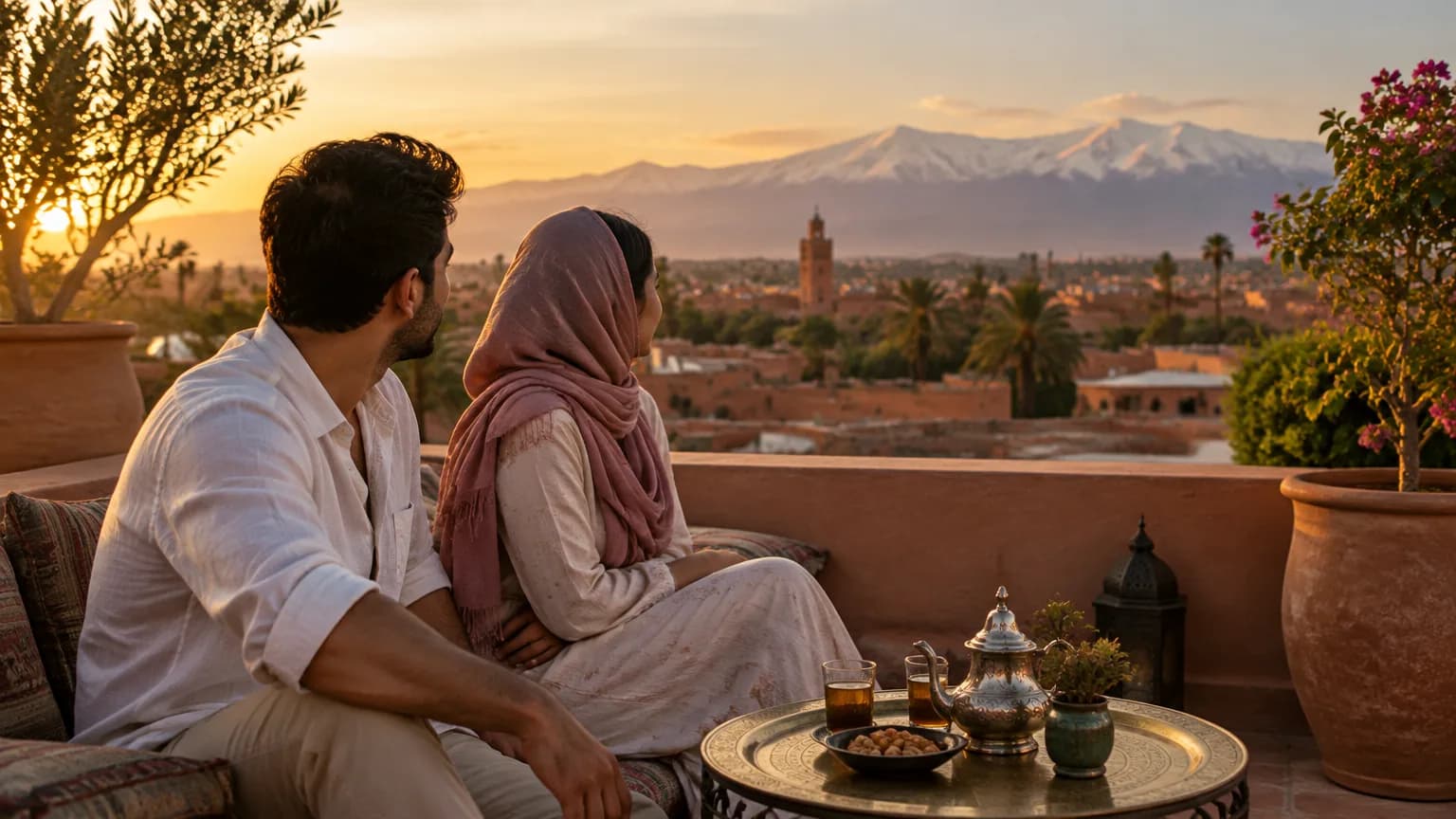
- First sunset on a rooftop: Day 2, from a Marrakech rooftop restaurant above Jemaa el-Fna as the food stalls open.
- Private dinner for two: Day 6 at the mountain stay, the quietest evening on the route and the best night for a celebration.
- A slow first morning in the mountains: Day 5, with a late breakfast and a village walk before the afternoon heat.
- Hammam for two: Day 3 evening, after a light day of gardens and palaces.
Why this route suits couples
This route suits couples because it limits movement and protects privacy. Two bases mean fewer packing days. Riad courtyards and mountain terraces give private corners that a large resort rarely does.
The pace is gentle by design. Guided time is short and mostly in the mornings, so afternoons stay open for rest, shopping or a second walk on your own. Marrakech handles the lively evenings, and the Atlas handles the quiet ones.
Romantic highlights on the route
Each of these is a named part of the trip with one detail worth knowing before you arrive.
- Marrakech medina walk: a guided morning through the souks and spice lanes, ending with mint tea in a courtyard cafe.
- Jemaa el-Fna at dusk: the square fills with food stalls after sunset, and a rooftop table gives a calmer view of it.
- Garden and palace visit: a short, shaded half-day on Day 3, easy on the legs.
- Hammam session for two: a traditional bath and scrub, to be confirmed at booking.
- Atlas village and valley walk: a guided half-day through walnut groves and terraced fields on uneven paths.
- Private dinner at the mountain stay: arranged in advance for Day 6, with a clear sky good for stargazing.
How the days flow
Days here run on a relaxed rhythm of late starts, midday breaks and long evenings. Guided activities sit mostly in the morning. Lunch and a rest come in the hottest hours, and sunset slots are kept free.
Day 1 is arrival and rest only. Days 2 and 3 are the Marrakech sightseeing days, each with an evening plan. Day 4 is the drive to the Atlas, Day 5 a guided walk, and Day 6 has no fixed plan at all. Day 7 is the return to Marrakech and Day 8 is checkout and departure. If you want an even slower pace, we can drop the Day 3 palace visit.
Choosing the right stay style
For couples, the stay that matters is the one with the right setting, not the longest facility list. In Marrakech, look for a riad-style room with a courtyard or terrace and a short, easy walk or transfer to the main lanes. In the Atlas, a room with a valley view, a private terrace and a quiet location matters more than a busy dining hall.
Ask about stairs and room position, since many riads have steep steps and rooms around a shared courtyard. Rooms on upper floors usually have more privacy and light. All stays on this package are in the standard 3-4 star category.
Add-ons worth considering
A few extras can lift specific days without changing the route. Prices and availability are confirmed at booking.
- Longer spa treatment: a couples massage after the hammam, best on Day 3 or Day 7.
- Private dinner setup: flowers and a reserved terrace table, best on Day 6 at the mountain stay.
- Photographer session: a one-hour shoot in the medina lanes or at golden hour, best on Day 2 morning.
- Hot air balloon ride: an early-morning flight near Marrakech, best slotted into Day 3 if the weather is clear.
- Cooking class: a hands-on tagine session, best on Day 6 afternoon.
Where you will stay in Marrakech and the Atlas
The stay is split between a Marrakech medina riad-style property and a mountain lodge or guesthouse in the Atlas foothills. Both sit in the standard 3-4 star category, with twin-sharing rooms and daily breakfast included. Hotel names are confirmed at booking.
| Tier | Indicative price per person | What it usually means |
|---|---|---|
| Budget 3-star | approx Rs.67,000 | Simpler riad or hotel rooms, fewer in-room extras, limited terrace access |
| Standard 4-star (this package) | Rs.89,000 | Courtyard or terrace riad stay in Marrakech and a lodge or guesthouse in the Atlas |
| Premium 5-star | approx Rs.1,42,500 | Larger rooms, private terraces or plunge pools, more in-house dining and spa |
Tiers are indicative and move with season and room type. Premium stays are worth considering if you want a private terrace in Marrakech and an in-room view in the mountains.
Entry, money and flights for Indian travellers to Morocco
Indian passport holders need to check the current entry rules before travel. Start with the Morocco visa for Indians guide and apply through the official route it lists. Check the official portal for the current fee and processing time, and carry a passport valid for at least six months.
The local currency is the Moroccan dirham (MAD). Exchange rates move daily, so check on the day you travel. Flights from major Indian cities to Marrakech usually connect through Casablanca or a Gulf or European hub, so plan for a long travel day on arrival and departure. Fares and airlines are confirmed at booking.