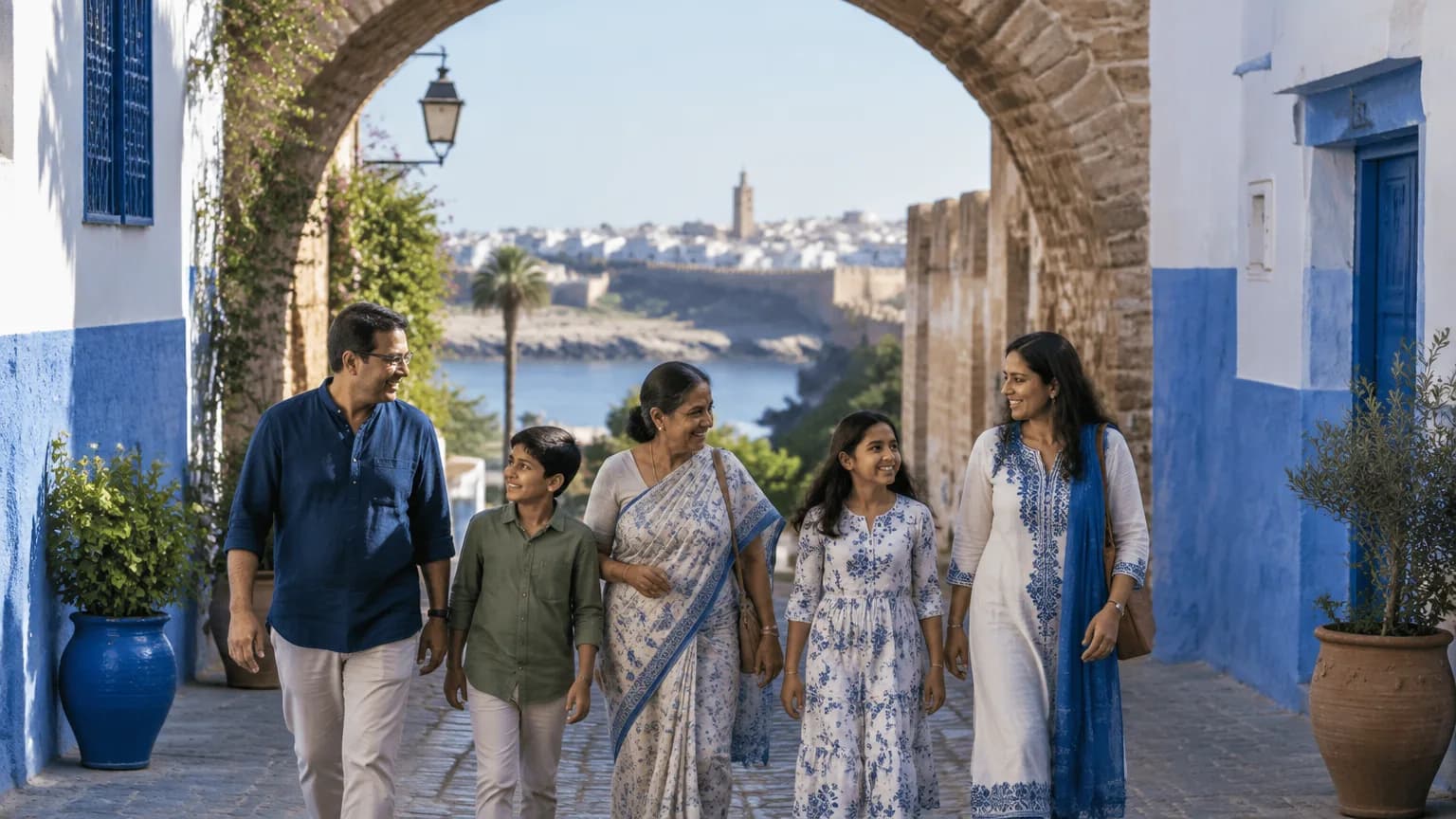
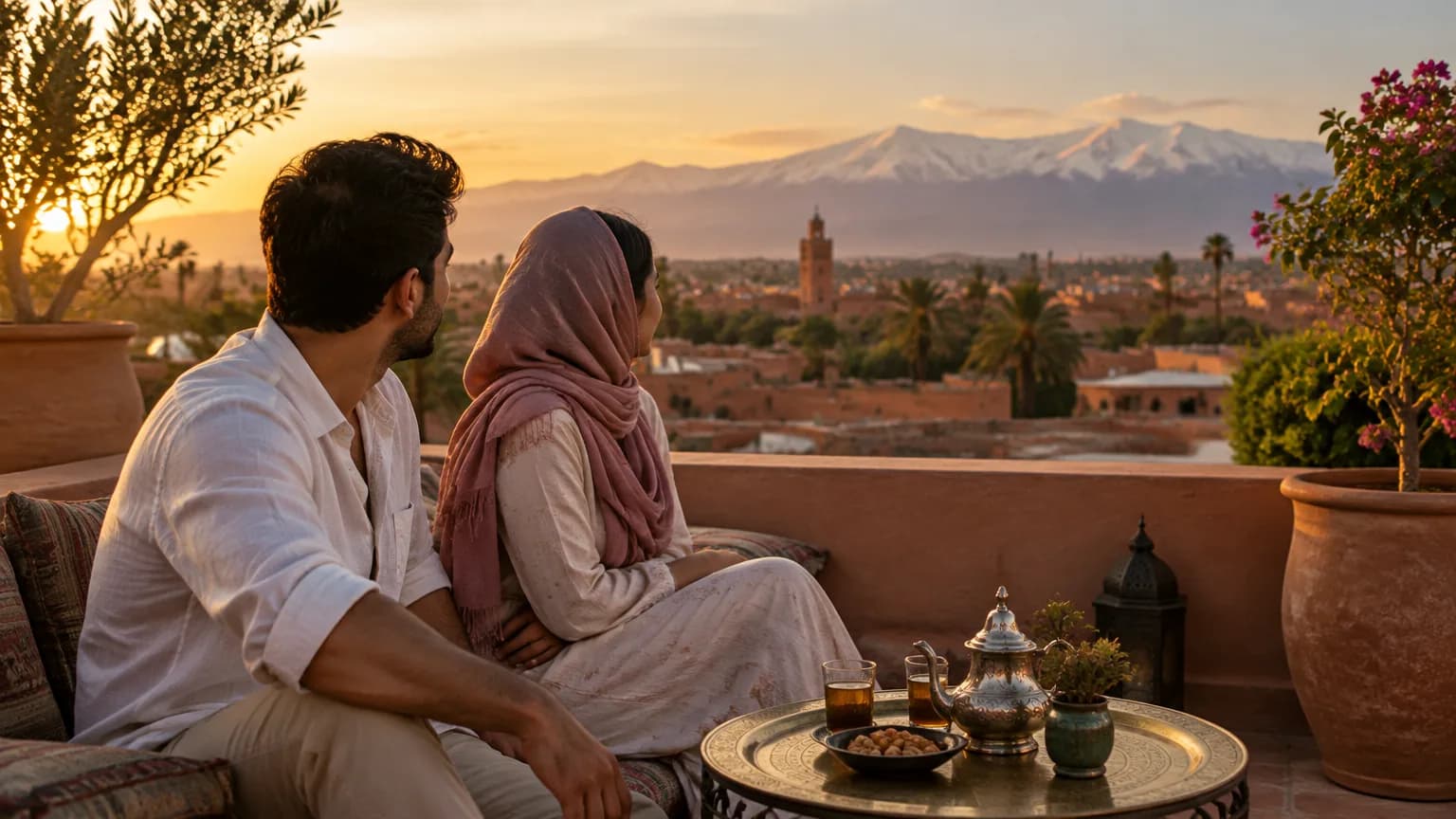
What does this Morocco family holiday cover?
This trip covers Casablanca for arrival and departure and Rabat for the middle days, over 8 nights. Both cities are linked by train, so each move takes about an hour instead of a long road transfer.
Casablanca brings the Hassan II Mosque and the Corniche. Rabat adds the Hassan Tower, the Mausoleum of Mohammed V and the Kasbah of the Udayas, which sit close together. Families who want the Sahara, Marrakech or the Atlas should pick another route, because this one does not leave the coast.
Day-wise summary at a glance
The table gives the shape of the Morocco holiday in one view. Each row states the night base and the main activity of that day.
Why this route suits children and grandparents
Short distances are the main reason this route works for a mixed-age group. Casablanca and Rabat are connected by ONCF trains and by the Al Boraq high-speed service on the Casablanca-Tangier corridor, so there are no full days spent in a vehicle.
- Walkable medinas, gardens and waterfront promenades instead of steep climbs
- Reserved train seats, which are easier on elders than long road drives
- Pharmacies and private clinics in both cities, within short drives of the hotels
- Early dinners arranged at the hotel or a nearby family restaurant, since local dinner hours run late
When is the best time to visit Morocco from India?
October to April is the most comfortable period for families, with mild coastal weather. October and November run around 14-28 C with medium to high crowds, while December to February drops to 8-21 C with low crowds and lower prices.
April and May are warm at 14-28 C and carry peak pricing. June to August is hot, with July and August reaching 34-35 C on the coast and around 40 C in the interior. If school holidays force a summer trip, plan outdoor visits for the morning and keep afternoons indoors. November is the wettest month on the coast at about 42 mm of rain, so carry a light rain jacket.
What affects the Morocco trip cost?
The listed price is Rs.90,500 per person on twin sharing, land only, with flights excluded. Hotel category, travel month and room type move the final figure most, and peak months and connecting family rooms add to the base.
Local transport is cheap. As of 2026, petit taxis run about 10-30 MAD per short trip, trams about 6-8 MAD, and second-class ONCF trains 49-260 MAD. Confirm current figures at booking.
Elder and child logistics on this route
Seating, room layout and rest stops are planned around the slowest walker in the group. On trains, families are seated together in reserved seats, and the Casablanca-Rabat leg is short enough that snacks and water carried from the hotel are enough.
- Rooms: twin or triple rooms for parents and children, with connecting or adjacent rooms where the hotel has them, to be confirmed at booking
- Wheelchair and stroller access: both cities have pavements and tram lines, but medina lanes and the Kasbah have cobbles and steps, so tell us in advance if a wheelchair is needed
- Rest stops: a hotel return after lunch on sightseeing days, and café stops during medina walks
- Luggage: only two hotel changes, Casablanca to Rabat and back, so bags are repacked just twice
Highlights by age group
Different ages enjoy different parts of the trip, so activities are spread across the days rather than stacked on one.
Younger children
- The Corniche walk in Casablanca, with open space to run
- Tram and train rides, which most young children enjoy
- Chellah gardens in Rabat, where storks nest on the old ruins
Teenagers
- The scale of the Hassan II Mosque and the unfinished Hassan Tower
- Medina walks with shopping for spices, leather and sweets
- The free day in Rabat to explore on their own pace within the group
Grandparents
- Slow garden walks in the Kasbah of the Udayas
- Seated rest breaks at cafés between sights
- The Mausoleum of Mohammed V, a calm site with limited walking
Pace, rest and logistics
The daily rhythm is one main sightseeing block in the morning, a hotel rest after lunch, and a short, light evening. The longest move is the train between the two cities, about one hour, and that is the only transfer day in each direction.
Days 6 and 8 are largely free. Use them to rest, shop or repeat a favourite stop. Dinners are early, usually around 7 pm at the hotel, so children are not kept waiting for late Moroccan dinner hours.
Rooms, meals and comfort
Rooms are in standard 3-4 star hotels on twin sharing, and families can ask for triple rooms or two adjacent rooms. Room types vary by hotel and date, so the exact layout is confirmed at booking.
Vegetarian food is easy to find: vegetable tagine, couscous, salads, bread, eggs and fruit are standard. Plain rice, dal and simple vegetable dishes can be arranged on request for children. Jain meals need advance notice and are handled case by case.
Tips for travelling with kids and elders
- Carry a valid passport for every traveller, including infants, with at least six months of validity and blank pages. Keep birth certificates of minors and a copy of each passport in your hand luggage.
- Pack layers for December to February, when coastal evenings are cool, and light cotton for April to September. A light rain jacket helps in October and November.
- Keep regular medicines in the original strips along with prescriptions, and add travel insurance that covers children and elders before you fly.
- Use a hat, sunscreen and a refillable water bottle for medina and garden walks, since shade is limited at the monuments.
- Dress modestly for mosque and mausoleum visits, with covered shoulders and knees. Non-Muslims generally view the Hassan II Mosque from outside or on a guided tour, so confirm timings at booking.
Where you stay in Casablanca and Rabat
You sleep in two cities across 8 nights: Casablanca at the start and end, and Rabat in the middle. Casablanca handles arrival, departure and rail connections, while Rabat is the capital with the main monuments close together.
- Budget 3-star (approx Rs.68,000): clean, basic rooms near the centre, usually with breakfast only and smaller family rooms.
- Standard 3-4 star (Rs.90,500, this package): central hotels with larger rooms, lifts, a restaurant and easier access to trains and sights.
- Premium 5-star (approx Rs.1,45,000): larger rooms or suites, more in-house dining, pools and concierge help for elders.
These tiers are indicative and per person. Final hotel names are shared at booking. Compare other routes on our Morocco tour packages page before you lock dates.
Entry, money and flights for Indian travellers
Indian passport holders need to check the visa rule and application route on the official Moroccan government portal, and our Morocco visa for Indians guide explains the steps. Check the official portal for the current fee, as the visa fee is not part of this package.
The local currency is the Moroccan dirham (MAD); check the rate at the time of travel and carry some cash for taxis and small shops. Flights from major Indian cities usually involve a connection and total roughly 10-14 hours of travel. Confirm routing and fares with us at booking, since fares vary by season. The arrival and departure airport is Mohammed V International Airport (CMN) in Casablanca. Rules and figures here are as of 2026.