What does the six-day route cover?
The itinerary moves from Tokyo arrival southwest to Hakone, then into the Japan Alps for the trekking block, before returning to Tokyo for departure. Tokyo Haneda (HND) and Narita (NRT) are the standard arrival airports for Indian travellers. All inter-city movement is by rail or private transfer — no self-driving involved.
Two places define the trip. Hakone sits inside a volcanic valley about 90 minutes from Tokyo by train; the ropeway, sulphur vents and Lake Ashi boat crossing fill a full day. The Japan Alps section is where the serious walking happens — marked mountain trails with a certified local guide, a fixed turnaround time and a safety briefing before you set off.
Why pick this route over a standard Japan city break?
A city-focused Japan holiday spends the week on temples, train stations and shopping streets. This itinerary trades some of that for trail time. Each day has a structured activity in the morning and afternoon, with evenings kept free so you recover before the next start.
The hot-spring evenings in Hakone are not just a comfort add-on — soaking after a long walk genuinely helps with muscle recovery, and the valley setting is worth the stop on its own. The Alps trekking day is the centrepiece: a full guided hike on marked trails with rest stops built in and weather cut-offs that the guide enforces without negotiation.
Best time to visit Japan from India for this trip
April to May and October to November offer the most reliable walking weather for this route. Spring averages 14–19 °C in April and 18–23 °C in May; autumn sits at 18–22 °C in October and 12–18 °C in November, with lower rainfall than the summer months.
Avoid June to mid-July — that is the rainy season across mainland Japan, with rainfall reaching 165 mm or more per month. September carries the highest typhoon risk of the year. July and August are hot and humid, with temperatures hitting 27–34 °C and heavy domestic holiday traffic on the trails. Winter is cold and generally dry, but the Alps trails hold snow and the trekking section may need rerouting.
Golden Week (late April to early May) and the New Year period bring crowded trains and higher accommodation prices; book well ahead if your dates fall in those windows.
What drives the Japan trip cost?
The Rs.1,40,000 per person figure covers land arrangements on twin sharing, with international flights excluded. It assumes a set departure and standard-category hotels. The guide-to-guest ratio, how many transfers are private versus shared, and any single-room supplement all affect the final number. Extra nights, peak-date departures and optional activities are quoted separately at booking.
Rail costs in Japan are worth noting separately. JR East revised fares in March 2026, and the nationwide Japan Rail Pass was scheduled to increase in price from 1 October 2026, with some exceptions. Whether a pass or point-to-point tickets work out cheaper depends on your exact route — confirm at booking.
Packing and practical tips for Indian travellers
- Pack in layers. Mountain mornings in the Alps are several degrees colder than Tokyo on the same day.
- Carry cash for small mountain-town shops and bus counters; cards are not universally accepted outside major cities.
- Waterproof trail shoes are essential for the trekking day — regular sneakers are not adequate on wet mountain paths.
- A small daypack (20–25 litres) is enough for the hike; the main luggage stays at the guesthouse.
- Download an offline map of the trail area before leaving the city — mobile signal is patchy on mountain routes.
- Keep one rest evening free after the longest transfer day (Day 3) to avoid arriving at the trekking section already tired.
The Hakone and Japan Alps Experience
The signature activity across Days 2 and 4 is the combination of the Hakone volcanic valley loop and the guided Japan Alps trek. Both involve a certified local guide, a pre-activity safety briefing and weather-dependent cut-offs.
In Hakone, the ropeway runs over active volcanic terrain; it closes in high wind or when sulphur levels rise. The Lake Ashi boat crossing is a short sightseeing ride with life jackets on board. The onsen visit in the evening uses the property's hot-spring bath — no swimming ability needed.
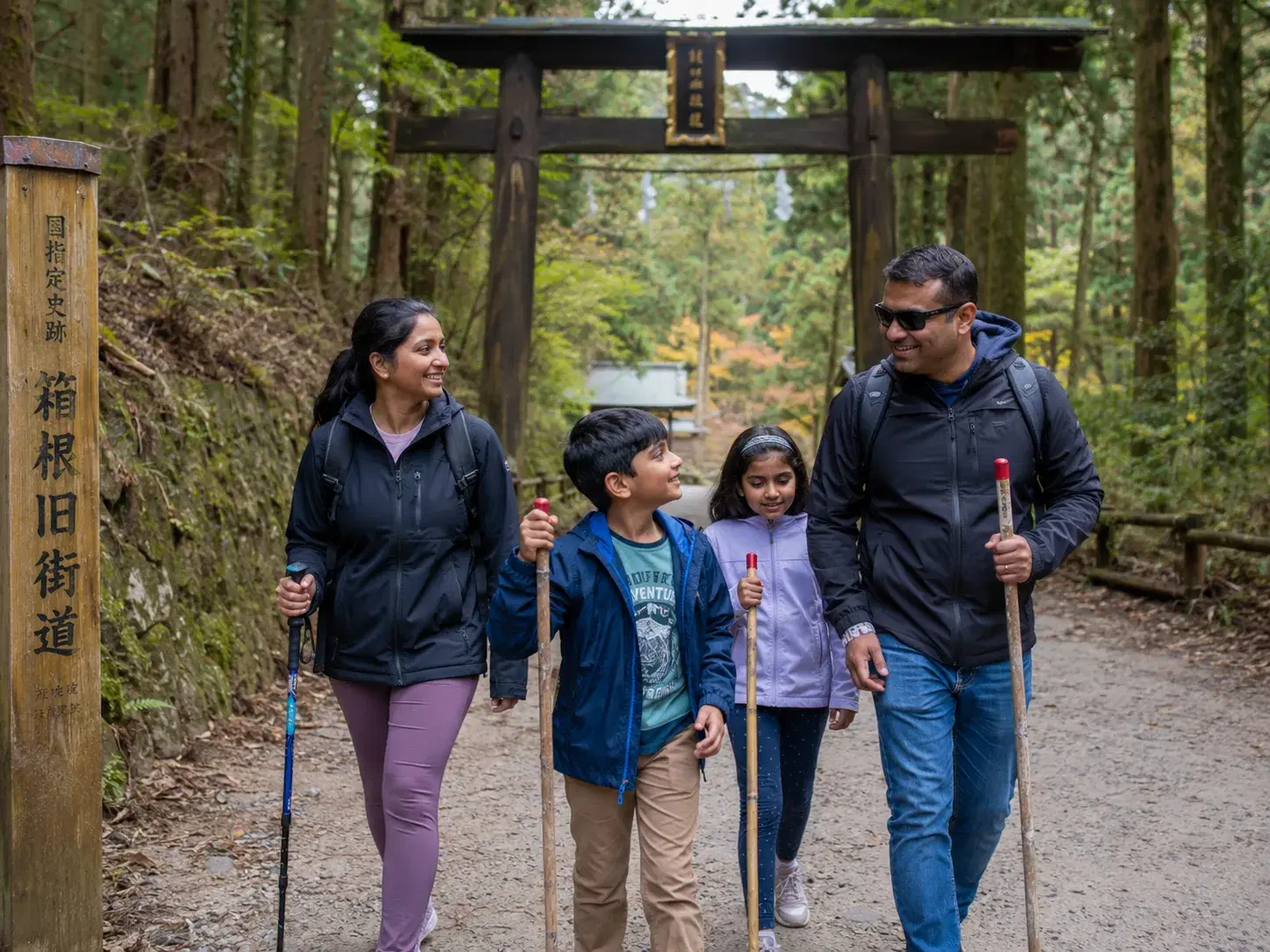
The Japan Alps trekking day starts with a gear check and safety briefing. The guide sets the pace, marks rest stops and enforces a turnaround time regardless of how the group feels at that point. Packed lunch is carried on the trail. If weather deteriorates mid-hike, the guide moves the group to a lower-elevation alternative route. Operator standards and emergency procedures are confirmed at booking.
Who this trip is for
This route suits adults who can sustain five to six hours of walking on uneven mountain terrain with a daypack. No technical climbing is involved, but a basic level of trail fitness is required — anyone who has completed a full-day Himalayan day hike will manage comfortably.
The minimum recommended age for the trekking day is 12 years. Travellers with knee, heart or respiratory conditions should discuss the itinerary with us before booking; a lower-intensity version of this route may be more appropriate. The trip is not designed for first-time walkers or travellers who prefer mostly flat terrain.
What you will do on this trip
- Hakone ropeway ride over the volcanic valley (half-day, weather-dependent)
- Lake Ashi sightseeing boat crossing (approximately 30 minutes)
- Sulphur vents walk in the Hakone volcanic area (1–2 hours, easy gradient)
- Acclimatisation valley trail walk on arrival at the Japan Alps (1–2 hours, easy)
- Full guided trekking day on marked Japan Alps mountain trails (5–6 hours, moderate)
- Evening hot-spring bath at the Hakone onsen property (included in stay)
Difficulty and fitness at a glance
Altitude, weather and safety on the trail
The Japan Alps trekking section involves significant elevation gain; exact altitude figures for this specific route are to be confirmed at booking, as the trail varies by season and guide availability. Arrive at the mountain base having slept at least one night at a lower elevation — Day 3's acclimatisation walk serves this purpose.
Weather cut-offs apply to both the Hakone ropeway and the Alps trekking day. The guide has authority to cancel or reroute without appeal. In the event of a full-day cancellation, a lower-elevation alternative is substituted; refund terms are confirmed at booking. Typhoon risk is highest in September, so avoid that month for this itinerary.
All guided sections use certified local guides. Emergency contact numbers and the nearest medical facility for the mountain area are shared at the Day 3 briefing.
Gear and packing checklist
- You bring: waterproof trail shoes or hiking boots, moisture-wicking base layers, a light waterproof jacket, trekking poles (optional but useful), sunscreen, a personal first-aid kit, a 20–25 litre daypack, snacks and a refillable water bottle
- Provided or arranged: certified guide, safety briefing materials, packed lunch on the trekking day, standard safety equipment as applicable (confirm specifics at booking)
- For onsen evenings: a small towel (most onsen properties supply one, but confirm at booking), no swimwear — traditional onsen use is without clothing
- Weather layers: mountain mornings can be 8–10 °C colder than the valley; a mid-layer fleece is worth the bag space
Permits, fees and trail rules
Some national-park trails and mountain areas in Japan charge a small entry or conservation fee. The four main Mount Fuji climbing routes required a ¥4,000 hiking fee during the most recent climbing season; this itinerary does not include Mount Fuji, but similar fees may apply to the specific Alps trail used. Confirm all trail-specific charges at booking, as they vary by route and season.
Onsen facilities have standard rules: tattoos may restrict access at some properties, and the bath is used without swimwear. The guide will brief the group on any site-specific rules before each activity.
Where you stay: mountain guesthouses and city hotels
The five nights split across three property types. Nights 1 and 5 are in a standard 3-star city hotel in Tokyo, convenient for the airport and rail connections. Night 2 is at a hot-spring guesthouse or onsen hotel in the Hakone area, with access to the property's thermal bath included. Nights 3 and 4 are at a mountain-area guesthouse or family-run lodge near the Japan Alps trekking base, with meals served at the property.
All stays are twin sharing. Single-room supplements are available on request and quoted separately. No specific hotel names are confirmed until booking, as availability varies by departure date.
Japan entry, money and flights for Indian passport holders
Indian passport holders require a visa to enter Japan. The application is made through the Japanese Embassy or an authorised visa application centre in India; check the official Japanese Embassy portal for the current fee and processing time, as these figures are not fixed. Japan's currency is the Japanese Yen (JPY); do not rely on an exchange rate quoted here — check a live rate close to your travel date. Carry some yen in cash for mountain-town purchases.
Flight time from major Indian cities to Tokyo varies: roughly 11.6 hours from Chennai, 11.8 hours from Kochi, 11.8 hours from Bengaluru, 12.6 hours from Mumbai and 12.8 hours from Delhi, typically routed via Singapore. These are approximate totals including a connection; confirm actual routing and duration with your airline at booking. International airfare is not included in the Rs.1,40,000 land price.