What is the Khajuraho cultural tour package route?
The route has three bases: 3 nights in Khajuraho, then 2 nights around Orchha, with Jhansi visited as a day trip from Orchha. Temples come first, palaces and cenotaphs next, and a fort and old town last. Each day has one main sightseeing block, so the Khajuraho temple circuit never turns into a checklist.
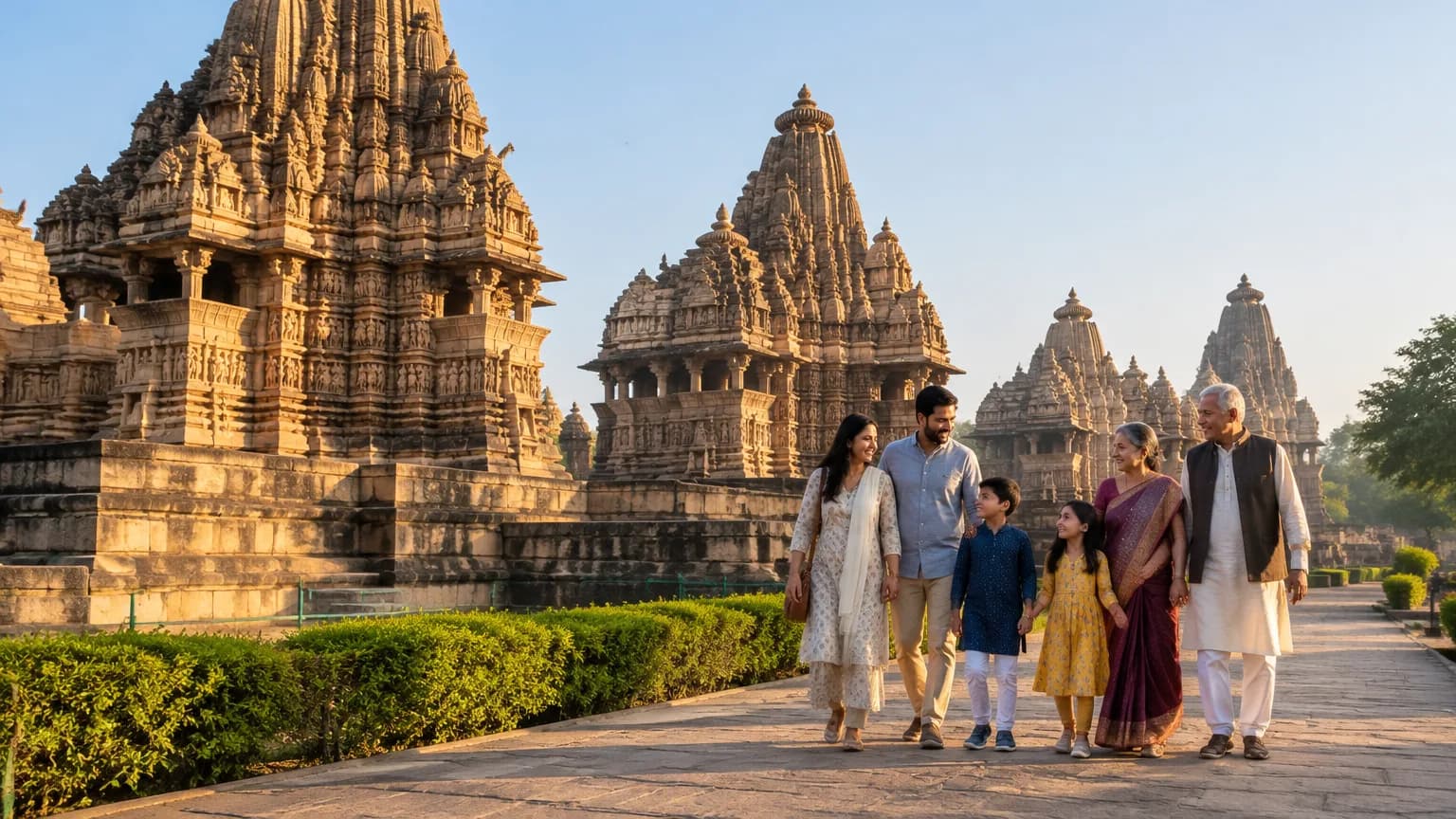
This is a Khajuraho holiday for people who want to understand what they are looking at. Guides explain the Chandela-era carving, the Bundela royal history at Orchha, and the 1857 story tied to Jhansi Fort. Chapters on stays, food, etiquette and logistics follow below.
The stories behind Khajuraho, Orchha and Jhansi
The three towns tell one regional story: temples built by the Chandela rulers, palaces raised by the Bundela dynasty, and a fort that became a symbol of the 1857 uprising. Here is how three of the stops connect.
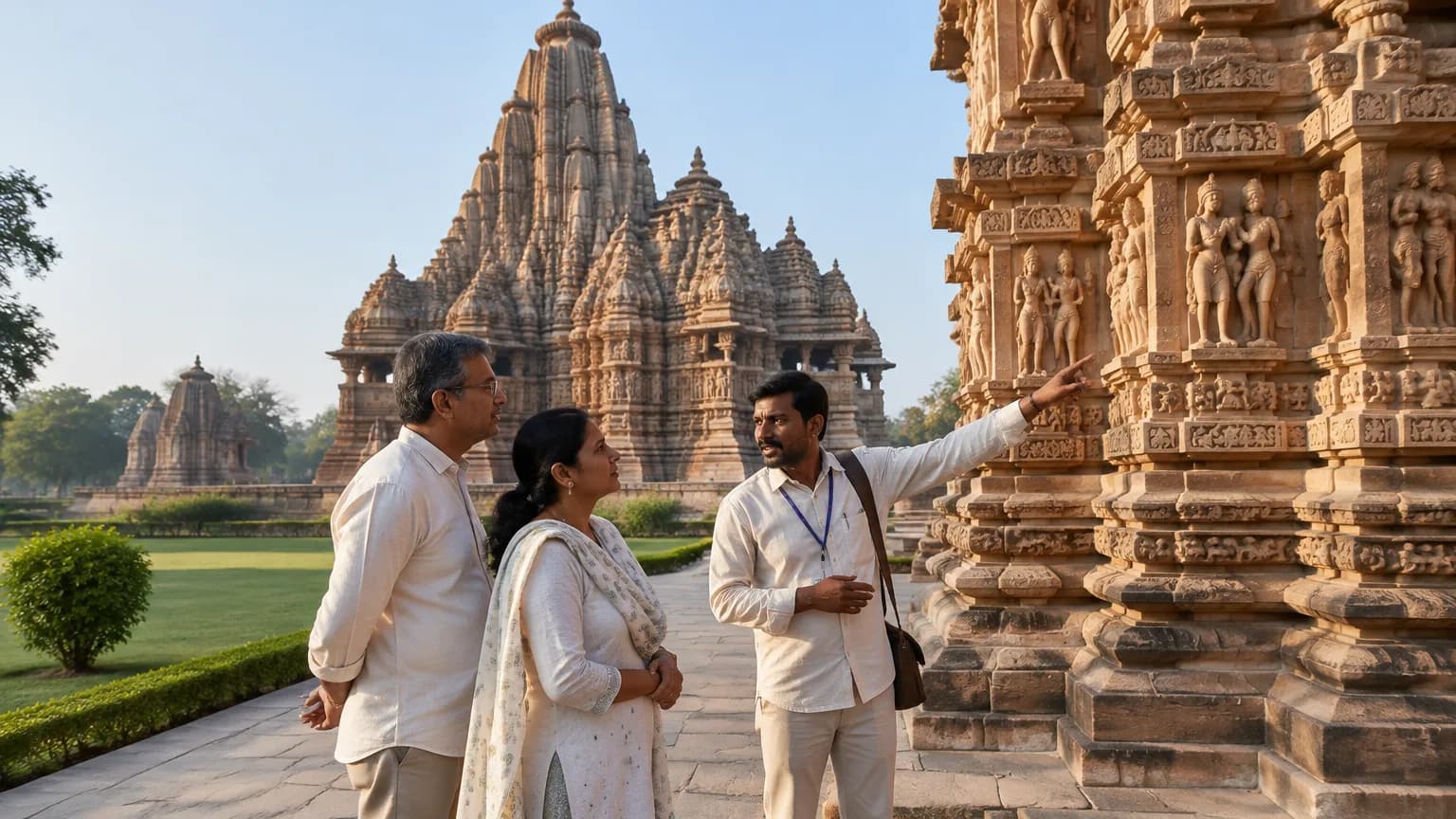
Kandariya Mahadeva, Khajuraho. It is the principal temple of the Western Group and shows the Chandela temple style at full scale: a tall spire over a raised platform, with bands of sculpture running around the walls. The carvings cover gods, musicians, dancers and everyday scenes. A guide helps you read them panel by panel rather than walk past.
Orchha's palaces and cenotaphs. Orchha was a Bundela capital on the Betwa river. Jahangir Mahal and Raj Mahal sit inside the fort complex, and the royal cenotaphs line the riverbank. Together they show how this ruling family built, worshipped and was remembered.
Jhansi Fort. The fort is tied to Rani Lakshmibai and the events of 1857. A museum inside the complex adds local history. After the temple days, it gives the trip a very different period and mood.
What makes this heritage journey distinctive?
The thread is royal patronage in Bundelkhand: the Chandelas who funded temple art, the Bundelas who built palaces and a living Ram temple, and the later fort history of Jhansi. You see how belief, power and craft shaped one region over centuries.
The pace is deliberate. Mornings are for monuments, afternoons for food and markets, and evenings are mostly free, apart from the sound and light show on Day 2. Guides are with you for listed sightseeing, so context comes with every stop.
Places on this route and what to know
Six stops carry most of the trip. Each has one detail worth planning around.
- Western Group of Temples, Khajuraho: the main complex with Kandariya Mahadeva, Lakshmana, Vishvanatha and Devi Jagadambi. Open daily 08:00-18:00; Rs.40 entry for Indian nationals; allow 3-4 hours.
- Eastern Group, Khajuraho: includes Jain temples such as Parsvanatha. Open 08:00-18:00; most temples are free; allow 2-3 hours.
- Southern Group, Khajuraho: a quieter cluster that includes Duladeo Temple. Rs.25 entry for Indian nationals; allow 1-2 hours.
- Archaeological Museum, Khajuraho: sculptures and artefacts from the site. Closed on Fridays; Rs.15 entry for Indian nationals.
- Orchha fort complex and Ram Raja Temple: palaces, cenotaphs and a temple where Ram is worshipped as a king. Entry fees and darshan timings are to be confirmed at booking.
- Jhansi Fort and museum: a fort complex with a small museum. Timings and fees are to be confirmed at booking; carry photo ID.
Temple fees above are as listed in published guides; they can change, so treat them as indicative.
Etiquette, timings and access at the sites
Dress modestly at all three towns. Shoulders and knees covered is a safe rule, and a light stole helps at active shrines. At Ram Raja Temple in Orchha, which is an active place of worship, footwear comes off at the entrance and leather items may not be allowed.
Khajuraho's temple groups open daily from 08:00 to 18:00, so early mornings give softer light and fewer people. Photography rules differ by monument and can change, so follow signs and your guide's advice. Temple platforms, steps and stone paving are uneven in places, and not every stop has step-free access. Tell us in advance if anyone uses a stick or has knee trouble, and we will adjust the order of visits.
How demanding is the pace?
The pace is easy to moderate. Khajuraho days involve 3-4 hours of on-and-off walking with seating breaks, and the transfer days include hotel check-in before sightseeing starts.
The Khajuraho to Orchha drive is the longest road day, and Jhansi is a day trip from Orchha with a return the same evening. Exact driving times depend on the road and stops, so confirm at booking. Senior travellers comfortable with moderate walking can manage the route, and we can add rest stops or shorten sightseeing blocks.
Madhya Pradesh and Bundelkhand cooking is mostly vegetarian-friendly, and every dish below can be ordered without meat. Look for dal bafla (baked wheat balls with dal and ghee), poha (flattened rice with onions, spices and sev), bhutte ki kees (grated corn cooked in milk and spices), mawa-bati (a fried khoya sweet with dry fruits) and jalebi.
Restaurants in Khajuraho serve poha and dal bafla, and a cited Khajuraho itinerary names Raja Cafe for lunch. For shopping, Khajuraho's local markets and tribal art museums are the natural stops. In Jhansi, the old town markets are a good place for handicrafts and street snacks. Prices at markets are bargained, so keep small notes handy.
Where will you stay on the Khajuraho Orchha Jhansi route?
You stay in standard 3-4 star hotels: central Khajuraho for the first three nights, and a hotel near the Orchha fort area for the last two. The price is based on twin sharing in this category. The tiers below are indicative per-person figures for context, with the standard 4-star tier being what this package uses.
Central Khajuraho keeps the Western Group within easy reach. Hotel names are confirmed at booking.
Cost, inclusions and best time to book
The package costs Rs.20,000 per person on twin sharing, land only, with flights excluded. The inclusions and exclusions below show what is and is not covered.
The best time to visit Khajuraho from across India is October to March. According to the cited Khajuraho weather data, January days range from about 3.7 to 30.2 degrees C and December from 9.6 to 34.3 degrees C. April to June is hot, with temperatures commonly 40-45 degrees C, and July to September brings moderate to heavy rain. Festival dates change every year, so confirm at booking for your dates.
If you want to compare routes before choosing, see our Khajuraho tour packages page for the other trip lengths we run.
Getting to Khajuraho: access and logistics
Khajuraho Airport (HJR) is about 2 km from the temple sites, with domestic connections to Delhi, Mumbai, Bhopal and Varanasi, and the railway station is about 5 km from the main town. The Hazrat Nizamuddin-Khajuraho Vande Bharat Express takes about 8 hours 20 minutes from Delhi.
Regular flights were expected to resume in September 2026 after an almost two-month suspension, so check the schedule before booking tickets. From Mumbai and Kolkata, trains reach Satna, then it is about three hours by road, and from Chennai the usual railhead is Jhansi. No permits are required for the monuments on this route. Carry a government photo ID. Mobile connectivity is generally available in the towns, but confirm coverage at booking for the Orchha stretch.
Tell us who is travelling and any mobility or dietary needs and we will pace the journey accordingly.