
Field notes
Kerala Main Travel Guide for Indians 2026
The Kerala main travel guide for Indians starts with the basics: Kerala is a narrow coastal state in south-west India with backwaters, tea-covered hills and long beaches. The best season runs from October to March. First-timers remember a houseboat cruise, a walk through Fort Kochi and a morning in Munnar. It suits couples, families and older travellers.
At a glance: Kerala in one read
Kerala is a coastal state in south-west India where the Arabian Sea meets the Western Ghats. Most first trips take about three nights and enter through Kochi or Thiruvananthapuram.
| Detail | What to know |
|---|---|
| Region | South-west India, with the Arabian Sea on one side and the Western Ghats on the other |
| Best season | October to March, with the heaviest demand from December to February |
| Typical trip length | Three nights for a short first trip; five to six nights to add more bases |
| Main gateways | Kochi for Munnar and Alappuzha; Thiruvananthapuram for Kovalam and Varkala |
| Entry and permits | No permit is needed for Indian citizens to travel within Kerala; Eravikulam National Park needs a timed entry reservation |
| Domestic demand | Kerala recorded 10.98% growth in domestic tourist arrivals in the first quarter of 2026 compared with the same period in 2025 |
That geography gives you three holiday zones in one state: the coast, the backwaters and the hills. Most first-time visitors land at Kochi and move between them by road, so a trip is really a short chain of bases rather than a single stay.
Heavy monsoon rain between June and September can make beach swimming unavailable and sea conditions rough, so the season you pick decides which zones work best. April and May turn hot and humid across the state.
A useful way to read the map is north to south. Kochi sits in the middle of the tourist belt, Munnar and Thekkady rise inland to the east, Alappuzha and Kumarakom spread across the backwaters to the south of Kochi, and Thiruvananthapuram anchors the southern beaches. Drawing a line through these points gives you the usual route of a first trip, and it explains why so many visitors fly in at one end and fly out from the other.
Tourism in the state has also become more organised in recent years. Digital tools and AI-based systems are now used for tourism packages and logistics, which mainly means easier comparison of options and booking. For a traveller, the practical result is that houseboats, park entries and drivers can be arranged well before arrival rather than on the spot.
Why travellers choose Kerala
Travellers choose Kerala for three reasons: the backwaters, the hills and how easy it is to reach from every major Indian city. Each one is tied to a real place.
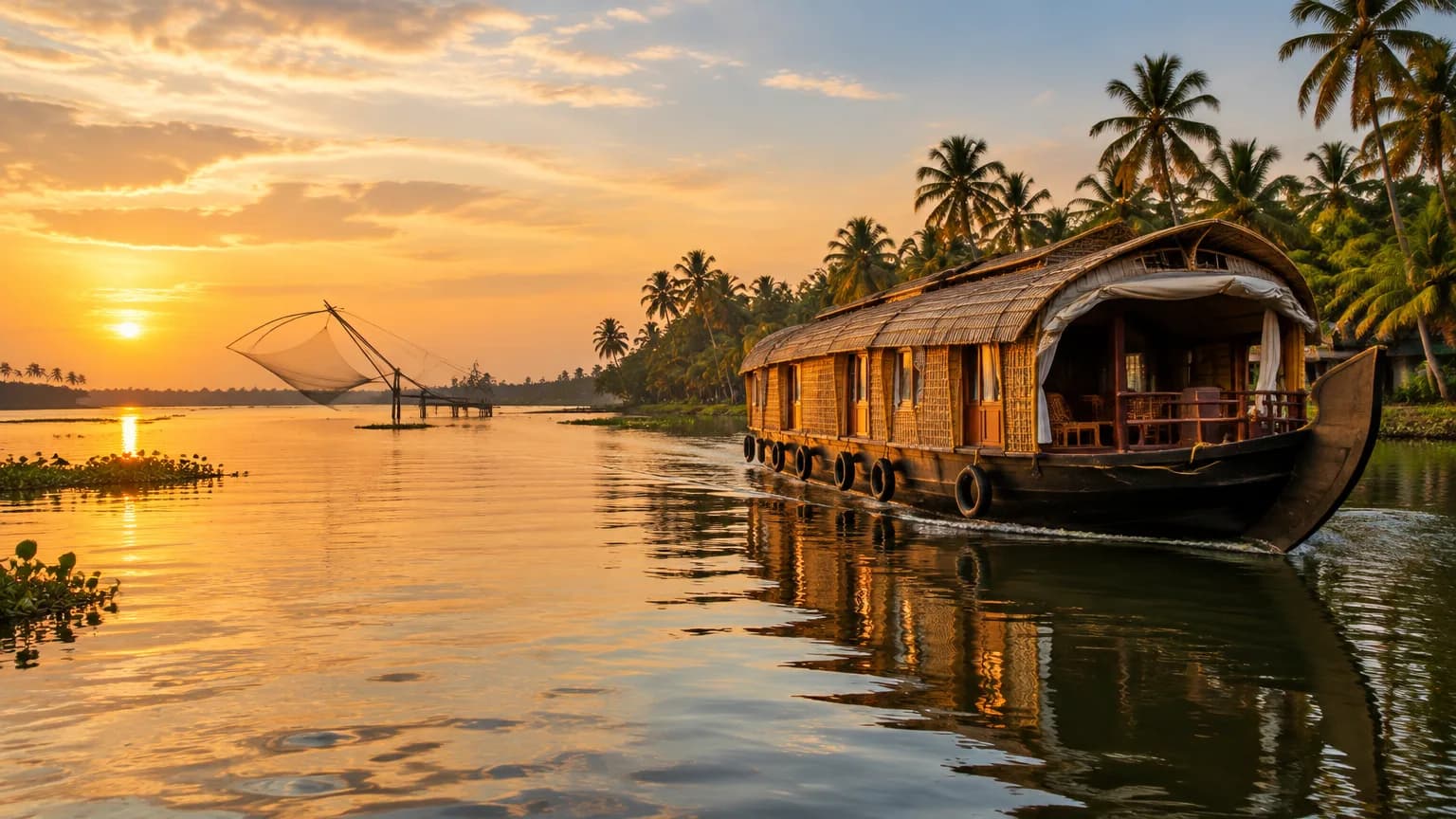
The backwaters. Alappuzha and Kumarakom are the best-known backwater areas, and houseboat travel is part of the common Kochi, Alleppey, Munnar and Thekkady circuit. A houseboat or a smaller boat moves through canals, paddy fields and villages at walking pace. It is the most photographed Kerala experience and works for couples, families and older travellers alike. The pace is the point: there is little to do on board except watch village life pass along the banks, which is a welcome change after a day of sightseeing.
The hills. Munnar, in Idukki district, is a hill station of tea country with cool mornings. Eravikulam National Park, Kerala's first national park, is reached via Munnar and prohibits private vehicles inside. Thekkady adds wildlife and spice-plantation country to the same circuit. Together these give a very different feel from the coast within a few hours of driving, which is why many travellers treat Kerala as two holidays in one.
Ease of getting there. Kochi and Thiruvananthapuram are linked by direct flights from Delhi, Mumbai, Bengaluru, Chennai and Hyderabad. Kerala is also connected by rail with Delhi, Kolkata, Hyderabad, Chennai and Mumbai, which makes it one of the simpler long-distance holidays to plan for travellers from across India. Flight times from the southern metros are about an hour, so even a long weekend is workable.
There is a cultural layer as well. Kerala Tourism lists traditional cuisine, sweet-making, local performing arts and guided birdwatching among its village and nature experiences, so a trip can go beyond sightseeing if you leave a few hours free. A village walk, a cooking session or an evening performance fits easily around a backwater stay.
Finally, the state suits mixed groups. Seniors are directed towards Kovalam and Kumarakom as easier stops, couples gravitate to backwater and beach stays, and families get a good spread of short walks, boat rides and a wildlife visit. Few destinations let a multi-generation group plan one trip that works for everybody.
Top places to visit in Kerala
Kerala places to visit cluster into three groups: heritage and backwaters around Kochi, hills around Munnar and Thekkady, and beaches near Thiruvananthapuram. These are the stops most first itineraries are built around.
- Fort Kochi (Kochi). A heritage district of historic forts, free to explore on foot. Tip: walk early morning or late afternoon, because the middle of the day is humid. The Ernakulam to Fort Kochi ferry takes about 10 minutes and is a pleasant way to arrive.
- Munnar (Idukki). A hill station and the access point for Eravikulam National Park. Tip: keep a full day free for the park and tea-country drives, and expect hairpin bends and sudden mist on the way up.
- Eravikulam National Park (near Munnar). The park runs a safari tour on foot lasting 2 to 3 hours, and private vehicles are not allowed inside. Tip: reservation is available through the park information centre in Munnar, and entry runs from 8:00 am to 2:00 pm, so plan to reach it in the morning.
- Alappuzha (Alleppey). The classic backwater town for houseboat cruises. Tip: book your boat before arriving in peak season and confirm which meals are included.
- Kumarakom (Kottayam). A backwater destination identified as one of the easier Kerala stops for seniors and suitable for couples. Tip: it pairs well with Alappuzha if you want two backwater moods.
- Thekkady (Idukki). Wildlife and spice-plantation country on the common Kerala circuit. Tip: Periyar wildlife guides can be arranged through the KTDC booking counter at Thekkady.
- Kovalam (Thiruvananthapuram). A beach destination that is also one of the easier Kerala stops for seniors. Tip: place it at the end of the trip so you are not driving back to the hills.
- Varkala (Thiruvananthapuram). A coastal stop that appears in Kerala budget itineraries. Tip: it suits travellers who want a slower beach stay.
- Poovar (near Thiruvananthapuram). A coastal area that appears in some 6-day itineraries alongside Kovalam. Tip: treat it as an add-on rather than a base for the whole holiday.
- Thiruvananthapuram. The southern gateway city for Kovalam and Varkala, with its own airport and Thiruvananthapuram Central railway station. Tip: useful as an arrival or departure point when you want to avoid doubling back.
A simple way to group these without building a day plan: Kochi, Alappuzha and Kumarakom sit close enough to combine as a heritage-and-water pair. Munnar and Thekkady form the hill pair. Kovalam, Varkala and Poovar form the beach trio near Thiruvananthapuram. Most first trips pick two of these three groups rather than all of them.
Adventure options exist for those who want them. Kerala Tourism lists jungle trekking, rafting and paragliding among its adventure activities, and the Eravikulam safari walk is a gentler alternative. These are best arranged through the local tourism offices or your tour operator, since availability varies by season.
Best time to visit Kerala
The best time to visit Kerala is October to March, the relatively dry period. December to February is the busiest stretch with peak prices, while April to September brings heat or monsoon rain.
- Best months: December, January and February for low rain, with high crowds and peak prices.
- Shoulder months: October, November and March, with moderate rain or medium crowds and medium prices.
- Months to avoid for beaches: June to September, the south-west monsoon, when heavy rain makes beach swimming unavailable and seas rougher.
- Months to avoid for heat: April and May, when heat and humidity rise; April is also a lower-price, low-crowd month if you can handle the weather.
October brings short afternoon rain from the northeast monsoon. If your dates are fixed to the monsoon, shift the plan inland: hill stations and backwater cruises still work, but keep beach days flexible.
| Season | Months | What to expect |
|---|---|---|
| Dry season | October to March | Warm and relatively dry; December to February has the highest demand and peak prices |
| South-west monsoon | June to September | Heavy rain, rougher seas and lower visitor demand |
| Pre-monsoon and north-east monsoon | April to May and October to November | Hot or humid conditions with intermittent to moderate rain |
Temperatures stay in a narrow band through the year. January and February run roughly 22 to 33 degrees Celsius, while April reaches around 26 to 35 degrees, which is the hottest stretch. July is among the coolest at about 24 to 29 degrees, but it is also among the wettest.
Many travellers assume the monsoon makes a trip impossible. It does not, but it changes the plan. Backwater cruises and hill stays carry on, prices drop, and crowds thin out. The trade-off is that you should keep schedules loose, avoid beach days and allow extra time on hill roads when rain or mist slows traffic.
Trip cost: what each budget level gets you
A Kerala trip costs what the season, stay category and transport add up to, so check current prices before you plan. Budget, mid-range and luxury trips differ mainly in where you sleep and how you move.
| Tier | Stay | Meals | Transfers |
|---|---|---|---|
| Budget | Guesthouses and budget hotels | Local eateries, few meals included | Government or private buses, ferries and autos |
| Mid-range | Three-star hotels, small resorts and one houseboat night | Breakfast included, houseboat meals on the cruise day | Private car with a driver for the circuit |
| Luxury | Premium resorts and private houseboats | Most meals included on stay and cruise days | Dedicated car and airport transfers |
Budget travel leans on public transport. Typical costs quoted for May 2026 include a ferry at about ₹5 and buses between circuit towns at roughly ₹80 to ₹200, such as ₹120 to ₹180 from Kochi to Munnar. Treat these as indicators and confirm at booking.
| Bus route | Typical cost (as of May 2026) |
|---|---|
| Kochi to Munnar | ₹120 to ₹180 |
| Munnar to Thekkady | ₹80 to ₹120 |
| Thekkady to Alleppey | ₹150 to ₹200 |
| Alleppey to Varkala | ₹80 to ₹120 |
What moves the price most is the date, with December to February at peak, then the choice of a houseboat night, the number of long drives, and whether you fly into one city and out of another instead of doubling back. Package pricing varies by operator, so compare inclusions as well as the headline number.
What to check before you pay
- Houseboat terms: confirm whether the quote covers meals, the number of hours on the water and whether the boat has air conditioning.
- Transfers: ask whether airport pickups and drops are included, and whether the driver stays with you for the whole circuit.
- Entry tickets: park and guide fees are usually extra unless the package says otherwise.
- Peak-date surcharges: December and January can carry extra charges on stays, so ask for a final amount rather than a base rate.
A common mistake is comparing a budget hotel quote with a package that includes a private car, which makes the cheaper option look better than it is. Compare like with like, and add the cost of buses or taxis to any stay-only quote.
How to reach Kerala
Kochi is the main airport for Munnar and Alappuzha, and Thiruvananthapuram is the main airport for Kovalam and Varkala. Kerala is also reached by rail and, from nearby southern cities, by road.
| From | Flight time | Note |
|---|---|---|
| Delhi | About 3.25 hours | Direct flight, as of October 2026 |
| Mumbai | About 2 hours | Direct flight |
| Bengaluru | About 1 hour | Overnight trains and buses also run |
| Chennai | About 1 hour | Flight duration stated |
| Hyderabad | About 1.5 hours | Multiple daily direct flights |
| Kolkata | About 3 hours | Check the current direct-flight schedule |
| Ahmedabad | About 2.5 hours | Check the current direct-flight schedule |
By rail, Kerala is connected with Delhi, Kolkata, Hyderabad, Chennai and Mumbai. Main stations include Thiruvananthapuram Central, Ernakulam Junction, Thrissur, Kozhikode and Alappuzha.
By road, Bengaluru to Kochi takes roughly 9 to 10 hours via NH 544, and Chennai to Kochi roughly 12 to 13 hours. Within the state, private cars and government or private buses link the main towns on the Kochi, Alleppey, Munnar and Thekkady circuit.
Choosing between air, rail and road
Air is the practical choice from Delhi, Kolkata, Mumbai and Ahmedabad, since rail or road would take much longer. From Bengaluru, Chennai and Hyderabad the options are closer: a flight is quick, but an overnight train or bus saves a hotel night and suits travellers who are comfortable sleeping in transit.
Open-jaw flights, arriving at Kochi and leaving from Thiruvananthapuram, avoid a long backtrack at the end of a circuit. Check this when comparing fares, because the saving in drive time can outweigh a small difference in airfare.
Once in the state, the shortest hop is the Ernakulam to Fort Kochi ferry. Between towns, a private car with a driver is the most flexible option, while government and private buses are the cheapest. Auto-rickshaws and tuk-tuks handle short local trips, and Uber is available in Kochi.
Where to stay in Kerala
Base yourself by what you want to do rather than by hotel brand. Most first trips use two or three bases and move between them by road.
- Kochi (Cochin): a common arrival and itinerary base, good for couples and families. Heritage-style stays sit near Fort Kochi, with standard hotels across the city.
- Munnar: a hill base with tea plantations and sightseeing. Choose a property close to town if you have an early park entry.
- Thekkady: a wildlife and spice-plantation base, usually with small resorts and homestay-style properties.
- Alleppey (Alappuzha): a backwater base where a houseboat cruise is the main stay, with town hotels for a land night before or after.
- Kovalam and Poovar: coastal bases commonly added to longer itineraries, best for the last leg. Poovar suits couples in particular.
For budget travel, look at guesthouses and budget hotels in Kochi, Munnar and Varkala. Mid-range travellers get the widest choice, from three-star hotels to small resorts and houseboats with attached bathrooms. Luxury sits in premium resorts and private houseboats, mostly across the backwater and coastal belts.
| Base | Best for | Stay type to look for |
|---|---|---|
| Kochi | Couples, families | Heritage-style stays, city hotels |
| Munnar | Couples, families | Hill hotels and plantation-side resorts |
| Thekkady | Couples, families | Small resorts and homestay-style properties |
| Alleppey | Couples, families | Houseboats and backwater resorts |
| Kovalam | Couples, families, seniors | Beach resorts and mid-range hotels |
| Poovar | Couples | Quiet coastal resorts |
One practical point on houseboats: a cruise usually means one night on the water, with a land stay before or after. Confirm check-in and check-out times, because most cruises run on fixed schedules and late arrival can shorten your time on board. If you are travelling with elderly relatives, ask for a boat with a ground-level cabin and easy boarding.
Local food and cuisine
Kerala food is rice-based, coconut-heavy and tangy with tamarind and curry leaf. You will find the dishes below in local eateries, homestays and houseboats rather than in one famous restaurant.
- Appam with stew: a lacy rice pancake served with a mild coconut-milk stew, common at breakfast in Kochi and the backwaters.
- Puttu with kadala curry: steamed rice and coconut cylinders with a black chickpea curry, a standard morning plate across the state.
- Kerala sadya: a vegetarian feast of rice with several vegetable dishes on a banana leaf, served in traditional eateries and at festival time.
- Fish moilee and fried fish: a coconut-milk fish curry and coastal fried fish, best along the Kochi and Alappuzha belt.
- Payasam: a sweet rice or lentil pudding; Kerala Tourism lists traditional cuisine and sweet-making among its cultural experiences.
Vegetarian food is widely served, and sadya is a vegetarian meal by tradition. The sources used for this guide do not state a blanket guarantee of vegetarian availability at every stop, so confirm with your hotel or houseboat when you book, especially for strict or Jain diets.
Eating well on the road
Breakfast is the easiest meal to get right. Appam, puttu and idli-style plates are served almost everywhere and are mostly plant-based. Lunch is typically rice with several side dishes, so ask for the vegetarian version if you want to avoid fish curry served alongside.
On a houseboat, meals are cooked on board and usually follow a fixed menu. Tell the operator about dietary needs when you book, not on the day. For small roadside eateries, choose places that are busy with local customers, since turnover is the best guide to freshness.
Spice levels are moderate in tourist areas but can be stronger in home-style kitchens. If you prefer mild food, say so; most cooks are happy to adjust.
Travel tips for Indians visiting Kerala
Planning is simple, but a few local details save time. Book park entries and houseboats early, keep small cash for ferries and autos, and schedule long drives for daylight.
- Permits and entries: no permit is needed for Indian citizens to travel within Kerala. Eravikulam entry timing is 8:00 am to 2:00 pm with the park closing at 6:00 pm, and Indian adults pay ₹200 as per the park details; reserve through the Munnar information centre. Periyar guides are arranged at the KTDC counter in Thekkady.
- Connectivity: coverage is generally reliable in cities and main towns but can be patchy on hill and backwater stretches, so download offline maps before you leave.
- Getting around: buses, taxis, autos and rentals cover local travel. Uber operates in Kochi, and government ferries run on available routes; the Ernakulam to Fort Kochi ferry takes about 10 minutes.
- Road safety: mountain roads to Munnar and Wayanad have tight hairpin bends and sudden mist, and hired drivers are described as safer than self-driving.
- Tourist buses: Kerala directed its State Transport Authority in September 2026 to review the uniform colour code for tourist buses, and in June 2026 it reduced the quarterly All India Tourist Permit bus tax to ₹900 per seat and ₹1,500 per sleeper berth, so check current rules if you are travelling by tourist coach.
- Etiquette: dress modestly at temples, remove footwear before entering and ask before photographing people at close range.
- Emergency numbers: fire station 101; ambulance 102 or 108.
Common planning mistakes
- Packing too much into too few days. Munnar, Thekkady and Alleppey are each a few hours apart by road. Three bases in three nights leaves very little time at each one.
- Skipping the park reservation. Eravikulam entry is timed and closes early in the day, so arriving late can mean missing it entirely.
- Booking beach days in the monsoon. Between June and September, swimming may be unavailable. Plan hill and backwater days instead.
- Ignoring humidity. Carry light cotton clothes, a hat and water. Afternoons in April and May are hot even for travellers used to the plains.
- Relying on mobile data for tickets. Keep screenshots or printouts of bookings in case signal drops on hill roads.
Families and couples can plan comfortably, and women travellers will find well-used tourist routes with plenty of other visitors. As anywhere, stick to registered operators, share your plans with someone at home and avoid driving on mountain roads after dark. Hotels and houseboat operators can usually recommend reliable drivers.
For wildlife visits, follow the guides' instructions closely. At Eravikulam the walk is on foot and private vehicles are not permitted inside, and at Periyar KTDC-registered guides are the recognised option. Carry a light rain jacket during the monsoon months and sturdy shoes for park trails.
Is Kerala right for you?
Kerala suits travellers who want water, hills and coast in one trip and can accept a few hours of road travel between bases. It is not a single-base holiday.
Short trip versus long trip
A three-night trip works best as Kochi plus one stop, either Alappuzha for the backwaters or Munnar for the hills. You get one strong experience without long drives, which suits first-timers with limited leave.
A five to six night trip lets you add Munnar, Thekkady and a beach such as Kovalam. You see the full range of the state, but you spend more time in the car.
| Trip length | Typical coverage | Best for |
|---|---|---|
| 3 nights | Kochi plus one of Alappuzha or Munnar | First-timers with limited leave |
| 5 to 6 nights | Kochi, Munnar, Thekkady, Alleppey and a beach | Travellers who want the full range of the state |
Who it suits and who it does not
- Suits: couples on a first holiday together, families who can handle short walks and a houseboat night, and older travellers who base themselves in Kovalam or Kumarakom.
- Suits less well: travellers who want nightlife-led holidays, anyone who dislikes humidity or winding hill roads, and people who want one base with no transfers.
For first-timers, the backwaters and Fort Kochi are the easiest wins. Hill stations and southern beaches can follow on a second trip if time is short.
If you are travelling with children, the shorter circuit is usually the better choice. Long hill drives can tire younger kids, so a Kochi and Alappuzha plan with a houseboat night keeps things relaxed. With elderly relatives, pick bases with minimal stairs and avoid early starts for park visits.
If you are a solo traveller or a group of friends, the longer circuit gives more variety, including trekking, rafting or paragliding where available. The trade-off is time on the road, so build in a rest day before the flight home.
To see this turned into a complete trip, have a look at the Kerala holiday packages.