
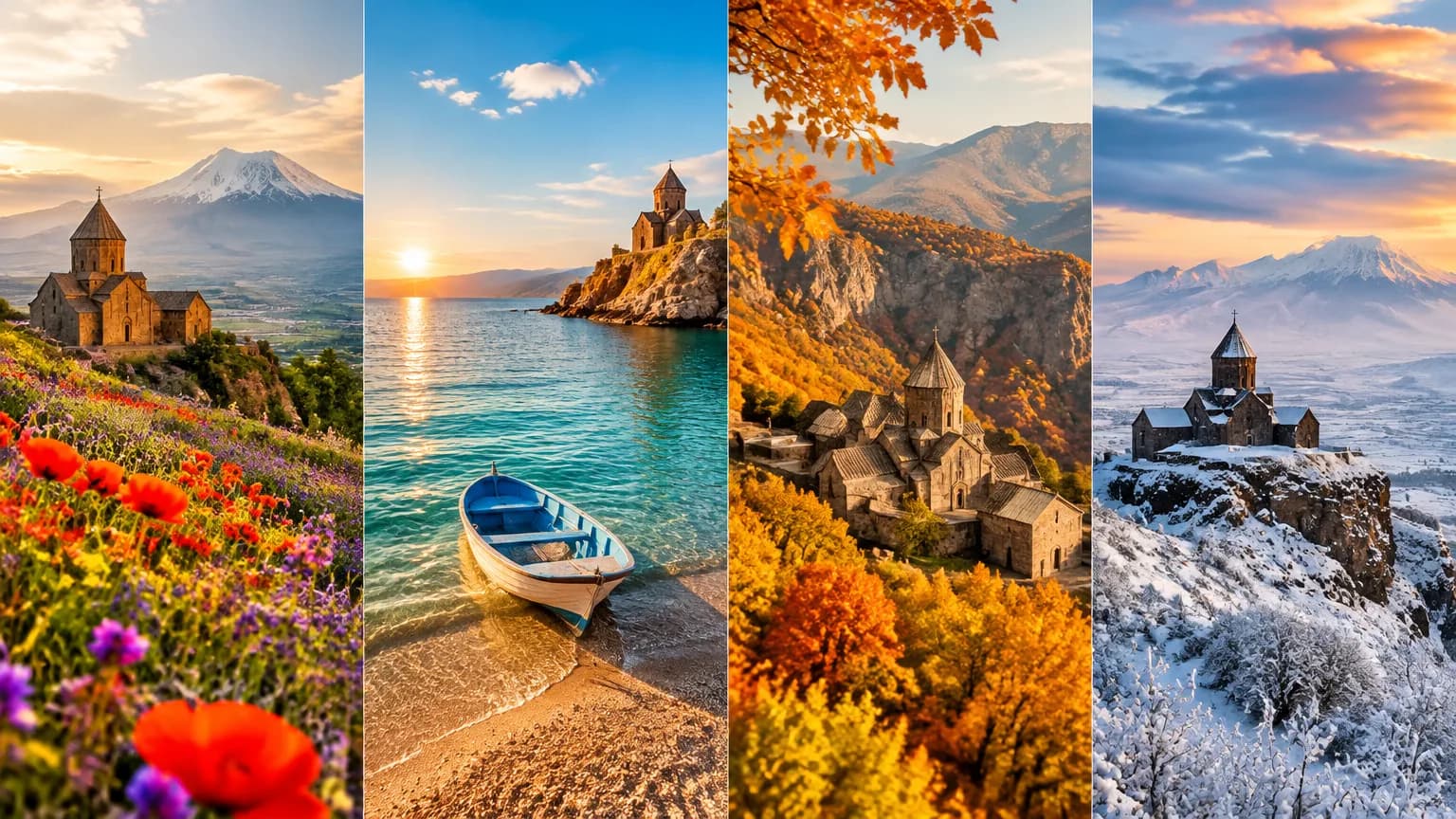
The best time to visit Armenia from India is April to June and September to October, when skies are clear, temperatures stay between 18°C and 28°C, and the countryside is at its most accessible. Crowds are moderate, flights from Indian cities connect via Dubai or Istanbul, and prices are reasonable compared to peak summer.
What is the month-by-month breakdown of weather and travel conditions in Armenia?
Armenia's climate shifts noticeably across twelve months, from frozen winters in Yerevan to warm, dry summers and cool, colourful autumns. Indian travellers planning a trip in 2026 should match their travel style — sightseeing, wine, hiking, or budget — to the right window. The table below covers average temperatures, rainfall, crowd levels, price bands, and the primary reason to travel each month.
| Month | Avg Temp (°C) | Rainfall | Tourist Crowd | Price Level | Best For |
|---|---|---|---|---|---|
| January | -5 to 2 | Low (snow) | Very Low | Low | Skiing at Tsakhkadzor, budget stays |
| February | -4 to 4 | Low (snow) | Very Low | Low | Ski season, quiet monastery visits |
| March | 2 to 10 | Moderate | Low | Low–Moderate | Early spring, apricot blossom start |
| April | 8 to 18 | Moderate | Moderate | Moderate | Wildflowers, Noravank canyon, hiking |
| May | 13 to 23 | Moderate | Moderate–High | Moderate | Sightseeing, Dilijan forests, wine tours |
| June | 18 to 28 | Low | High | Moderate–High | Long days, Garni gorge, outdoor dining |
| July | 22 to 34 | Very Low | Peak | High | Festivals, Lake Sevan, Ararat views |
| August | 21 to 33 | Very Low | Peak | High | Wine harvest start, Yerevan nightlife |
| September | 15 to 26 | Low | Moderate–High | Moderate | Grape harvest, wine festivals, cooler days |
| October | 9 to 18 | Moderate | Moderate | Moderate | Autumn foliage, Tatev monastery, value stays |
| November | 2 to 10 | Moderate | Low | Low–Moderate | Quiet travel, indoor museums, local life |
| December | -3 to 4 | Low (snow) | Low | Low | Christmas markets, Tsakhkadzor ski opening |
Climate data for Yerevan is recorded at Yerevan Zvartnots International Airport weather station (ICAO: UDYZ), which the Armenian State Hydrometeorological and Monitoring Service uses as the primary reference point for the Ararat Valley. Temperatures in Dilijan and Vanadzor in northern Armenia typically run 4–6°C cooler than Yerevan in summer.
When is peak season in Armenia and what should Indian travellers know before booking?
Peak season in Armenia runs from July through August, when daily temperatures in Yerevan reach 32–34°C, international tourist arrivals are highest, and hotels in central Yerevan charge a 30–40% premium over shoulder-season rates. Indian travellers booking in this window should reserve accommodation and guided tours at least 8–10 weeks in advance.
July and August are the driest months in Armenia, with Yerevan recording fewer than 15 mm of rainfall across both months combined. Lake Sevan, Armenia's largest freshwater lake at 1,900 metres above sea level, becomes the primary escape from city heat. Sevan's water temperature reaches 20–22°C in late July, making it suitable for swimming. The drive from Yerevan to Lake Sevan takes approximately 65 kilometres via the M4 highway.
The Yerevan Wine Days festival runs in late May and draws significant crowds, but July and August see the highest overall footfall at sites like Geghard Monastery, Garni Temple, and the Cascade complex in Yerevan. Guided tours to Khor Virap monastery, which sits 8 kilometres from the Turkish border and offers direct views of Mount Ararat at 5,137 metres, are heavily booked in peak season. Indian travellers who want a quieter Khor Virap visit should target early morning departures before 8 AM.
Flight prices from Indian cities — primarily Delhi, Mumbai, and Bengaluru — to Yerevan Zvartnots Airport peak in July and August. Connecting routes via flydubai from Delhi, Air Arabia from Mumbai, or Turkish Airlines via Istanbul are the most common options for Indian passengers. Booking 10–12 weeks ahead for July travel typically saves 20–30% on airfare compared to last-minute fares.
When is shoulder season in Armenia and why does it offer the best value for Indians?
Shoulder season in Armenia covers April to June and September to October, when temperatures are comfortable between 10°C and 26°C, crowds are lighter than peak summer, and hotel rates in Yerevan run 20–30% below July–August levels. These four months give Indian travellers the most practical combination of good weather, open attractions, and reasonable pricing.
April is when apricot trees bloom across the Ararat Valley, a sight that lasts roughly two to three weeks from mid-April. The apricot is Armenia's national symbol, and the Ararat Valley's orchards near Artashat district are the most accessible from Yerevan, about 30 kilometres south. May extends the pleasant weather and adds the Yerevan Wine Days festival, typically held over a long weekend in late May at Republic Square.
September is arguably the single strongest month for Indian travellers combining sightseeing with food and wine. The grape harvest in the Areni wine region, located in the Vayots Dzor province approximately 120 kilometres from Yerevan, runs from mid-September through early October. Areni-1 cave, near the village of Areni, is the site where a 6,100-year-old winery was discovered — the oldest known winery in the world. The Areni Wine Festival takes place annually in early October in the same village.
October adds autumn colour to Dilijan National Park in the Tavush region, which covers 28,000 hectares of mixed forest. The Haghartsin and Goshavank monasteries inside the park are far less crowded in October than in summer. Tatev Monastery in Syunik province, reached via the Wings of Tatev aerial tramway — 5.7 kilometres long, one of the world's longest reversible cable cars — is also quieter and more accessible in October.
When is off-season in Armenia and what still works for Indian travellers?
Off-season in Armenia runs from November through March, when temperatures in Yerevan drop to -5°C at night, snowfall is common above 1,500 metres, and most outdoor attractions operate on reduced hours or close entirely. Hotel rates fall to their lowest, and Indian travellers on tight budgets can find central Yerevan guesthouses for significantly less than shoulder-season prices.
The primary off-season draw is skiing at Tsakhkadzor Ski Resort, located 50 kilometres north of Yerevan in the Kotayk province at an elevation of 1,966–2,819 metres. Tsakhkadzor's ski season typically runs from December through March, with 23 kilometres of groomed slopes and a gondola system. Day ski passes and equipment rental are available on-site. This is a practical option for Indian travellers who want a ski trip without the cost of Austria or Switzerland.
Yerevan's indoor attractions remain fully open year-round. The History Museum of Armenia on Republic Square, the Matenadaran manuscript repository on Mesrop Mashtots Avenue — which holds over 23,000 ancient manuscripts — and the Armenian Genocide Memorial at Tsitsernakaberd are all accessible in winter. The Cascade art complex, a giant stairway connecting central Yerevan to the Monument neighbourhood, is walkable in winter and houses the Cafesjian Museum of Art across seven indoor gallery levels.
Safety in Armenian winters is generally not a concern for Indian travellers. Roads between major cities are maintained, though mountain passes like the Selim Pass in Vayots Dzor (2,410 metres) can close in heavy snow. Travellers planning monastery circuits in Gegharkunik or Syunik provinces in January or February should confirm road conditions locally before departure.
What festivals and events should Indian travellers plan around in Armenia in 2026?
Armenia's festival calendar in 2026 includes cultural, religious, and wine events spread across the year, several of which align well with Indian travel preferences around long weekends and school holidays. The table below lists key events, their typical dates, and booking requirements.
| Festival / Event | Typical Date (2026) | Why Indians Find It Relevant | Advance Booking Needed? |
|---|---|---|---|
| Vardavar (Water Festival) | Late July (98 days after Easter) | Public water-throwing festival similar in energy to Holi; held across all cities | No, but book hotels 6–8 weeks ahead |
| Yerevan Wine Days | Late May (Republic Square) | Armenian wine tasting, food stalls, live music; entry typically free | No ticket needed; accommodation books fast |
| Areni Wine Festival | First weekend of October | Harvest festival in the world's oldest wine region; local food and folk music | No ticket; transport from Yerevan fills up |
| Yerevan Jazz Festival | October (Aram Khachaturian Concert Hall) | International jazz acts; indoor venue suits October weather | Yes — tickets sell out 3–4 weeks ahead |
| Navasard (Armenian New Year) | 11 August | Ancient Armenian calendar new year; street celebrations in Yerevan | No |
| Armenian Apostolic Christmas | 6 January | Theophany and Christmas combined; candlelit church services across the country | No, but January is cold |
| Republic Day | 28 May | Military parade and public events in Yerevan; good for photography | No |
Vardavar deserves special mention for Indian travellers. The festival's roots are pre-Christian, tied to the goddess Astghik, and the tradition of dousing strangers with water has survived into modern Armenia. The event runs for one full day and is most active in Yerevan's central districts. Indian families travelling with children consistently rate Vardavar as a highlight of an Armenia trip.
What is the best time to visit Armenia from India for specific travel purposes?
The right travel window in Armenia depends on whether the trip is a honeymoon, a family holiday, an adventure-focused itinerary, or a budget trip. Each purpose aligns with a different seasonal window, and the differences in experience are significant enough to plan around.
When should Indian couples visit Armenia for a honeymoon?
May and September are the strongest months for honeymoon travel to Armenia. May brings mild weather, blooming landscapes in the Ararat Valley, and the Yerevan Wine Days festival. September offers the grape harvest in Areni, cooler evenings in Yerevan, and fewer crowds at romantic sites like Noravank Monastery — a 13th-century red-stone church set inside a narrow canyon in Vayots Dzor. Cave hotels and boutique guesthouses in the Areni and Yeghegnadzor areas are best booked 4–6 weeks ahead for September travel.
When is Armenia best for Indian families travelling with children?
June and early July work well for Indian families. School summer holidays align with this window, temperatures are warm but not extreme, and Lake Sevan is accessible for outdoor activities. The Children's Railway in Yerevan's Malatia-Sebastia district, a narrow-gauge railway operated partly by children as a training facility, is a practical half-day activity for families. Tsakhkadzor, known primarily as a ski resort, also has a summer gondola ride and walking trails suitable for children above age 6.
When is the best time for adventure and outdoor activities in Armenia?
April through June is the primary window for trekking and outdoor adventure in Armenia. The Transcaucasian Trail passes through Armenia, with sections in Dilijan National Park and Khosrov Forest State Reserve — one of the oldest protected areas in the world, established in the 4th century AD and covering 29,196 hectares south of Yerevan. Mountain biking routes around Lake Sevan are accessible from May. Rafting on the Debed River in Lori province is possible from April through June when water levels are adequate.
When should budget-conscious Indian travellers visit Armenia?
November, February, and March offer the lowest prices across flights, hotels, and tours. A 5-night Yerevan-based trip in February can cost 35–40% less than the same itinerary in July. The trade-off is cold weather and limited outdoor access. Indian travellers who prioritise museums, food, wine, and city walks over outdoor sightseeing will find the off-season perfectly functional. Yerevan's restaurant scene, centred around the Northern Avenue and Abovyan Street areas, operates year-round without seasonal closures.
How does Armenia's travel timing compare to Georgia for Indian travellers planning a Caucasus trip?
Georgia, specifically Tbilisi and the Kazbegi region, is the most common alternative destination Indian travellers consider alongside Armenia. Both countries share similar seasonal patterns, but there are meaningful differences that affect timing decisions.
Georgia's peak season also runs July through August, but Tbilisi summers are slightly more humid than Yerevan due to Georgia's proximity to the Black Sea. The Kazbegi mountain region in Georgia, at 1,740 metres elevation, stays cooler in summer and is the primary draw for Indian travellers seeking mountain scenery. Kazbegi is accessible by road from Tbilisi in approximately 3 hours via the Georgian Military Highway, which closes in heavy winter snow — typically December through February.
For Indian travellers combining both countries, the most practical itinerary runs in May or September. A 10-night trip can cover Yerevan, Khor Virap, and Noravank in Armenia (4 nights), then cross into Georgia by road via the Bagratashen border crossing and continue to Tbilisi and Kazbegi (6 nights). Both countries are visa-free for Indian passport holders as of 2025, which simplifies the logistics considerably. September gives the added advantage of Armenia's wine harvest before crossing into Georgia, where the Kakheti wine region harvest runs slightly later in October.
Budget comparison: Armenia is generally 10–15% cheaper than Georgia for mid-range accommodation and restaurant meals. Yerevan's restaurant prices on Northern Avenue are lower than comparable Tbilisi options in the Old Town. For Indian travellers on a fixed budget, starting with Armenia and ending in Georgia is the more cost-efficient sequence.
What are the key climate data points and airline routes Indians should know before booking Armenia in 2026?
Yerevan Zvartnots International Airport (IATA: EVN) is the primary entry point for international travellers. The airport sits at 858 metres above sea level in the Ararat Valley, and its weather station provides the baseline climate data most travel guides reference for Armenia.
Annual rainfall in Yerevan averages 318 mm, concentrated in April–May and October–November. Yerevan receives approximately 2,700 hours of sunshine annually, making it one of the sunniest capitals in the broader European region. The city's continental climate means temperature swings between day and night can reach 12–15°C even in summer, so Indian travellers should carry a light jacket regardless of the travel month.
As of early 2025, direct or single-stop connections from India to Yerevan include: flydubai from Delhi via Dubai (approximately 7–8 hours total travel time), Air Arabia from Mumbai via Sharjah, and Turkish Airlines from multiple Indian cities via Istanbul. Fly One and Wizz Air Abu Dhabi also operate seasonal routes into EVN. IndiGo and Air India do not operate direct services to Yerevan as of this writing. Indian travellers should check for new route announcements for the 2026 summer season, as Yerevan has seen increased connectivity from Gulf hub carriers since 2022.
The Armenian dram (AMD) is the local currency. As of 2025, 1 Indian Rupee equals approximately 4.8–5.0 AMD. Currency exchange is available at Zvartnots Airport and at exchange kiosks throughout central Yerevan. Most Yerevan hotels and restaurants accept Visa and Mastercard. Cash is preferred in rural areas, including the Areni wine region and Tatev village.