
Field notes
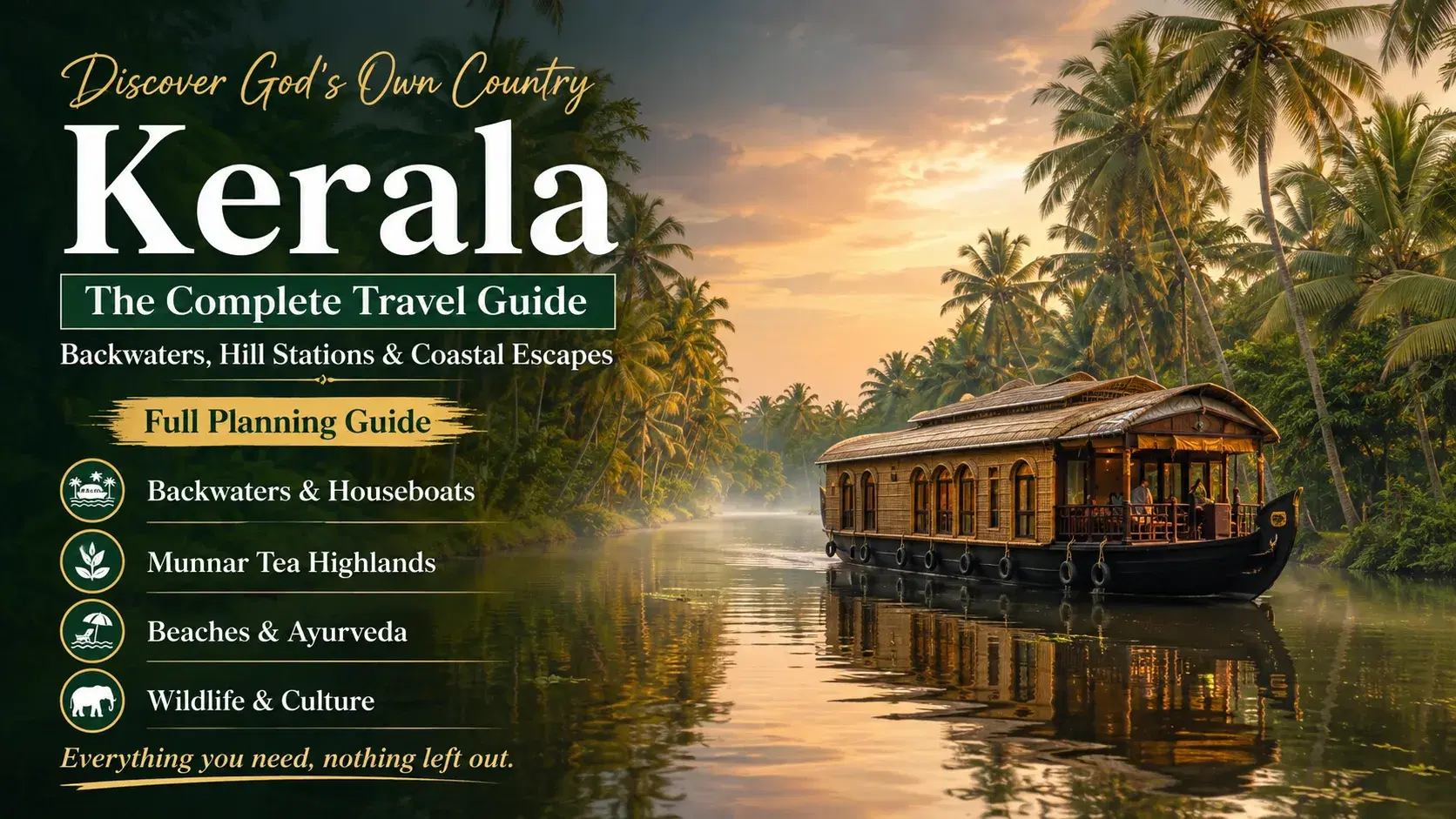
Complete Kerala Travel Guide: Everything You Need to Know
Kerala is a 38,852 sq km state on India's southwestern coast, bordered by the Western Ghats to the east and the Arabian Sea to the west. This kerala travel guide applies the ZEST Framework to help travelers sequence geographic zones, calibrate travel season, and map days against budget — replacing the common mistake of building a Kerala itinerary around a random list of attractions.
Why does planning matter more for Kerala than for most Indian destinations?
Kerala demands more deliberate planning than most Indian destinations because its four geographic zones span a wide corridor where poor sequencing creates 300–400 km of unnecessary road travel, seasonal windows are narrow, and peak-season inventory for houseboats and Ayurveda resorts sells out weeks in advance.
Kerala's 14 districts stretch roughly 580 km from Kasaragod in the north to Thiruvananthapuram in the south. A traveler who visits Munnar, then Alleppey, then Wayanad without a logical sequence covers over 300 km of backtracking. Zone sequencing is the single highest-impact planning decision for a Kerala trip.
Kerala operates across three distinct seasons. Each season changes the experience quality, not just the weather. Peak season runs October through March. Shoulder season covers April–May and September. Monsoon season spans June through August.
Monsoon travel involves real tradeoffs. Hill trails in Wayanad and Silent Valley become hazardous and leech-prone from June onward. Kovalam and Varkala beaches carry active swimming bans during the southwest monsoon. Houseboat availability on Vembanad Lake drops sharply in this period.
Monsoon does carry advantages. Ayurveda practitioners consider the monsoon months optimal for Panchakarma treatments. Humidity opens skin pores, improving absorption of herbal oils. Prices fall 30–40% across most accommodation categories.
During peak December–January, overnight houseboat bookings on the Alleppey backwaters require 4–8 weeks of advance notice. Travelers who book within one week of arrival typically find only day-trip vessels available. The overnight and day-trip experiences are not equivalent.
Kerala records a literacy rate of approximately 96%, the highest among all Indian states, according to Census of India data. This directly correlates with traveler infrastructure quality — English signage, trained hospitality staff, and reliable transport information are more consistent here than in most Indian destinations.
Solo female travelers consistently rate Kerala among India's safer destinations. National Crime Records Bureau data places Kerala below the national average for crimes against women per lakh population. Well-lit public spaces, active KSRTC bus networks, and app-cab availability in major towns contribute to this profile.
How does a Kerala trip work logistically from arrival to departure?
A Kerala trip typically begins at one of three international airports and moves through the state using a combination of trains, buses, hired cars, and houseboats. Logical entry-to-exit sequencing reduces total road travel and prevents the backtracking that costs travelers one to two full days.
Why does Kerala matter for Indian travellers?
Kerala matters for Indian travellers because it delivers four geographically distinct experiences within a single state boundary. Coastal beaches, backwater networks, hill stations, and wildlife reserves are all accessible without an international flight or a lengthy cross-country journey.
Kerala is a 38,852 sq km state on India's southwestern coast. No other Indian state of comparable size compresses this range of terrain into a single contiguous travel circuit. The Western Ghats form the eastern boundary. The Arabian Sea defines the western edge.
For Indian travellers specifically, Kerala removes the visa and foreign-exchange friction that comparable multi-terrain destinations require. Rajasthan offers desert and heritage. Himachal offers mountains. Kerala offers both water and elevation within a four-hour drive.
The state's infrastructure also sets Kerala apart from most domestic alternatives. Kerala's literacy rate of approximately 96% produces a hospitality workforce with consistent English communication ability. Transport signage, ticketing systems, and app-cab availability function reliably across all 14 districts.
Kerala is also the primary Ayurvedic treatment hub under India's AYUSH Ministry framework. Indian travellers seeking medically supervised Panchakarma programs find Kerala's certified resort network unmatched domestically. The Green Leaf and Olive Leaf certification scheme, operated by Kerala Tourism, provides a verifiable quality filter that most Indian wellness destinations lack.
Cultural continuity is a further draw. Kathakali, a classical dance-drama form originating in the 17th century, and Theyyam, a ritualistic art form with over 400 distinct forms practiced in northern Kerala, are living traditions rather than staged tourist performances. The Kerala Sadhya, a vegetarian feast of 24 to 28 dishes served on banana leaf, remains central to daily ceremonial life.
For Indian travellers building a first serious domestic itinerary, Kerala functions as a complete destination rather than a single-experience stop.
How do you use the ZEST Kerala Planning Framework to build a kerala travel guide for your trip?
The ZEST Kerala Planning Framework structures a Kerala trip across four components: Zone Sequencing, Experience Layering, Season Calibration, and Time-Budget Mapping. Travelers input their available days, budget, and priority experiences to produce a logical, backtrack-free itinerary.
Step 1 — Zone Sequencing: Establish a geographic spine before booking anything
Zone Sequencing is the first ZEST component. Zone Sequencing assigns each Kerala district to one of four geographic zones: Coastal, Backwater, Hill, or Wildlife.
The practical output is a south-to-north or north-to-south travel spine that eliminates redundant road kilometers. A traveler flying into Cochin and out of Trivandrum, for example, moves logically through Backwater, then Coastal zones without retracing ground.
Munnar, situated at approximately 1,600 m elevation in Idukki district, anchors the Hill zone. Alleppey anchors the Backwater zone on Vembanad Lake, which covers 2,033 sq km. Thekkady anchors the Wildlife zone within Periyar Tiger Reserve's 925 sq km boundary. Kovalam anchors the Coastal zone in Thiruvananthapuram district.
Sequencing these four anchors in a single directional arc reduces total road travel by 200–300 km compared to an unplanned attraction-list approach.
Step 2 — Experience Layering: Match activity type to the correct zone and season
Experience Layering is the second ZEST component. Experience Layering prevents travelers from booking wellness, adventure, cultural, and nature activities in zones where those experiences deliver lower quality.
Panchakarma Ayurveda programs, which range from 7-day to 28-day residential packages, perform best in the Coastal zone during the monsoon window. Ayurvedic texts specify that the monsoon season — when humidity opens skin pores — maximizes treatment absorption. Booking a Panchakarma program in a hill resort during peak season misaligns both zone and season.
Kathakali performances, originating in 17th-century Kerala, are concentrated in Thrissur and Ernakulam districts within the Backwater-adjacent cultural corridor. Theyyam rituals, with over 400 distinct forms, occur exclusively in northern Kerala's Malabar region between November and May.
Step 3 — Season Calibration: Align travel dates to traveler priorities
Season Calibration is the third ZEST component. Season Calibration prevents travelers from arriving during a season that structurally conflicts with their primary experience goal — a mistake that no amount of good zone sequencing can correct.
Kerala operates across three distinct seasonal windows. Peak season (October to March) delivers the highest experience quality for beach, backwater, and wildlife activities. Shoulder season (April to May and September) offers reduced pricing with acceptable conditions in coastal and backwater zones. Monsoon season (June to August) closes most hill trails and suspends swimming at Kovalam and Varkala due to rip currents and official beach bans.
Travelers prioritizing Ayurveda should apply an inverse logic. Monsoon season is the clinically preferred window for Panchakarma programs, as elevated humidity maximizes treatment absorption. Booking a 14-day Ayurveda program during peak season is a Season Calibration failure — the therapeutic outcome is measurably lower.
Step 4 — Time-Budget Mapping: Allocate days and rupees per zone by traveler profile
Time-Budget Mapping is the fourth and final ZEST component. Time-Budget Mapping converts the zone sequence and season decision into a concrete day-count and per-zone rupee allocation, matched to one of three traveler profiles.
A budget backpacker allocates roughly 2–3 days and INR 1,500–2,500 per day per zone. A mid-range couple allocates 3–4 days and INR 5,000–9,000 per day per zone. A luxury family allocates 4–5 days and INR 18,000–35,000 per day per zone, accounting for premium houseboat and Green Leaf-certified resort pricing.
Time-Budget Mapping also flags inter-zone transfer costs, which travelers consistently underestimate. Road travel between hill sections — particularly the Munnar to Thekkady corridor — averages 3–4 hours due to gradient and road quality, consuming a meaningful share of a short itinerary.
What are the most common mistakes when planning a Kerala travel guide?
The most common Kerala planning mistakes are over-zoning short itineraries, ignoring monsoon-specific trail and beach closures, booking day-trip houseboats instead of overnight stays, and skipping Green Leaf certification checks for Ayurveda resorts — each mistake compounds cost and reduces experience quality.
Why does visiting too many zones in too few days backfire?
Kerala's four geographic zones span a combined road distance that punishes unsequenced itineraries. An unplanned Munnar–Alleppey–Wayanad loop generates over 300 km of redundant road travel. That distance consumes roughly two full travel days on hill-grade roads. Two lost days in a 7-day trip represent nearly 30% of available time.
Kerala's backwater and hill zones are slow-travel environments by nature. Rushing through Alleppey in a half-day to reach the next destination eliminates the core experience the zone offers.
How does ignoring the monsoon calendar affect the experience?
Wayanad and Silent Valley National Park trails become hazardous between June and August due to rainfall exceeding 2,500 mm annually in Wayanad district. Kovalam and Varkala beaches carry active swimming bans during the southwest monsoon due to rip currents. Travelers who book coastal or hill itineraries for June–August without adjusting plans face closed attractions and safety restrictions.
Monsoon travel does carry genuine advantages. Ayurveda treatment efficacy is higher during monsoon months. Accommodation prices drop 30–50% below peak-season rates. Crowd density at major sites falls sharply.
What booking mistakes cost travelers the most money and time?
Booking a day-trip houseboat instead of an overnight stay is the single most reported Kerala regret among repeat visitors. A day-trip covers 4–5 hours on the Vembanad Lake network. An overnight stay includes sunset, dinner, and dawn on the backwaters — the experiences that define the zone.
Not verifying Kerala Tourism's Green Leaf certification before booking an Ayurveda resort exposes travelers to facilities without certified therapists or standardized Panchakarma protocols. The Green Leaf scheme, operated by Kerala Tourism under the AYUSH Ministry framework, is the primary quality signal for residential wellness stays.
How do you use the ZEST Kerala Planning Framework to build a kerala travel guide for your trip?
The ZEST Kerala Planning Framework structures a trip across four components: Zone Sequencing, Experience Layering, Season Calibration, and Time-Budget Mapping. Travelers input their available days, budget, and priority experiences. The framework outputs a sequenced itinerary with minimal backtracking and accurate cost allocation.
The ZEST Framework addresses the core planning failure most travelers make. That failure is selecting destinations from a list without a geographic or seasonal logic connecting them.
Zone Sequencing establishes the travel spine first. A south-to-north flow runs Kovalam (Coastal) to Alleppey (Backwater) to Munnar (Hill) to Wayanad (Wildlife). A north-to-south flow reverses that sequence. Either direction eliminates the 300-plus km backtracking that unsequenced itineraries produce.
Experience Layering assigns activity types to the correct zone. Ayurveda residential programs belong in the Coastal or Backwater zone. Wildlife safaris belong in Periyar or Wayanad. Cultural performances — Kathakali and Theyyam — anchor the Coastal and northern zones respectively. Assigning experiences to the wrong zone forces detours.
Season Calibration aligns the chosen zone sequence to the traveler's travel window. Peak season (October to March) supports all four zones fully. Shoulder season (April to May, September) suits Coastal and Backwater zones. Monsoon season (June to August) favors Ayurveda-focused Coastal stays and reduces Hill and Wildlife zone access.
Time-Budget Mapping allocates days and rupee spend per zone. A 10-day mid-range trip distributes roughly as follows: two days Coastal, three days Backwater, three days Hill, two days Wildlife. Daily mid-range spend averages INR 4,000 to INR 7,000 per person including accommodation, meals, and local transport.
The ZEST Framework converts a destination list into a decision sequence. Each component answers one planning question before the next component is applied.
How do you use the Tripstor Planning Framework to build a kerala travel guide for your trip?
The Tripstor Planning Framework applies the four ZEST components in sequence to convert a destination wish list into a structured Kerala itinerary. Each component filters one planning variable, so the final output is a zone-sequenced, season-aligned, budget-mapped trip plan.
Travelers begin by submitting their travel window, budget range, and experience priorities. The framework then assigns geographic zones in a logical south-to-north or north-to-south flow. The output is a day-by-day zone sequence with allocated spend per zone, eliminating the backtracking that unsequenced itineraries produce.
Zone Sequencing is applied first. The framework maps the traveler's entry airport to the nearest zone. A traveler arriving at Cochin (COK) enters the Coastal or Backwater zone directly. A traveler arriving at Trivandrum (TRV) enters the Coastal zone at the southern end.
Experience Layering is applied second. The framework matches each requested experience type to the correct zone. Ayurveda residential programs are assigned to the Coastal zone. Wildlife safaris are assigned to Periyar or Wayanad. Kathakali performances are anchored in the Coastal zone. Theyyam rituals are anchored in the northern Malabar zone.
Season Calibration is applied third. The framework cross-checks the travel window against Kerala's three seasons. Peak season supports all four zones. Monsoon season restricts the Hill and Wildlife zones and redirects days toward Ayurveda-focused Coastal stays.
Time-Budget Mapping is applied last. The framework allocates days and INR spend per zone based on the traveler's profile. A 10-day mid-range trip distributes roughly as: two days Coastal, three days Backwater, three days Hill, two days Wildlife. Daily mid-range spend averages INR 4,000 to INR 7,000 per person.
ZEST Framework: Zone-by-Zone Planning Reference | ||
Zone | ZEST Components Applied | Practical Output for Traveler |
|---|---|---|
Coastal Zone (Kovalam, Varkala, Kochi) | Zone Sequencing: entry or exit anchor. Experience Layering: Ayurveda, Kathakali, beach. Season Calibration: avoid southwest monsoon swimming bans. Time-Budget Mapping: INR 3,500–6,000 per person per day (mid-range). | Traveler arriving at TRV begins here. Two to three days allocated. Ayurveda consultations booked on day one. Kathakali performance scheduled for evening of day two. |
Backwater Zone (Alleppey, Kumarakom) | Zone Sequencing: mid-trip placement between Coastal and Hill zones. Experience Layering: overnight houseboat on Vembanad Lake. Season Calibration: peak season requires 4–8 weeks advance booking. Time-Budget Mapping: INR 5,000–12,000 per houseboat night (mid-range to premium). | Traveler transitions from Coastal zone via NH 66. Overnight houseboat replaces hotel accommodation. Day-trip houseboats are excluded — overnight stay is the minimum viable experience in this zone. |
Hill Zone (Munnar, Wayanad) | Zone Sequencing: interior placement, accessed after backwater days. Experience Layering: tea estate walks, tribal village visits, trekking. Season Calibration: June–August trails restricted; shoulder season (September) viable. Time-Budget Mapping: INR 3,000–5,500 per person per day (mid-range). | Traveler gains elevation from sea level to approximately 1,600 m at Munnar. Road quality on hill sections adds 30–40 minutes per 50 km. Buffer day built into schedule absorbs transfer delays. |
Wildlife Zone (Periyar, Silent Valley) | Zone Sequencing: final zone before departure airport. Experience Layering: boat safari on Periyar Lake, guided forest walks. Season Calibration: peak season (October–March) maximises wildlife sighting probability. Time-Budget Mapping: INR 4,000–7,000 per person per day including safari fees. | Traveler exits Wildlife Zone toward Cochin (COK) or Trivandrum (TRV) depending on entry point. Periyar Tiger Reserve covers 925 sq km and supports Bengal tiger and Indian elephant populations. |
How does a worked example apply the ZEST Kerala Planning Framework to a real trip budget?
A worked ZEST example translates the four framework components into concrete numbers. A 10-day mid-range couple trip sequenced across three zones — Coastal, Backwater, and Hill — produces a predictable cost and itinerary structure with minimal backtracking.
The following example uses a couple traveling in shoulder season (September), entering via Cochin International Airport (IATA: COK) and exiting via Trivandrum International Airport (IATA: TRV).
How do the four ZEST components translate into a 10-day itinerary with real numbers?
Zone Sequencing places Coastal Zone (Kovalam, Varkala) first, Backwater Zone (Alleppey) second, and Hill Zone (Munnar) third. This south-to-north flow eliminates backtracking entirely. Total road distance covered: approximately 320 km across 10 days.
Experience Layering assigns beach and Ayurveda activities to Days 1–3, houseboat and village experiences to Days 4–6, and tea estate walks with trekking to Days 7–10. Each zone receives its highest-value experience type.
Season Calibration for September means reduced houseboat pricing (approximately 20–25% below peak rates) and viable hill trails. Kovalam beach swimming carries a rip-current advisory in early September; travelers substitute coastal walks and Ayurveda sessions instead.
Time-Budget Mapping produces the following per-zone allocation for two people:
Zone | Days Allocated | Accommodation Cost (INR, 2 persons) | Activities + Meals (INR, 2 persons) | Transport (INR) | Zone Total (INR) |
|---|---|---|---|---|---|
Coastal (Kovalam) | 3 | 6,000–9,000 | 4,500–6,000 | 1,200 | 11,700–16,200 |
Backwater (Alleppey) | 3 | 9,000–12,000 (overnight houseboat x1 + guesthouse x2) | 3,500–5,000 | 800 | 13,300–17,800 |
Hill (Munnar) | 4 | 10,000–16,000 | 6,000–8,000 | 2,500 | 18,500–26,500 |
10-Day Total | 10 | 25,000–37,000 | 14,000–19,000 | 4,500 | 43,500–60,500 |
Flights (COK arrival, TRV departure) add INR 8,000–14,000 per person from major Indian metros in shoulder season. The total trip cost for two travelers lands between INR 59,500 and INR 88,500, or approximately INR 3,000–4,400 per person per day all-inclusive.
This worked example confirms that the ZEST Kerala Planning Framework converts abstract components into a bookable, budgeted itinerary without requiring travelers to calculate logistics from scratch.
What advanced strategies do experts use when planning a Kerala trip?
Experienced Kerala travelers apply four strategies that most first-time visitors overlook: reverse-sequencing zones to avoid peak-crowd overlap, booking accommodation by certification tier before fixing dates, using train segments to replace road transfers between coastal and backwater zones, and pre-scheduling Ayurveda consultations at least three weeks in advance.
The first advanced strategy is reverse zone entry. Most itineraries flow south to north, meaning Kovalam, then Alleppey, then Munnar. Expert travelers invert this sequence during December and January, entering via Cochin International Airport (IATA: COK) and moving north to south. This approach places travelers in Munnar and Wayanad before peak-season crowds peak in the coastal zone.
The second strategy involves anchoring bookings to Kerala Tourism's Green Leaf certification tier. Green Leaf properties meet verified environmental and service standards. Booking by certification tier — rather than by price alone — reduces the risk of misrepresented Ayurveda programs and substandard houseboat operators.
The third strategy is substituting the Ernakulam–Alleppey train segment for road transfer. The rail journey covers approximately 55 km in under 90 minutes. Road transfer on the same route can extend to three hours during peak season due to NH 66 congestion near Kochi.
The fourth strategy applies specifically to wellness travelers. Panchakarma programs at certified Kerala Ayurveda resorts require a physician consultation before treatment begins. Travelers who contact resorts three to four weeks before arrival can complete intake forms remotely. This removes one to two days of on-site assessment time from a 7-day program.
Each of these strategies operates within the ZEST Kerala Planning Framework's Zone Sequencing and Experience Layering components, converting general planning intent into specific, time-saving decisions.
What advanced strategies do experienced Kerala travelers apply in the second half of a trip?
Experienced Kerala travelers apply four additional strategies in the second half of a trip: consolidating hill-zone days around a single base, using ferry connections where available, pre-booking wildlife safari slots, and building a buffer day before departure.
The fifth strategy involves base-camping in Munnar rather than moving between hill properties. Munnar sits at approximately 1,600 m elevation in Idukki district. Travelers who stay in one Munnar property for three nights can reach Eravikulam National Park, Mattupetty Dam, and Top Station as day excursions. This eliminates two check-in and check-out cycles and reduces luggage handling time.
The sixth strategy uses the Alleppey–Kollam ferry route as a transit option. The Kerala State Water Transport Department operates this service across Vembanad Lake and connecting waterways. The journey covers approximately 96 km over eight hours. Travelers who align this transit day with a rest day convert a logistics cost into a backwater experience at no additional activity spend.
The seventh strategy applies to Periyar Tiger Reserve visits. Periyar Tiger Reserve covers 925 sq km in Thekkady, Idukki district. The Kerala Forest Department releases a limited number of bamboo rafting and border hiking permits each day. Travelers who book these permits online at least two weeks before arrival avoid the common outcome of arriving at Thekkady and finding all activity slots filled.
The eighth strategy is scheduling a buffer day before the departure airport. Road travel from Munnar to Cochin International Airport covers approximately 130 km. Hill road conditions and NH 85 traffic near Kochi can extend this journey beyond four hours during peak season. A buffer night in Kochi removes flight-miss risk entirely.
Together, these eight strategies complete the ZEST Kerala Planning Framework's Time-Budget Mapping component, converting a planned itinerary into a resilient, executable travel sequence.
Conclusion: Applying the ZEST Kerala Planning Framework to Your Trip
The ZEST Kerala Planning Framework consolidates every decision layer in this kerala travel guide into four executable components: Zone Sequencing, Experience Layering, Season Calibration, and Time-Budget Mapping. Travelers who apply all four components reduce backtracking, avoid booking errors, and align their itinerary to Kerala's distinct seasonal windows.
Each section of this guide maps directly to one ZEST component. Zone Sequencing prevents the most common and costly planning error — building an itinerary around a random attraction list rather than geographic logic. Season Calibration ensures travelers arrive when their chosen zones deliver the highest experience quality. Time-Budget Mapping converts a planned route into a resilient, day-by-day sequence with realistic cost expectations per traveler profile.
Kerala rewards deliberate planning. Travelers who treat this guide as a decision framework rather than a checklist consistently report higher satisfaction across all four geographic zones.
Ready to Plan Your Trip?
Tripstor's Kerala travel specialists apply the ZEST Kerala Planning Framework to build itineraries that match your zone preferences, travel season, and budget — eliminating the sequencing errors and booking gaps that most travelers encounter when planning independently.
Speak directly with a Kerala travel consultant to confirm zone sequencing, seasonal availability, and a day-by-day cost estimate tailored to your traveler profile.
Call Tripstor: +91-9825343323— Kerala travel planning consultations are available seven days a week, with dedicated support for both first-time visitors and repeat travelers seeking deeper regional coverage.