
Field notes
Bali Visa for Indians 2026 — Complete Guide
Quick answer
The Bali visa for Indians is issued on arrival at certain Indonesian Immigration Checkpoints — no advance appointment or embassy visit is needed. Indian passport holders receive a Visitor Visa (Visa on Arrival) that allows a maximum stay of 30 days, single-entry. Alternatively, an e-VOA can be requested online before travel through the official Indonesian e-Visa website.
Arrival visa for Bali: the essentials
Every confirmed field for this visa route is listed below, based on the official government portal.
| On arrival | What to expect |
|---|---|
| Visa category | Visa on arrival |
| Visa type | Visitor Visa (Visa on Arrival) |
| Maximum stay | 30 days |
| Validity | Single-entry; valid for a 30-day stay |
| Fee (2026) | IDR 500,000 |
| Where it is issued | Certain Indonesian Immigration Checkpoints on arrival; or online via the official Indonesian e-Visa website before travel (e-VOA) |
| Foreign tourist levy | IDR 150,000 per person, payable once during travel in Bali through Love Bali or designated payment counters |
What happens when you land in Bali
The process at Ngurah Rai International Airport in Denpasar is straightforward for Indian passport holders, provided your documents are in order before you join the immigration queue. Knowing the sequence in advance saves time and avoids being turned back from the wrong lane.
- Arrival stage 1: Enter the immigration area. After your flight lands at Ngurah Rai International Airport, Denpasar, follow signs for international arrivals and immigration. Keep your passport, return ticket and any e-VOA approval accessible in your hand luggage — not packed away in a bag you will need to open at the counter. Flights from Indian cities typically connect via Singapore, so you will already have cleared one transit point before landing in Bali.
- Arrival stage 2: Locate the Visa on Arrival checkpoint. Indian passport holders who have not arranged an e-VOA before flying proceed to the designated Indonesian Immigration Checkpoint for Visa on Arrival. This counter is separate from the regular immigration lanes used by passengers who already hold a visa. Look for signage directing you to the correct queue; joining the wrong lane will cost you time.
- Arrival stage 3: Present your documents. Hand over your passport — it must be valid for at least 6 months from the date of arrival — along with your return ticket or onward ticket to continue travelling to another country. The officer will review both documents. If you have an e-VOA, present the approval at this stage instead of queuing at the on-arrival counter.
- Arrival stage 4: Pay the visa fee. The fee is IDR 500,000, confirmed by the official government portal. Pay at the checkpoint and keep any receipt issued to you; it may be useful if there is a query about your entry later. Accepted payment methods at the counter are not specified in the official source, so carry sufficient Indonesian rupiah or confirm accepted methods on the official portal before you travel.
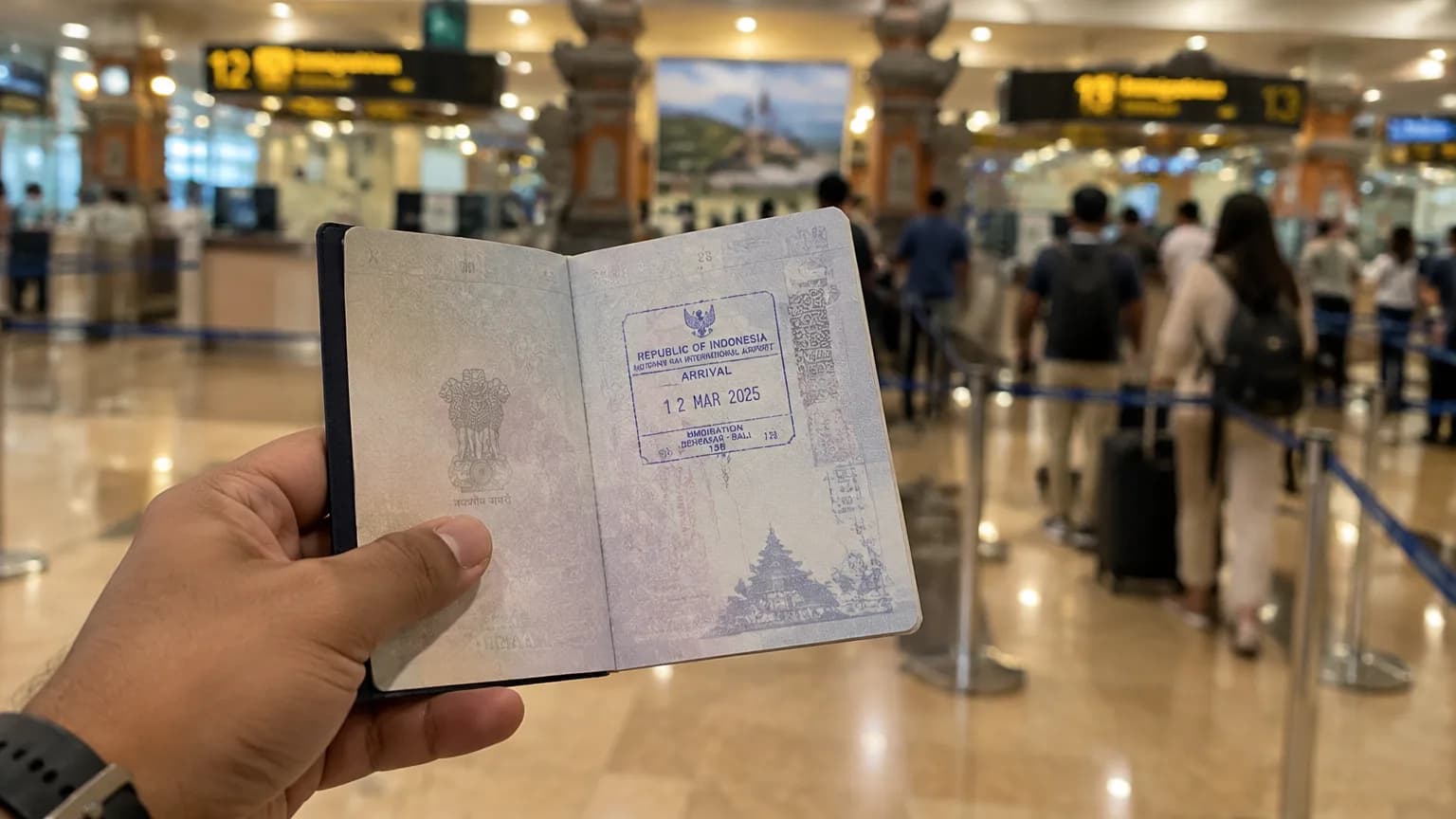
- Arrival stage 5: Collect your stamped passport. The officer stamps the Visitor Visa (Visa on Arrival) into your passport. This single-entry visa is valid for a 30-day stay from the date of entry. Before stepping away from the counter, check the stamp details — entry date and permitted stay duration — to make sure they match your travel plan. Any discrepancy is far easier to resolve at the counter than after you have left the airport.
Documents to have ready before you land
Only two documents are confirmed as required by the official government portal for the Visitor Visa (Visa on Arrival). Have both physically accessible — not buried in checked luggage — before you reach the counter.
| Have ready | Why it is asked |
|---|---|
| Passport valid for at least 6 months from the date of arrival | Confirms you meet the minimum validity requirement for the Visitor Visa (Visa on Arrival) |
| Return ticket or onward ticket to continue travelling to another country | Demonstrates you intend to leave Indonesia within the permitted 30-day stay |
No additional documents — hotel bookings, bank statements or photographs — are listed as requirements for this visa route. That said, Indian travellers occasionally carry these anyway as a precaution, particularly if their onward travel is complex — for example, a one-way ticket with a separate booking for the return leg. If your situation is non-standard, carry supporting evidence and confirm the current requirements on the official portal before you fly.
One practical point worth checking at home: make sure there are enough blank pages in your passport for the entry stamp. A passport that is nearly full can cause delays at any immigration counter, and Indonesian immigration is no exception.
What you pay on arrival
Two separate charges apply to Indian travellers visiting Bali. They are collected at different points and through different channels, so it helps to understand each one before you land.
- Visa fee: IDR 500,000 — paid at the Indonesian Immigration Checkpoint on arrival when you apply for the Visitor Visa (Visa on Arrival). This figure is confirmed by the official government portal as of 2026. The fee applies whether you pay at the counter or use the e-VOA route; confirm the e-VOA fee on the official Indonesian e-Visa website.
- Foreign tourist levy: IDR 150,000 per person — a separate charge, payable once during travel in Bali. Collected through the Love Bali platform or designated payment counters, not at the visa counter. This levy is distinct from the visa fee and is not part of the immigration process.
Exchange rates between IDR and INR move daily. A rough sense of scale: a 7-day mid-range trip to Bali from India costs approximately INR 80,000–1,50,000 per person, so the visa fee and levy together are a small fraction of overall trip spend. Do not rely on a fixed conversion figure for the IDR amounts; check the current rate at your bank or a reliable forex source close to your travel date. Check the official portal for any fee updates before you fly.
Pre-arrival option for Bali
Indian passport holders have two confirmed entry routes: applying at the checkpoint on arrival, or requesting an e-VOA online before travel through the official Indonesian e-Visa website. The e-VOA is an alternative, not a requirement — you are not obliged to apply online before flying.
If you choose the online route, complete the application on the official Indonesian e-Visa website before your departure date. Allow enough time for the application to be processed; no processing time is stated in the official source, so do not leave it to the night before your flight. Carry a printed or digital copy of the e-VOA approval to show at immigration on arrival.
The practical advantage of the e-VOA is that it can reduce time spent at the on-arrival counter, which can have queues during peak arrival periods. Bali's dry season runs broadly from April to October and attracts high visitor numbers; if you are travelling during this window, the e-VOA route is worth considering.
Whether pre-arrival registration or an arrival card is separately required is not stated in the official source, so confirm the current steps on the official portal before you fly. Travellers who prefer to apply at certain Indonesian Immigration Checkpoints on arrival can still do so without any pre-travel paperwork beyond the two required documents.
Extending your stay
A one-time extension is possible. According to the official government portal, the extension can be obtained once for an additional 30 days through Indonesian Immigration, bringing the maximum possible stay to 60 days.
Detailed procedure, office location and any fee for the extension are not stated in the official source. A few practical points follow from what is known. First, start the process before your initial 30-day stay expires — overstaying an Indonesian visa carries penalties, and leaving the extension to the last day is risky if there are administrative delays. Second, the extension is obtained through Indonesian Immigration, which means visiting an immigration office in Bali during your stay; the specific location is not named in the official source, so confirm this on the official portal once you arrive. Third, carry your passport, your original entry stamp details and your return ticket when you go to apply, as these are the documents most commonly requested in extension processes of this type — though the official source does not confirm the exact list.
If you are planning a longer stay from the outset — for example, combining Bali with other Indonesian islands — factor the extension process into your itinerary rather than treating it as an afterthought.
Transit and layover rules for Bali
Transit is included as a permitted purpose of the Visitor Visa (Visa on Arrival), according to the official government portal. This means the visa category itself covers transit as a reason for entry, not just tourism or a short visit.
Specific airside or landside transit rules are not detailed in the official source. If your itinerary involves a connection through another Indonesian city before reaching Bali, or a layover at Ngurah Rai on the way to a third country, the general visa-on-arrival framework applies — but the precise conditions for your route need to be confirmed on the official portal. Do not assume a short connection is automatically covered without checking, particularly if you plan to leave the international transit zone.
Most Indian travellers flying to Bali connect via Singapore rather than transiting through another Indonesian city, so this section is most relevant to those with more complex routing. If your ticket shows a stop at another Indonesian airport en route to Denpasar, check the immigration requirements for that stop separately.
Insurance
Whether travel insurance is required or recommended for the Visitor Visa (Visa on Arrival) is not stated in the official government portal. No minimum cover amount, policy type or named insurer is specified. Check the official portal for the latest position before you travel, and consider what medical and trip-disruption cover is appropriate for your trip independently of the visa requirement.
Where to confirm the arrival rules
Two official sources are named for this visa route: the official Indonesian e-Visa website — for the Visitor Visa on Arrival and the e-VOA application — and the Love Bali portal, for the foreign tourist levy. Facts on this page were verified on 15 October 2026.
Visa rules, fees and procedures can change without notice. Check both portals again close to your departure date to confirm nothing has been updated since this page was last verified. If you are travelling as part of a group, note that the levy and visa fee apply per person, so the total outlay scales with group size.
For Indian travellers, the entry process for Bali is among the more straightforward in Southeast Asia — two documents, one counter, one fee. The main variables are the e-VOA decision, the tourist levy payment timing and the extension process if you plan a longer stay. All three are covered by the official portals named above.
If you need help putting together a Bali trip — flights, day-by-day planning and accommodation options — the team at Tripstor is happy to work through the details with you.