
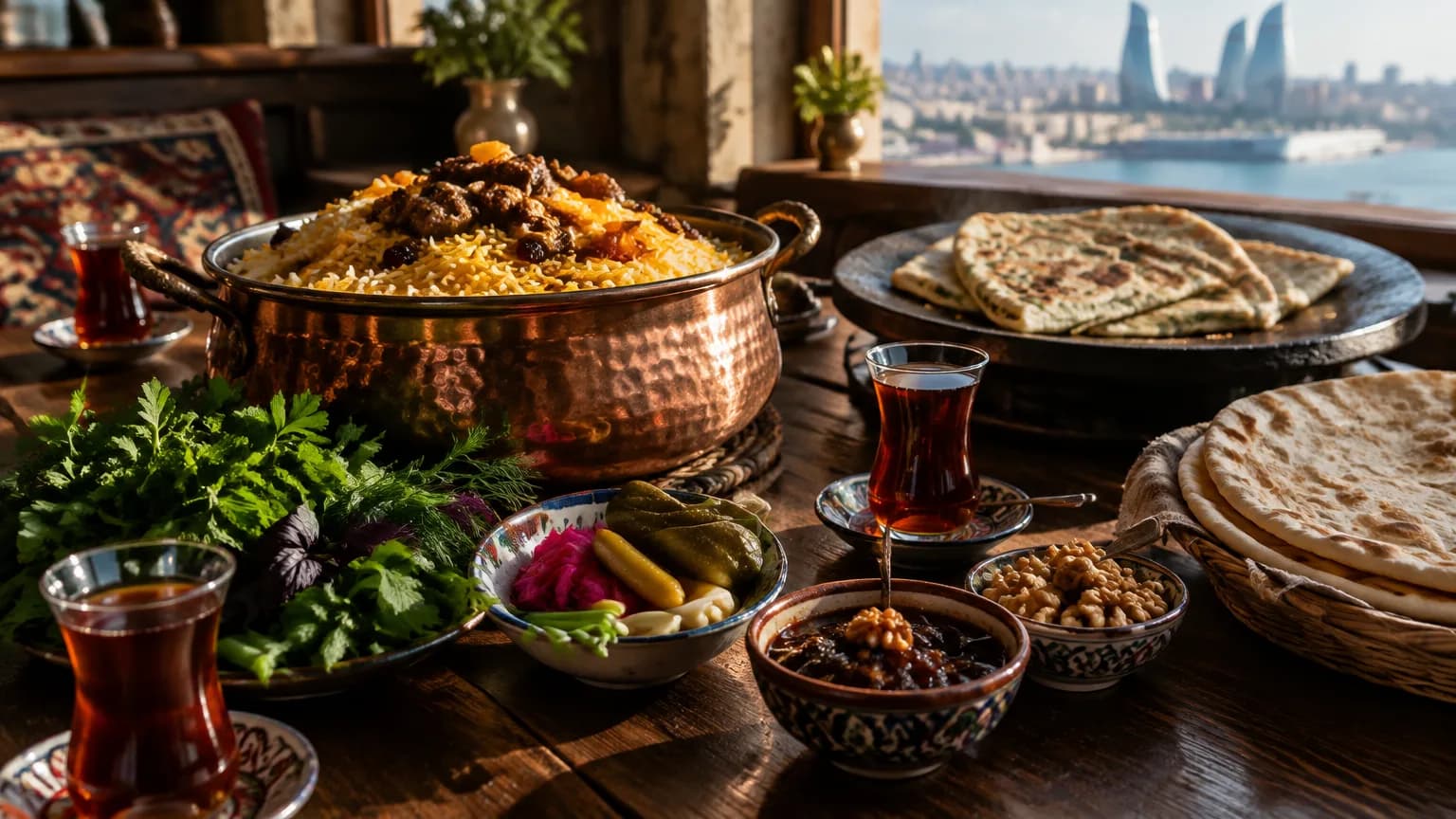
Azerbaijan food & cuisine guide for Indians answers three questions: which dishes define the country, how vegetarian and Jain travellers can eat well, and the one food mistake to avoid. Plov, dolma, qutab and dushbara are the dishes to know. The mistake is assuming a dish that looks meat-free is actually vegetarian, because stock, lamb fat and minced-meat fillings are common.
Dishes to try in Azerbaijan
Azerbaijani cooking draws on Turkish, Persian and Caucasian kitchens, so the flavours of rice, saffron, herbs, sour fruit and grilled meat will feel familiar to an Indian palate. The dishes below cover most of what the country eats, and you can order several of them in a single meal to share. Ordering three or four plates for a table of two or three is the easiest way to taste widely without over-ordering.
- Plov: the national rice dish, made in regional styles with meat, chestnuts, dried fruit, saffron and herbs. Shah plov and kourma plov are the versions you will see most often in Baku restaurants and home kitchens. Ask whether the rice is cooked with meat stock if you are vegetarian, because many kitchens use it by default.
- Dolma: vine leaves, cabbage or vegetables stuffed with rice and minced meat. Vegetarian versions exist but must be asked for, and they are usually served with yoghurt or sour cream. Check the filling before you accept a plate, since the meat-free version is a special order in many places.
- Qutab: thin folded flatbreads cooked on a saj griddle, filled with meat, cheese, herbs or pumpkin. The herb and cheese versions are the easiest vegetarian pick and are sold at almost every market counter. They are cooked to order, so expect a short wait at busy stalls and a fresher result for it.
- Dushbara: tiny lamb dumplings in broth, a staple in Baku and Ganja. Not vegetarian, so plan around it if you are avoiding meat. Served hot with a sprinkle of dried mint and vinegar or sumac, it is a filling small-portion dish that suits a light lunch.
- Piti: a slow-cooked lamb and chickpea soup served in a clay pot, traditionally eaten by tearing bread into the broth. Order it for a filling lunch on a cool day. Because the pot is cooked for a long time, it is one of the most reliable meat-based meals for travellers who want to try a traditional Azerbaijani dish end to end.
- Kebab and lula kebab: minced or cubed lamb and beef grilled over charcoal, usually served with sumac onions, grilled tomato and lavash. Lula kebab is the minced version shaped around a skewer. Ask for the meat cooked well done if you prefer it that way, as kebabs are often served slightly pink by default.
- Dovga: a yoghurt and herb soup, often vegetarian, served warm or chilled depending on the season. Confirm the recipe with the kitchen, as some versions add meat stock. In summer the chilled version makes a refreshing starter on a hot afternoon in Baku.
- Pakhlava and shekerbura: layered nut pastry and nut-filled sweet crescents, the standard tea-time sweets. Sheki pakhlava is the best-known regional style. Both are usually sold by weight, so buying a small box lets you taste several kinds without committing to a large quantity.
Tea is the default drink, served in armudu glasses with jam, lemon or sugar cubes. A pot of tea with pakhlava is the simplest way to sit down and rest between sights, and most cafes will refill the pot without charge. Ask for black tea if you prefer it without milk, as milky tea is less common here than in India. If you want a sugar-free option, say so when ordering, since jam is often added to the tea by default.
Where to eat by area
Baku covers most of what visitors need, and the city is compact enough to visit two or three food areas in a day using the metro and short taxi rides. Outside Baku, food clusters around markets and bus stations rather than dedicated restaurant streets, so plan meals around the town centre or the bazaar. Peak meal times are roughly lunch between midday and 2 pm and dinner from about 8 pm, when Baku cafes are at their busiest.
Baku
- Nizami Street and Fountain Square: the central strip for casual cafes, tea houses and mid-range restaurants. Good for a first evening when you want options close together and easy walking back to hotels. Menus here are usually in Azerbaijani, Russian and English, which makes ordering straightforward.
- Old City (Icherisheher): small courtyard restaurants and tea spots inside the walled quarter, suited to a slow lunch between the Maiden Tower and the caravanserai. Prices are higher here than in the outer districts, so check the menu before sitting down.
- Teze Bazar: the main produce market, selling cheese, herbs, pickles, dried fruit, saffron and fresh bread, with stalls cooking qutab on the spot. Go in the morning for the freshest produce and the best selection. Bring small cash in manat, since many stalls do not take cards.
- Boulevard and the Caspian seafront: cafes with water views, mostly casual to mid-range, busiest after sunset when the promenade fills with families. It is a good place to order tea and a dessert and watch the evening pass.
Outside Baku
- Ganja: known for its own sweets and a relaxed cafe culture around the central squares. Good for a long lunch of soup, bread and kebab. Restaurants here are fewer than in Baku, so eating at the central bazaar or a well-reviewed tea house is the surest option.
- Sheki: famous for Sheki pakhlava and local halva, best bought from the bazaar area in small boxes you can carry on the road. Buy sealed boxes to keep the pastry intact on long journeys.
- Gabala and Quba: mountain towns where meals are simple, such as grilled meat, soups, bread and preserves, usually served at guesthouses. Eat where your host eats, and ask what is available before the meal. Plan extra snacks, because options at smaller towns close earlier than in the capital.
If you are still planning the wider trip, the Azerbaijan travel guide covers regions and travel logistics alongside this food plan, including how long to spend in each town. Food-focused days work best when you travel between towns in the morning and keep the afternoon free for market visits and tea.
Vegetarian, Jain and other dietary needs
Vegetarian food is easy to find in Azerbaijan but is rarely labelled, so you need to ask at every meal. Jain travellers have a harder task, because onion and garlic appear in most cooked dishes, including many salads, soups and sauces. Planning ahead and carrying a few snacks makes the difference on long travel days. A simple sentence in the local language or a written note listing your restrictions can save a lot of time at the counter.
What works reliably:
- Fresh salads of tomato, cucumber and herbs, dressed with oil or served plain
- Cheese and herb qutab, cooked to order on the griddle
- Dovga, if the kitchen confirms it contains only yoghurt, herbs and rice
- Grilled vegetables, pickles, olives, walnuts and fresh bread
- Fruit from Teze Bazar and other markets, which is inexpensive and good
Watch for hidden non-vegetarian ingredients: meat stock in soups and rice, lamb fat used for frying, and dolma fillings that mix rice with minced meat. Yoghurt and sour cream are common, so a strict vegan diet needs more planning than a vegetarian one. Ask whether bread has been brushed with butter or lamb fat if you avoid animal fats. Pastries often contain butter and eggs, so check labels or ask before buying sweets for the road.
For Jain meals, ask for dishes cooked without onion and garlic, and expect a plain salad, bread, fruit and tea as the realistic fallback. Carrying your own nuts, dried fruit and biscuits for long travel days helps. If you are travelling with a group, mention the diet when you book so the kitchen can be briefed in advance, and confirm the arrangement again on arrival at each guesthouse. Reconfirm the order with the server before the food arrives, because a single missed onion can mean sending a plate back.
Halal food is the norm for meat in Azerbaijan, which suits most Muslim travellers. Egg-free eating is harder, because eggs appear in pastries, some soups and breakfast plates, so state it clearly when ordering. For a Hindu vegetarian who eats eggs or avoids them by choice, the same rule applies: say what you want left out, not just what you want included.
Street food safety and eating etiquette
Street food in Baku is generally safe if you choose busy stalls and eat food cooked fresh in front of you. Do not drink tap water; use sealed bottled water and skip ice in drinks outside hotels and established restaurants. Most travellers who fall ill do so from a single unsafe item, not from street food as a whole, so be selective rather than avoiding it altogether.
- Choose stalls with a queue and a high turnover of food
- Eat qutab, kebabs and bread straight off the griddle or grill
- Avoid pre-cut fruit and salads that have been sitting out
- Peel your own fruit and wash market produce with bottled water
- Carry tissues and hand sanitiser, as not every stall provides them
- Keep a small packet of oral rehydration salts and any personal medicines in your day bag
- If you feel unwell after a meal, rest, drink sealed water in small sips, and consult a pharmacy or clinic in Baku rather than waiting it out
Etiquette is relaxed. Bread is treated with respect, so do not throw it away or place it upside down on the table. Tea is often poured by the youngest person at the table, and it is fine to decline a second glass by leaving the glass with some tea in it. Tipping is not compulsory; rounding up the bill or leaving a small amount for good service is enough. Alcohol is widely available in Baku but less so outside it, so check before ordering, and remember that many visitors from India prefer to stay dry for religious or personal reasons. Eating with your right hand is the common custom at informal tables, and sharing dishes from the centre of the table is normal.
What meals cost
Meal costs in Azerbaijan depend more on the kind of place than on the city. Street stalls and market counters are cheapest, casual cafes sit in the middle, and sit-down restaurants with table service cost the most, especially in central Baku and the Old City. Check whether a service charge is already included before you add a tip. Rates change with the exchange rate, so confirm at booking or check current prices before you budget for the trip.
- Street stalls and market counters: qutab, bread, tea and snacks, with the lowest spend per person.
- Casual cafes and tea houses: soups, salads, plov and kebabs at moderate prices. Most meals on a short trip happen here.
- Sit-down restaurants: full menus, table service and often a service charge. Highest per-head cost, and higher again in the Old City and along the boulevard.
Two habits keep the food budget predictable: eat your main meal at lunch when set menus are often cheaper, and buy fruit, cheese and bread from markets for breakfast. Ordering shared plates such as plov, kebabs and salads for a group also reduces the per-person spend. Carrying a small cash reserve for market stalls, which may not accept cards, avoids awkward moments at the counter. Prices change with the season and exchange rate, so confirm at booking or check current prices locally rather than relying on older figures.
If you are ready to plan it, the Azerbaijan packages page shows current options you can compare.