
Field notes
Andaman Islands Main Travel Guide for Indians 2026
The Andaman Islands main travel guide for Indians covers an archipelago of nearly 300 islands in the Bay of Bengal, reached by air through Sri Vijaya Puram, formerly Port Blair. Cellular Jail is the signature site, October to March is the best season, and scuba diving, island hopping and Havelock beach time stand out. It suits couples, families and first-timers.
Andaman at a glance
The Andaman Islands are an Indian archipelago in the Bay of Bengal, southeast of the mainland, with tourism limited to a few developed islands. Sri Vijaya Puram, formerly Port Blair, is the capital and the gateway for almost every trip.
Tourism is concentrated on selected inhabited islands and protected natural areas, while the remaining islands stay uninhabited for conservation. That is why most holidays follow the same compact route: arrive in Port Blair, then take a ferry to Havelock and Neil. The summary below gives the basics in one place.
| Element | What to know |
|---|---|
| Region | Bay of Bengal, southeast of mainland India |
| Best season | October to March, with the peak from November to February |
| Ideal trip length | 5 nights and 6 days is the sample itinerary most operators cite |
| Gateway | Sri Vijaya Puram (Port Blair) airport |
| Main bases | Port Blair, Havelock (Swaraj Dweep), Neil (Shaheed Dweep) |
| Entry basics | Domestic trip within India; carry a valid photo ID and confirm any local permit for protected areas at booking |
Anyone planning an Andaman holiday for the first time can treat this table as the frame and fill in the detail section by section below.
One point worth fixing early: the islands are spread over a large stretch of sea, and only a handful of them are open to visitors. That shapes everything else. Your plan is really a plan about which two or three islands you will use, how you will move between them, and how many days you are willing to spend on ferries and jetties. Travellers who treat Andaman like a single beach town often feel rushed, while those who treat it as a small chain of bases usually come home relaxed.
A second point is timing of the planning itself. Flights and ferries are the two bottlenecks, and both tighten in the November to February stretch. A sensible order is to lock the dates, secure flights, confirm the ferry legs, and only then fix hotels and activities. Doing it the other way round is the most common reason first-timers end up with a hotel booked on an island they cannot reach on the day they planned.
Why travellers choose Andaman
Three reasons come up again and again: island landscapes unlike any mainland beach, a compact heritage circuit in Port Blair, and nonstop flights from several metros. Together they make Andaman trip planning simpler than most island destinations.
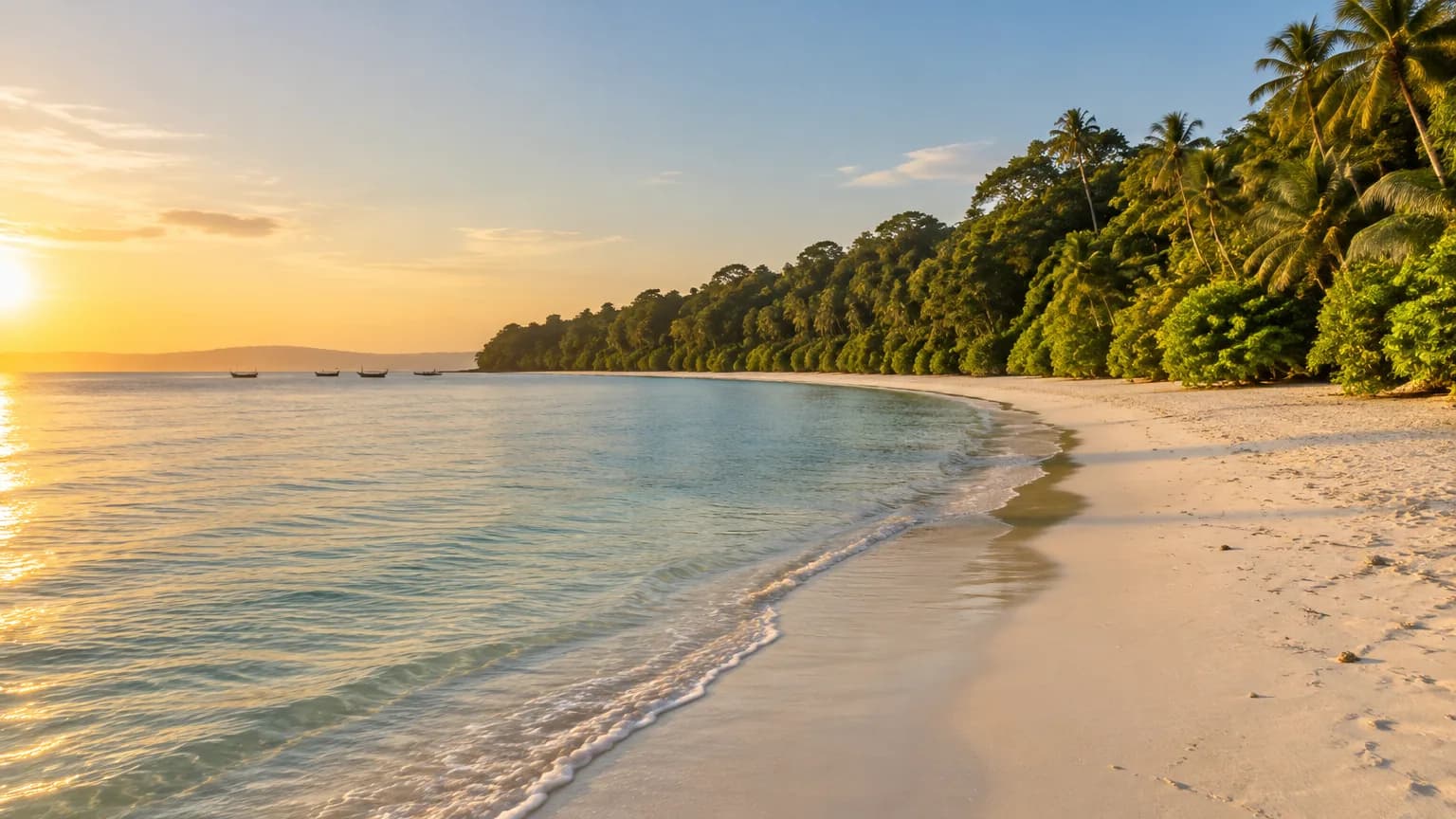
The first reason is the water. Radhanagar Beach on Havelock is the beach most people picture, and Elephant Beach is the usual stop for snorkelling and sea walking. The islands are associated with coral reefs and marine life, which is why scuba diving and snorkelling are listed among the main water activities.
The second is history. Cellular Jail anchors the heritage side of the trip, and the Japanese Bunker, Chatham Saw Mill and the Anthropological Museum sit in the same city. A single half day covers most of them. For many Indian families this is the part of the trip that gives the holiday a purpose beyond the beach, because the jail is tied to the freedom struggle and children often respond well to seeing it in person.
The third is access. Nonstop flights reach Sri Vijaya Puram from Delhi, Mumbai, Bengaluru, Chennai, Hyderabad and Kolkata, with flying times running from about 2 hours 15 minutes to about 3 hours 35 minutes. That makes a long weekend realistic for travellers from those cities. If you are still choosing dates, the best time to visit Andaman guide goes through the months in more detail.
There is also a practical side that gets less attention. Because tourism is limited to selected islands, the trip has a natural shape. You are not choosing between fifty possible bases. Port Blair, Havelock and Neil cover most needs, so decisions are fewer and the planning is easier to finish. For travellers doing an island holiday for the first time, that narrow choice is a genuine advantage.
Top places to visit
Ten places cover the core of a first visit, and they fall into three clusters: Port Blair, South Andaman and the two island stops. Grouping them by cluster keeps travel time sensible.
Port Blair
- Cellular Jail: the heritage site most closely tied to the islands' history. Go early in the day, and check the evening programme timing at the gate before you plan the rest of your afternoon.
- Japanese Bunker: a small fort site from the Japanese occupation period. It pairs easily with a city sightseeing round and rarely needs more than a short stop.
- Chatham Saw Mill: a museum and heritage attraction. Worth a short stop for anyone who likes industrial history, and easy to add on the same day as the jail.
- Anthropological Museum: covers the islands' communities and heritage. A good indoor option if rain interrupts a day.
- Marina Park: a waterfront spot that doubles as a boat excursion point, so it combines well with a harbour ride. Boat excursions also run from here towards North Bay, Corbyn's Cove, Chidiyatapu and Wandoor.
South Andaman
- Chidiyatapu: a viewpoint known for and biodiversity. Late afternoon is the usual time to go, and a driver who knows the road saves time.
- Mount Manipur National Park: a national park area associated with biodiversity. Carry water, wear shoes you can walk in, and plan the visit with your driver rather than improvising on the day.
- Wandoor Beach: a beach listed among the nature attractions, and a quieter alternative to the Havelock beaches. It works well as a half-day outing from Port Blair.
Havelock and Neil
- Radhanagar Beach, Havelock (Swaraj Dweep): the island's best-known beach and a favourite for sunset. A scooter or a short taxi ride gets you there, and arriving a little before sunset leaves time to walk the sand.
- Natural Bridge, Neil (Shaheed Dweep): a rock formation on the quieter island. Ask locally about tide timing before you go, since access depends on the water level.
A useful way to read this list is by time. Port Blair places fit into a single day, South Andaman places into one or two half days, and the beaches on Havelock and Neil reward unhurried time rather than a checklist approach. If your trip is short, drop the South Andaman nature spots first and keep the heritage circuit and Havelock.
Best time to visit
October to March is the window to aim for, with pleasant weather, clearer skies and generally favourable sea conditions. Demand and prices peak from November to February, so ferries and rooms need early booking.
- Best months: November to February, with temperatures around 22-30 C and low rainfall (about 30-130 mm a month).
- Shoulder months: October and March, plus April and May, which are warmer and more humid with fewer visitors.
- Months to avoid: June to September, when heavy rain and rough seas disrupt ferries and water activities.
Rain is heaviest from May through September, and one cited climate table puts June at about 480 mm. Beach visits and water sports are not advised when seas are rough or unpredictable, so a monsoon booking carries real risk of cancelled activities.
The month-by-month figures help when you are trading comfort against cost. January and February run at 22-30 C with about 50 mm and 30 mm of rain respectively, and crowds and prices are at their peak. March warms slightly to 24-31 C with 30 mm of rain and medium crowds. April brings 25-32 C but rain rises to about 110 mm, while crowds fall to low and prices to medium.
October is a useful in-between month, with about 250 mm of rain, medium crowds and medium prices as the sea settles after the monsoon. November and December return to peak conditions, with rain around 130 mm and 50 mm and the highest crowds and prices. If you have flexibility, October and March often give a better balance of weather and cost than the middle of the peak.
One common mistake is assuming a shoulder month is safe because the forecast looks mild a week out. In May the cited rainfall is about 430 mm, so a few clear days can still be followed by weather that cancels ferries. If your dates are fixed in the monsoon, keep a spare day in the plan and avoid scheduling an early flight home straight after an island leg.
Trip cost: what each budget gets you
An Andaman trip costs more or less depending on stay category, ferry class, the number of islands and the season. Check current prices for your exact dates before committing, because peak weeks and monsoon weeks differ sharply.
Budget trips usually mean guesthouses or simple hotels, government ferries between islands and meals eaten locally. Transfers are often shared, and you arrange your own sightseeing. This tier suits students, solo travellers and anyone flexible about comfort.
Mid-range trips move to three-star or equivalent hotels, faster private ferries on the Port Blair, Havelock and Neil routes, and a mix of included meals and local dining. Airport and jetty transfers are generally private, and some activities such as snorkelling are often bundled.
Luxury trips use the top room categories, mostly on Havelock, with private transfers throughout and pre-booked diving or sea walking slots. Meals are largely at the property, and the pace is slower with fewer island changes.
Four things move the price most:
- Travel dates, with November to February the most expensive stretch.
- The number of inter-island ferry legs in the plan.
- Government versus private ferry class. The cited ranges as of April 2026 were about ₹500-₹1,500 for government ferries and ₹1,500-₹3,500 for private ferries, so confirm the current fare at booking.
- Water activities added to the plan. Scooter hire on Havelock and Neil was cited at ₹400-₹800 a day as of April 2026.
The table below summarises what changes between tiers, without quoting package prices, which vary by date and operator.
| Tier | Typical stay | Inter-island travel | Meals and transfers |
|---|---|---|---|
| Budget | Guesthouses and basic hotels | Government ferries | Local eateries, shared or self-arranged transfers |
| Mid-range | Three-star or equivalent hotels | Private ferries on main routes | Mix of included and local meals, private transfers |
| Luxury | Top room categories, mostly on Havelock | Private ferries, fewer island changes | Largely at the property, private transfers throughout |
Two budgeting habits save money without lowering the quality of the trip. First, shorten the number of island changes rather than the number of nights, because each ferry leg adds both cost and a half day of transit. Second, price the same itinerary for two different weeks, since moving a trip from the middle of the peak to its edge can change the total noticeably. Add a small cushion for scooter hire, entry to activities and snacks, which tend to be underestimated at the planning stage.
How to reach Andaman
The nearest airport is Sri Vijaya Puram (Port Blair), the the Andaman and Nicobar Islands. There is no railway on the islands, so flying is the practical route for almost every traveller, with passenger ships as a slower alternative from the mainland.
Nonstop service is stated from six cities, and the other three connect through them. The table below gives approximate flying times as of October 2026.
| Departure city | Service type | Approximate journey time to Sri Vijaya Puram |
|---|---|---|
| Delhi | Nonstop | About 3.5 hours |
| Mumbai | Nonstop | About 3.4 hours |
| Bengaluru | Nonstop | About 3 hours |
| Hyderabad | Nonstop | About 2.75 hours |
| Chennai | Nonstop | About 2.3 hours |
| Kolkata | Nonstop | About 2.25 hours |
| Ahmedabad, Pune, Kochi | Connecting via Chennai, Kolkata, Bengaluru or Hyderabad | About 8.5 hours, with a stated range of 5 to 12 hours |
Passenger ships also run between mainland India and the islands, and mainland-island passenger fares were revised with effect from 7 April 2025. Sailing takes far longer than flying, so most first-time visitors fly in and use ferries only between islands. Because the airport sits in Sri Vijaya Puram itself, the first night is normally spent in the city.
If you are flying from a connecting city, plan the layover carefully. The stated total of 5 to 12 hours for Ahmedabad, Pune and Kochi depends heavily on the connection, so a tight transfer is a common cause of missed onward flights. Choose a connection with a comfortable buffer, keep your checked baggage details handy, and avoid booking an island ferry for the same evening you land.
Flight timing also shapes the rest of the trip. A morning arrival lets you see Cellular Jail on day one, while an afternoon arrival usually means checking in and resting. On the way back, keep the last day free of long ferry legs, because an inter-island crossing that runs late can put your flight at risk. Allow a generous gap between a morning ferry arrival in Port Blair and an afternoon departure.
Where to stay
Three bases cover most first trips: Port Blair for arrival and heritage, Havelock for beaches and water activities, and Neil for quieter evenings. Choose two or three depending on trip length.
Port Blair is the main arrival and departure base, with Cellular Jail, city sightseeing and access to nearby islands. Families and budget travellers do well here because it has the widest range of room categories. Staying near the main town helps when ferries leave early.
Havelock (Swaraj Dweep) is the beach-focused island, home to Radhanagar Beach, Elephant Beach and most water activities. Couples and families both enjoy it. Stays range from simple beach huts to full-service resorts.
Neil (Shaheed Dweep) is quieter, with beaches, the Natural Bridge and stargazing. Couples and families who prefer a slow pace and accept fewer dining choices will like it.
Across the three bases, budget stays are guesthouses and basic hotels, mid-range means three-star or equivalent properties, and luxury means the top room categories, usually on Havelock. The best rooms go first in the November to February peak, so book early.
A few practical points help when comparing stays. Check how far a property is from the jetty, because a long transfer after a ferry crossing is tiring with children or luggage. Ask whether breakfast is included and what dinner options exist nearby, since choices thin out on the smaller islands. On Havelock, a stay closer to the beach you plan to use most reduces dependence on scooters or taxis.
For a trip of four or five nights, two bases is usually enough: Port Blair plus Havelock. Adding Neil makes sense from about six nights, where the extra ferry leg does not eat into your beach time. Switching bases too often is the single biggest source of wasted hours in Andaman itineraries, so resist the urge to see every island.
Local food and cuisine
Andaman food leans on seafood, coconut and rice, shaped by the South Indian and Bengali communities who settled here. Five dishes are worth planning around, and each has an easy place to find it.
- Grilled or fried fish: the day's catch, served at beachside eateries on Havelock and Neil.
- Coconut prawn curry: a coconut-based curry found in local eateries in Port Blair and on the islands.
- Fish curry with rice: the everyday meal in small local kitchens, lightly spiced and easy on first-timers.
- North Indian thali: widely available around Port Blair's market area for travellers who want familiar food.
- Fresh coconut water and tropical fruit: sold at roadside stalls and markets across the islands.
Vegetarians are well served in Port Blair, where South Indian breakfasts, thalis and Jain-friendly options are easy to find. On Havelock and Neil the choice narrows, so tell your hotel about dietary needs in advance and stay near the main market strip or a larger property for dinner.
Seafood is the main specialty, but nobody is forced into it. Egg-based and vegetable dishes are standard on most menus, and rice, dal and roti are available almost everywhere. For travellers with strict dietary rules, the safest approach is to eat at places that show a clearly vegetarian menu, and to carry dry snacks for ferry days when food options on board can be limited.
It also helps to know when kitchens run. Smaller eateries on Havelock and Neil often close earlier than city restaurants, so a late ferry arrival can leave you with few options. Ask your hotel to arrange a simple dinner if you expect to land after dark, and keep a few packaged snacks and water in your bag as a buffer.
Travel tips for Indians
This is a domestic trip within India. Carry a valid photo ID, since it is commonly asked for at airports and sometimes at jetties and protected areas, and confirm any permit requirement for restricted zones when you book.
Connectivity: mobile and internet coverage can be patchy once you leave Port Blair and may drop out in parts of Havelock and Neil. Download offline maps and keep ferry tickets saved on your phone and printed.
Etiquette: dress modestly away from the beach, ask before photographing people and follow the rules posted at heritage sites and protected areas.
Safety: check swimming conditions with a lifeguard, including currents, tides, visibility and dangerous marine creatures, and stay out of the water in rough seas. Emergency numbers are 100 for police, 101 for fire and 108 for ambulance, and Pillar Hospital in Sri Vijaya Puram can be reached on 233193 or 240987, according to the official tourism department.
Getting around:
- Ferries are the main link between islands. Government ferries cost less, while private operators such as Makruzz, Green Ocean and Nautika run faster crossings on the Port Blair, Havelock and Neil routes.
- Book inter-island ferries for the exact route you need before you travel, especially in peak months.
- Scooters are commonly rented on Havelock and Neil, while taxis and auto-rickshaws cover local trips elsewhere.
- MV Nalanda, a 500-passenger vessel, was introduced as of October 2026 to improve inter-island connectivity.
A few common mistakes are easy to avoid. Do not schedule a ferry and a flight on the same day without a generous buffer, because sea conditions can delay a crossing. Do not assume you can buy a ferry ticket on arrival in peak season. And do not leave all cash and documents in one bag, since a wet ferry deck is no place for a paper ticket.
On a scooter, follow local speed limits and avoid riding at night on unlit roads. Carry your driving licence, wear a helmet, and check the vehicle condition before you leave the rental point. For families with young children, a taxi for the day is usually more comfortable than two scooters, and it removes the stress of navigating unfamiliar roads.
Health preparation is simple but worth doing. Carry sunscreen, a hat, insect repellent, any regular medication and basic first-aid supplies, since pharmacies are fewer on the smaller islands. Keep water with you on ferry and beach days, and carry a waterproof pouch for phones and documents. If you plan to dive or snorkel, mention any medical condition to the operator before you enter the water.
Finally, respect the protected character of the islands. Do not remove shells, corals or marine life, avoid littering on beaches and jetties, and keep to marked paths in national park areas. These rules protect the very landscape that makes the trip worth taking.
Is Andaman right for you?
Andaman works for travellers who want water, beaches and light history in one trip, and it handles both short breaks and longer stays. The deciding factors are how many days you have and how much time on boats you can enjoy.
A short trip of four to five nights usually covers Port Blair and Havelock, giving you Cellular Jail, a couple of beach days and a taste of water activities. Neil and the South Andaman nature spots tend to drop off. A longer trip of six to eight nights adds Neil and Chidiyatapu and lets you slow down instead of racing between ferries.
Good fits:
- Couples looking for beaches, sunsets and quiet evenings.
- Families comfortable with ferry rides and short beach days.
- Adventure travellers keen on scuba diving, sea walking, kayaking or game fishing.
- First-time island visitors who are happy to plan ferries and transfers in advance.
Weaker fits:
- Travellers who dislike boat travel.
- People who need constant mobile connectivity.
- Anyone wanting a packed sightseeing schedule or a lively nightlife scene.
The trade-off between short and long trips is worth thinking through honestly. A short trip is efficient but leaves little slack, so one delayed ferry or a rainy afternoon eats a large share of your time. A longer trip costs more but absorbs those disruptions, and it lets you add the quieter experiences, such as stargazing on Neil, that a rushed plan never reaches.
Honeymooners tend to favour Havelock and Neil for sunsets, beach time and island hopping. Families lean towards Port Blair for the heritage circuit and boat excursions, with a beach stay on Havelock. Adventure travellers should build the plan around dive and sea walking slots, and keep a spare day in case weather pushes an activity back. Wildlife and nature enthusiasts can add Chidiyatapu and Mount Manipur National Park for biodiversity.
If your group falls in the first list, compare the current Andaman tour packages against your dates and budget.
Once the plan feels right, compare the current Andaman packages and pick the one that fits.